Reading Point: Archive.
Work below – ‘Palma Bird’ – Mixed media
The work below was produced after a trip to Palma in Spain. I had photographed a small balcony window with a bird in cage sitting on top of a table. The bird inside was flitting around the cage cheeping noisily, perhaps from the excitement of being out in the fresh air or the desperate need to break free. The scene was both charming and tinged with sadness at the caged bird. The colours were beautifully muted and traditional of the area. It was situated in a less affluent part of the city.
At this time I was interested in preservation and the passage of time. Wanting to retain and capture the essence of a place/building. Aiming to hold onto some part of it to make it more real and tangible for the viewer. Being able to share a greater part of the image encompassing the materiality of the actual place. To own and retain a discarded part of it, to better understand visualise it.
Below the crumbling building I recovered flaked paint and plaster both from the brick work ad the green blinds.
On my return I printed the image onto the slightly vulnerable surface of Khadi paper. To create a distorted and aged look I used an eraser over the surface to rub away some of the images clarity.
Next to the image in a similar sized aperture I began arranging the found material to loosely represent the photographed scene. The image of the bird can is loosely represented in each piece but this was initially by chance, but repeated on my second image. The ‘almost ‘mirror images are purposeful but do not have to be viewed as one piece.
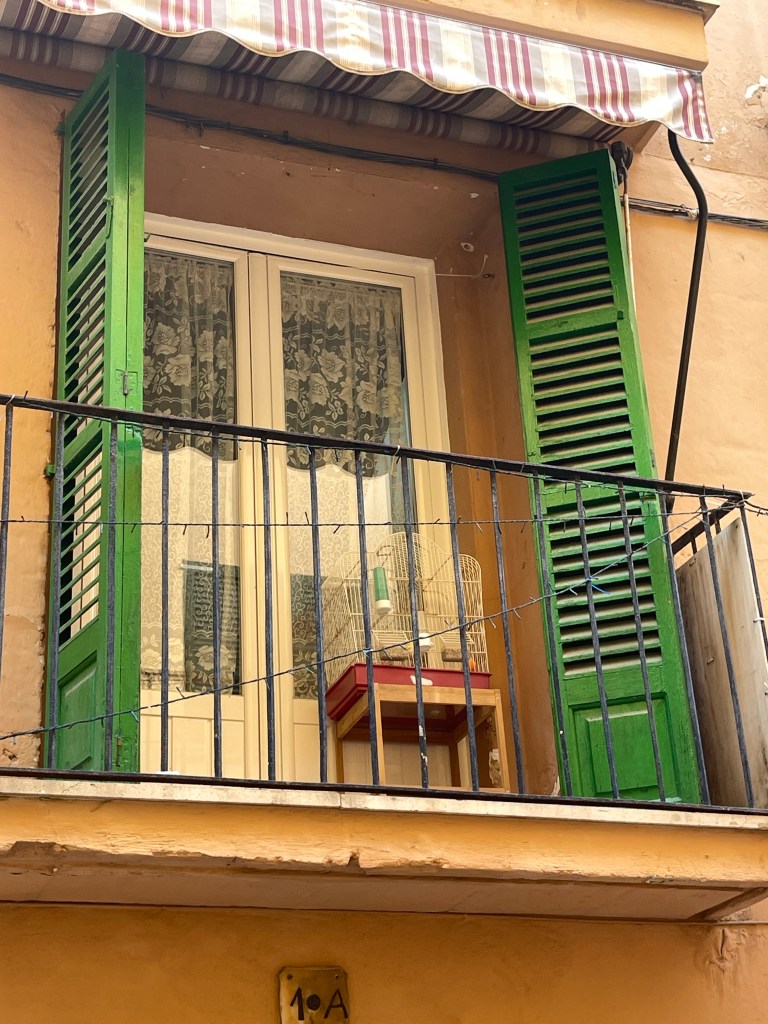
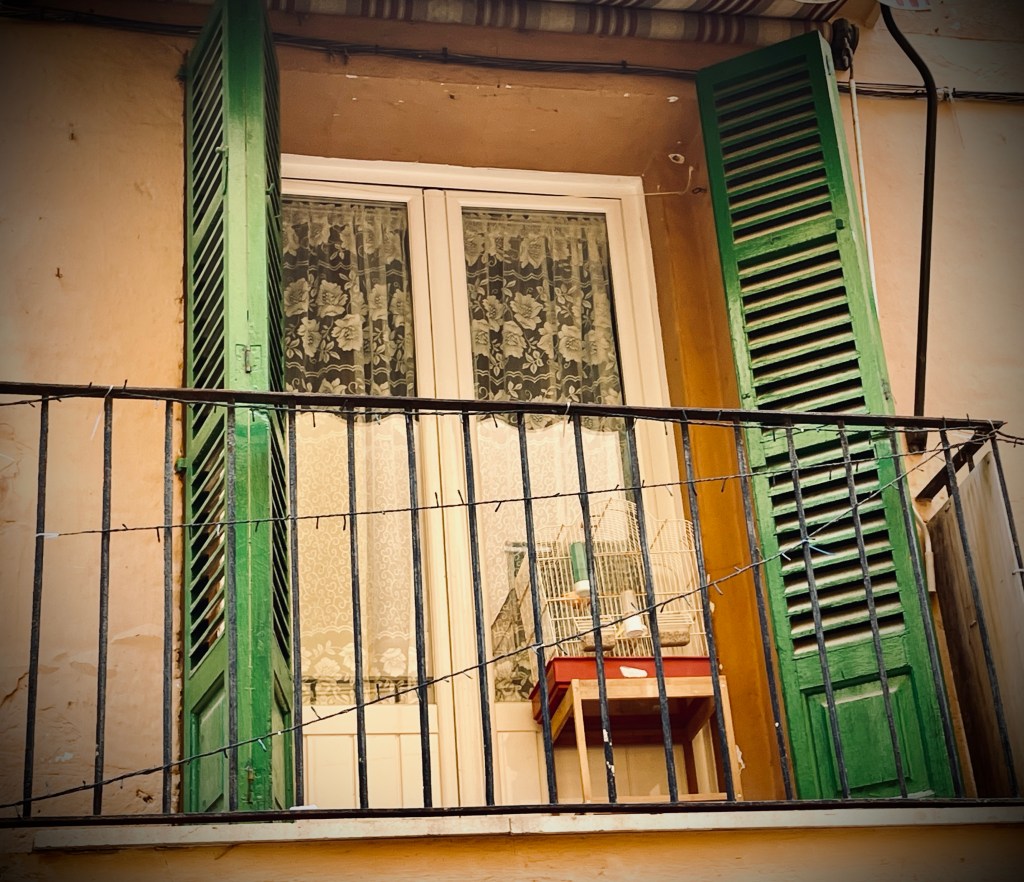
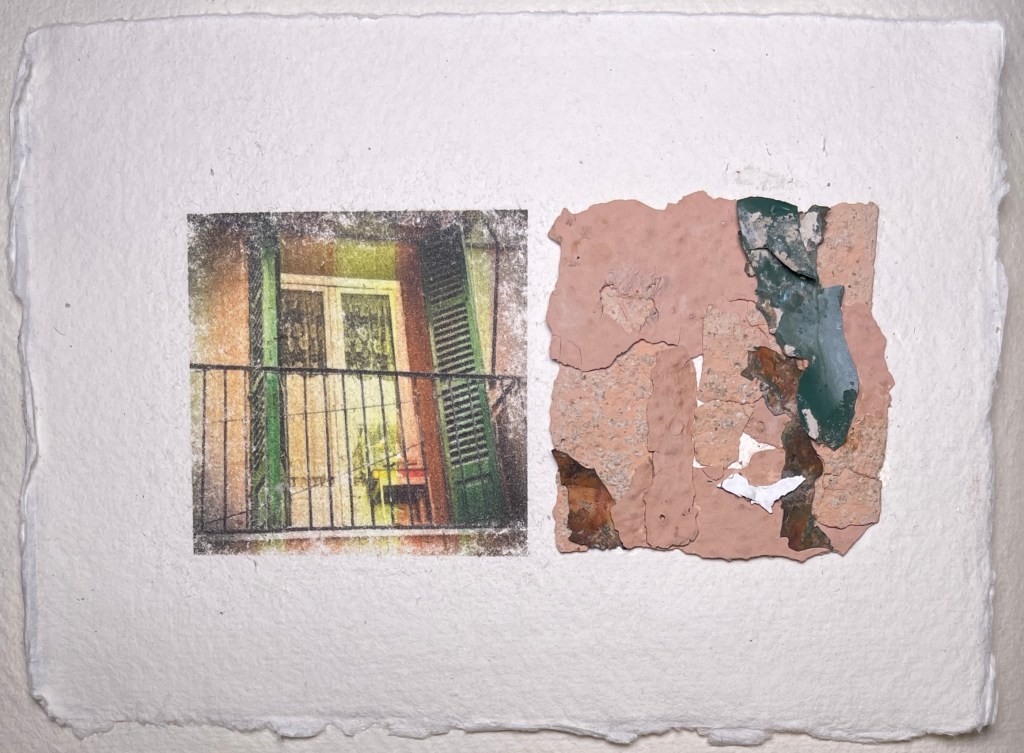
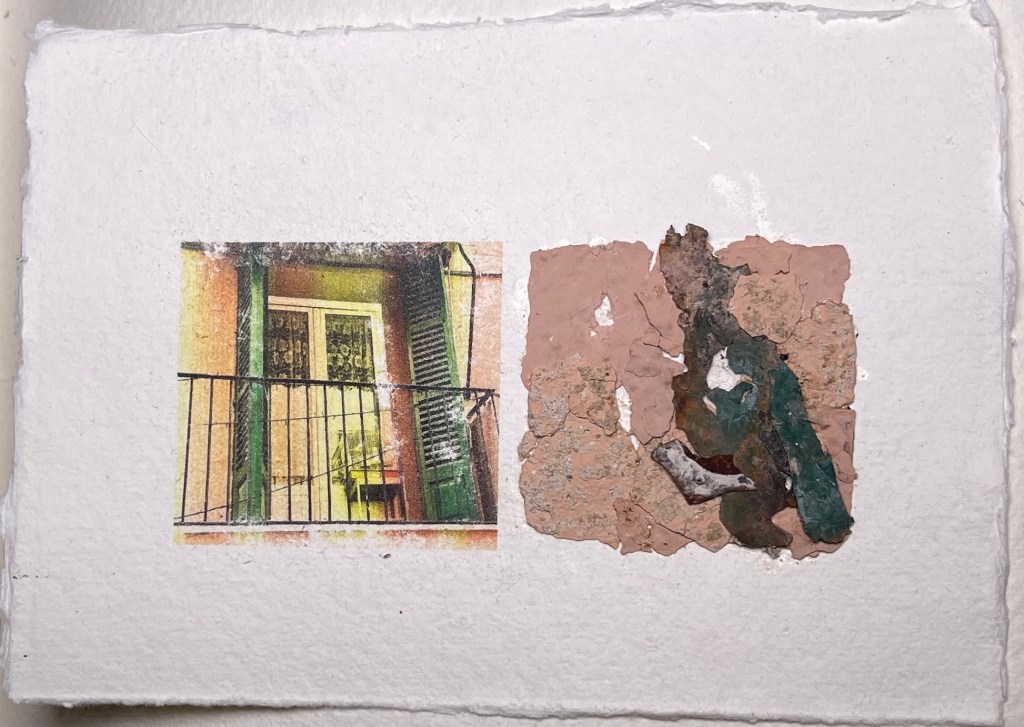
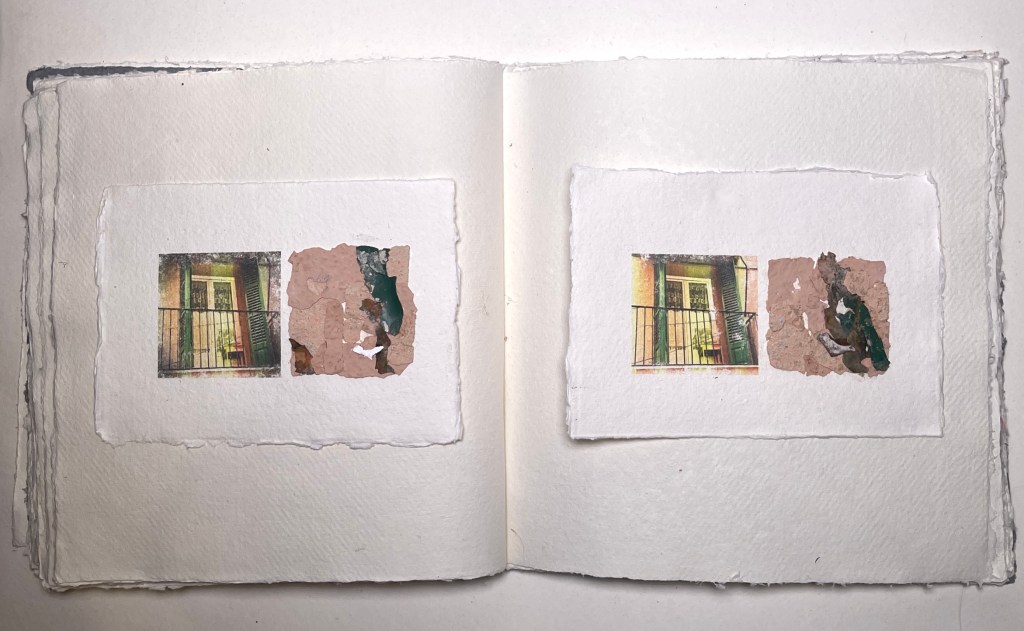
Looking back on this work was a mindful experience as I have not revisited this concept or process for some time. It is a work that is part of a longer concern but not one that I have fully realised or finished with, it is still active.
Almost a year on, Im very much intrigued by the photographic image by way of its momentary capture of time. Less about the art of the photograph itself and more about what it holds.: ie the moment never to be repeated, lost and intangible to those that were not there. My project was looking to bring the image to life in some way to make it more relatable and physical. I felt the inclusion of the materiality shown in the shot would help this connection to it.
Perhaps in hindsight , there is a sense of memento or memorabilia about the work, a subject I had also previously explored. Mindful of the insensitivity of this and the ‘show and tell’ sensationalism of that concept which did not intend associate with this particular piece. Going forward I can see other areas of interest I would like to explore within this theme. My current work on Murmurations and its links to mental health might benefit from a further tactile application to the work, certainly presenting its imagery on more common objects photographed in appropriate settings could be an addition, combining photographic placement of the work alongside the actual piece.
The photograph and the work is an archive in itself, capturing that moment on that balcony in that town at that moment on. Septemeber 2022, 3pm ish. Producing a series of this work chronological curation would be ideal as it directly concerns the capture of time and the retelling of those moments.
Derrida’s notion of nostalgia and compulsion to return to the original and the beginning I feel are inherent within us. For the very notions he underlines, to find truth, authority, confirmation, identity and a greater purpose we seek out the archive for these answers. Artistically a personal archive explores a diary of artistic development and this retrospective can be explored over chronological time periods, despite time gaps and returns to projects at a later late that can show the development of process, vision and narrative.
Notes : The concept of a bias free archive – it is linked to the context of its creation.
It should be a place that generates ideas, there is no one fixed meaning to any archive document. Archives should state no opinion.
How do we archive everything ? We need to search out original context – how do we do this in the future?
WIll we be deprived of the memory if we are deprived of the actual thing/object that the memory is connected to?
We cant collect and keep everything – we become bogged down by memories associated to objects etc
When we place an object in a vitrine ( museum) it stops its process midway, it looses function and its identity – it becomes untouchable , sterile, lost.
Considering Work:– Interviews with artists ..
Jeremy Deller (b. 1966 in London; lives and works in London) studied Art History at the Courtauld Institute and at Sussex University. He began making artworks in the early 1990s, often showing them outside conventional galleries. Deller won the Turner Prize in 2004 and represented Britain in the 55th Venice Biennale in 2013. He has been producing projects over the past two decades which have influenced the map of contemporary art.
Jeremy Deller – This Cultural Life Interview with John Wilson . Radio 4. Mon 12th June 2023.
Deller’s early love of museums, art history vitrine curiosities/artefacts have been the spark to artistic pursuits. He was blown away by the rock musical/opera ‘Tommy’ as this extraordinary art form captured so much of what he was concerned interested in as a teenage boy: Music, religion, politics etc. He found the chaos of it inspiring and a far cry away from the regimented culture of art he had experienced at school.
Viewing works by Francis Bacon was another seminal moment for Deller – the combination of gothic horror of the Crucifixion triptych and his passion at the the time for Goth music. Having managed to speak to Bacon at a gallery for some time he was further inspired by him and his generosity and understanding and respect.
Deller was extremely lucky to spend time with Andy Wahol in his factory for a year as a young man, experiencing and exploring the world of Wahol at this prolific time for him. Deller states that this was one of the the most inspiring times for a young artist. The lack of boundaries and mass media expansiveness that Wahol occupied with a mischevious presence. He credits the openess and variety of media that Wahol worked with was eye opening and exciting.
His Turner prize winning piece in 2004 ‘ Texas Memory Bucket’ featured supporters and opponents of the then American President ‘George Bush’. He dedicated the prize to everyone who cycles in London, everyone who looks after wildlife and The Quaker movement.
His own clubbing experience and passion for music led onto collaborations with Acid Brass – performing all over the country continually, a combination of raves and classical industrial music , bringing these two great entities together with great success.
His art work is bold, conceptual. thoughtful, moving. His work for the centenary of the Battle of the Somme took the memorial to the public in a beautifully performed work , the soldiers dressed in full combat last from 7am -7pm and covered the width and breadth of th eUK. Each soldier gave out a card to th epublic with the name regiment of the soldier represented the age ( if known) on the day he diesd on 1st July 1916.
This work was truly beautiful, moving and visceral and a monumental move away from a static memorial of some kind. Deller continues to push artist boundaries in many medias.
The experienced interviewer was able to take Deller back to very early childhood influences to find a source of inspiration and push gently at further life events that allowed new work and ideas to flow. Some unexpected consequences out of genuine desire or interest to explore themes with out fully understanding outcomes. Deller is a risk taker and has a confidence about him but is gentle and intellectual in his explorations and executions. Able to convey and convince with out arrogance. His work is very much for the people and seems less commercially orientated.
I was able to see some of his diverse work recently in the Esbaluard Museu D’ast Contemporani De Palma – Spain. October 2023.
In this exhibition ‘ Music as a Foreign Language’ we become immersed in a two-way connection/conversation between Carles Congost and Jeremy Deller, two artists who have never met each other personally but whose work has a lot in common, Music and politics. An inspiring collaboration between two artists who had yet to meet!
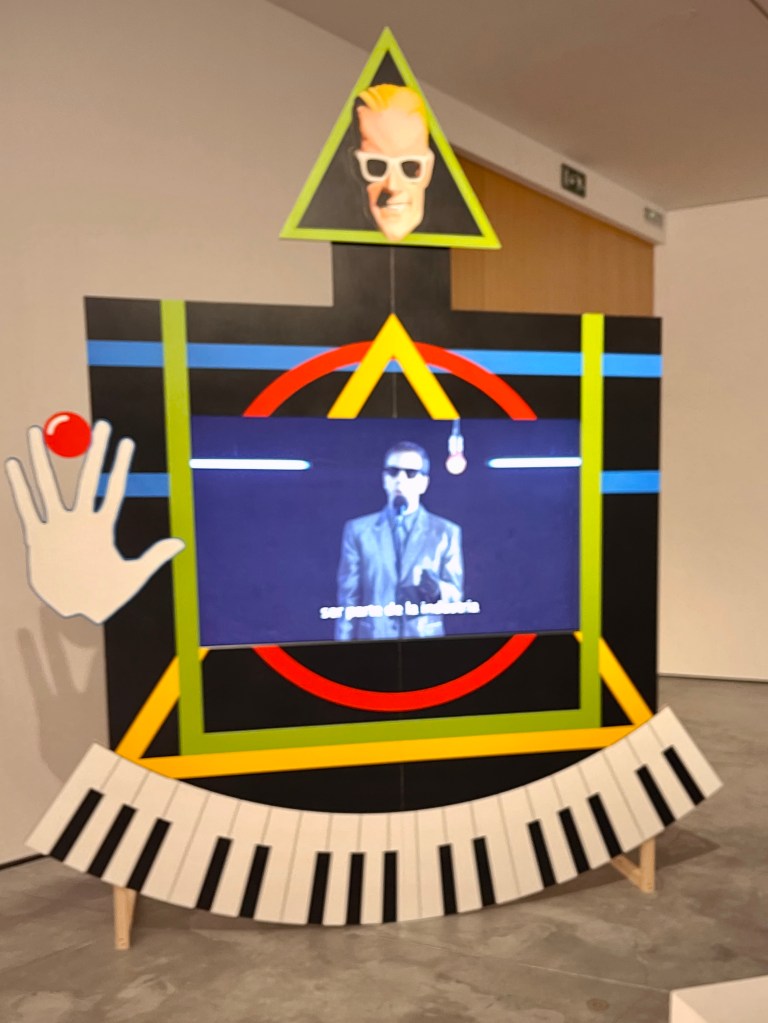
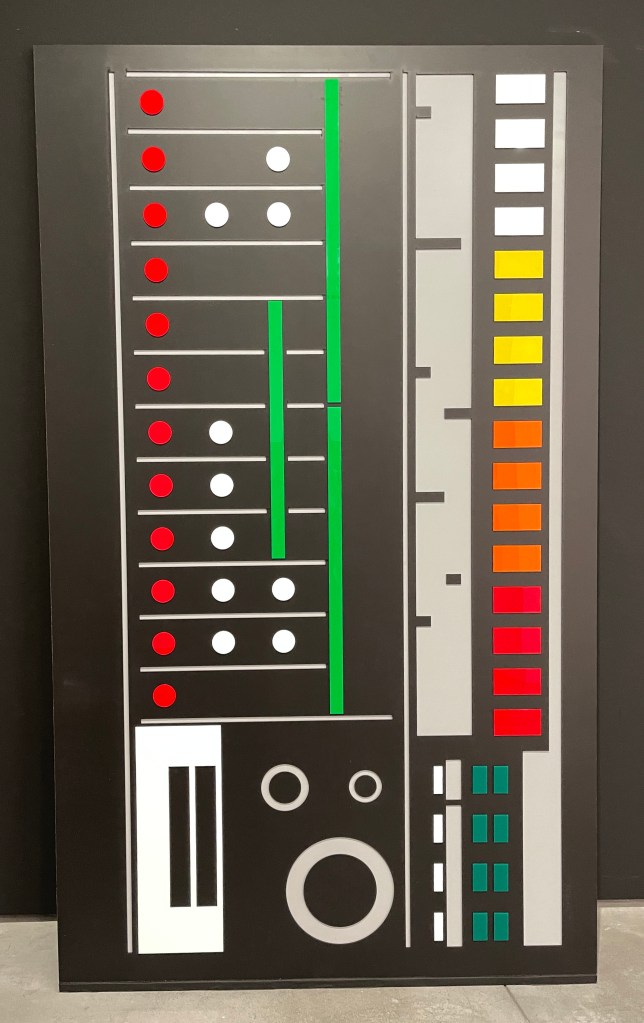
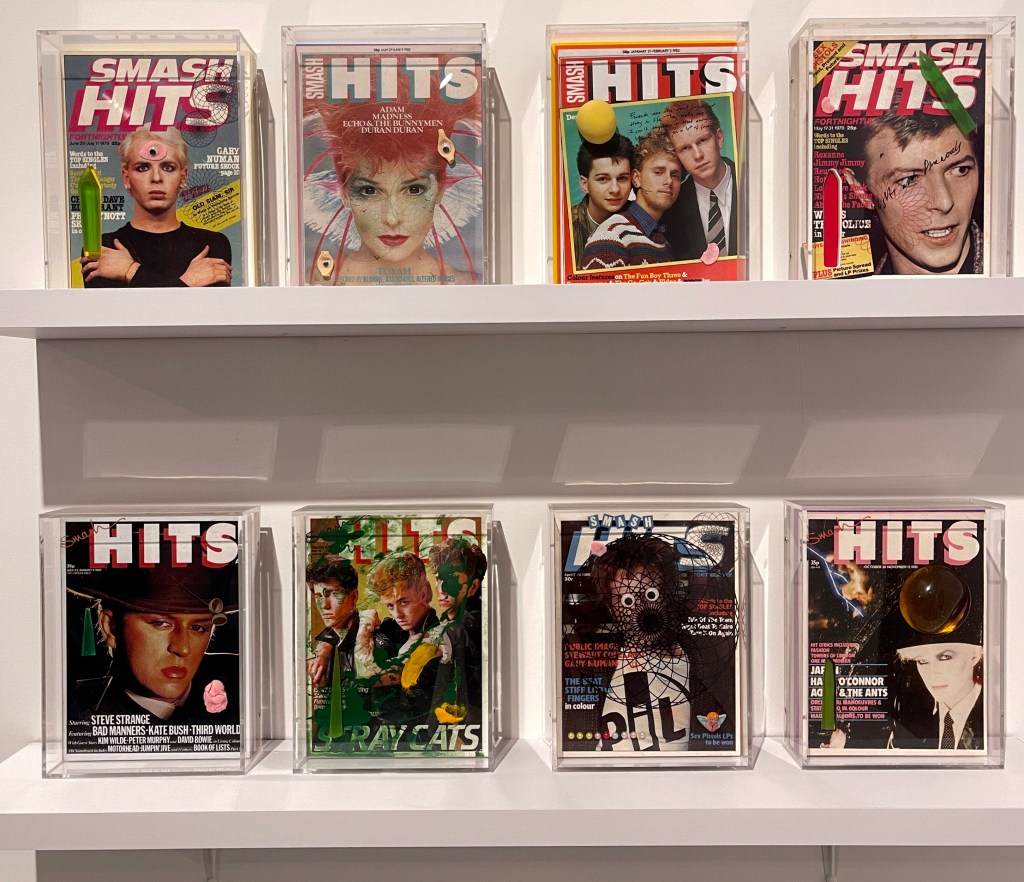
From Left :
Drum Machine ( Roland 808) 2023. Middle : Bravo 1998 . Left : HITS 2018
Exercise 2.1 Understanding Risk.
Lack of confidence initially stops my artistic practice being .. ‘risky.’… It is hard to stop these demons of doubt getting in the way when moving an artwork forward. Perhaps being based from home and not in a university red brick building also accentuates these doubts with lack of peer encouragement, a team environment does spur you on and encourage experimentation. There are good and bad days of confidence and gusto. I doubt anything will fully allay these doubts or fears they are they to conquer and spur you onto better things things, doubt is not always a negative if viewed as a way to always want to do better.
I imagine that to be overconfident is an artistic negative – does an artist ever sit back and experience true happiness with the end result? Are we not always chasing the next thing, the improvement the development of the next work? It is this essential drive that encourages the next piece of work to be an advancement or development on the previous.
I have not taken huge risks with work previously but I came close when using clay directly onto paper by way of describing crumbling, flaked and decaying walls. It was applied with out previous material knowledge. The previous media I used was not successful enough so in desperation I reached for the air dried clay and smeared and scraped the medium directly onto the paper in frustration. The results were surprisingly good and allowed me to continue to work with the project and convey the illusion I had wanted. The risk level was not high in regards to required out come but I was in a place that allowed my despair to create a new creative channel that resulted in a a satisfactory conclusion.
Traces ( Below ) Mixed Media
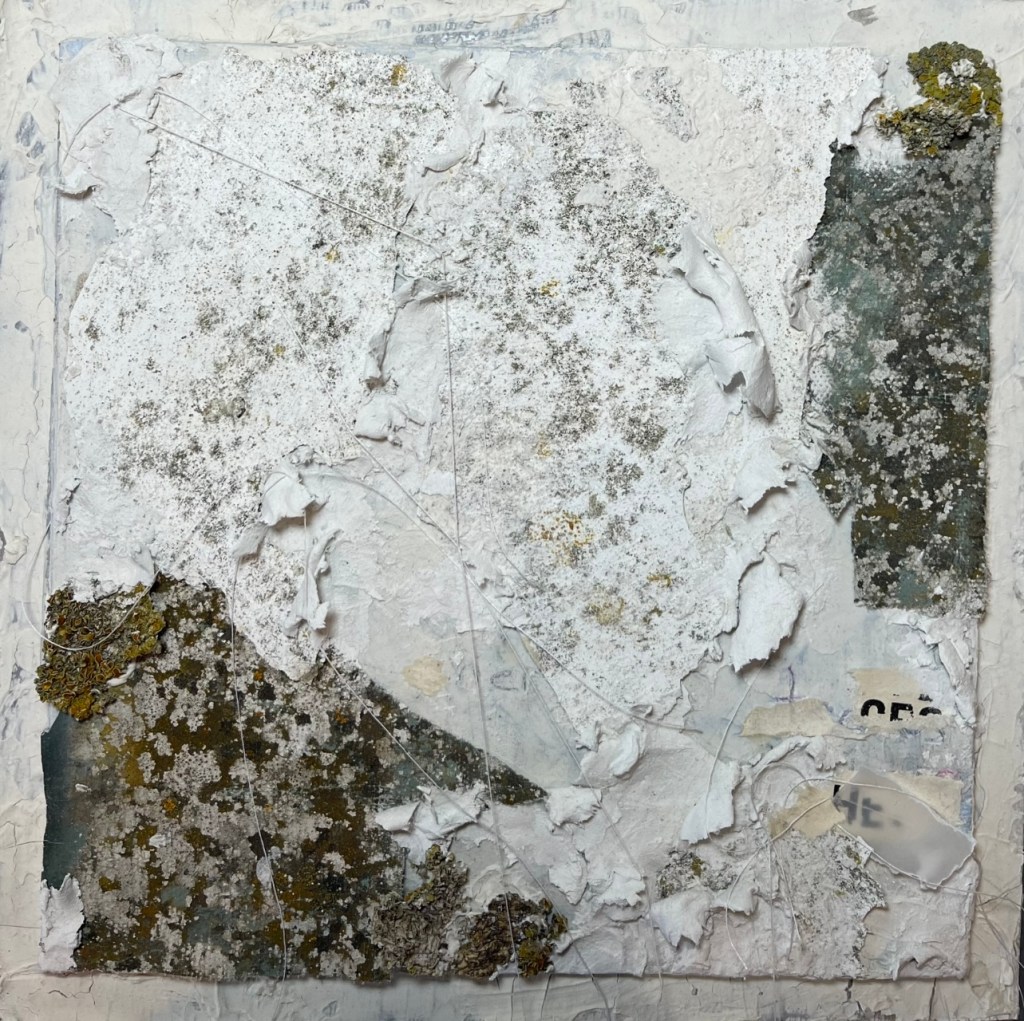
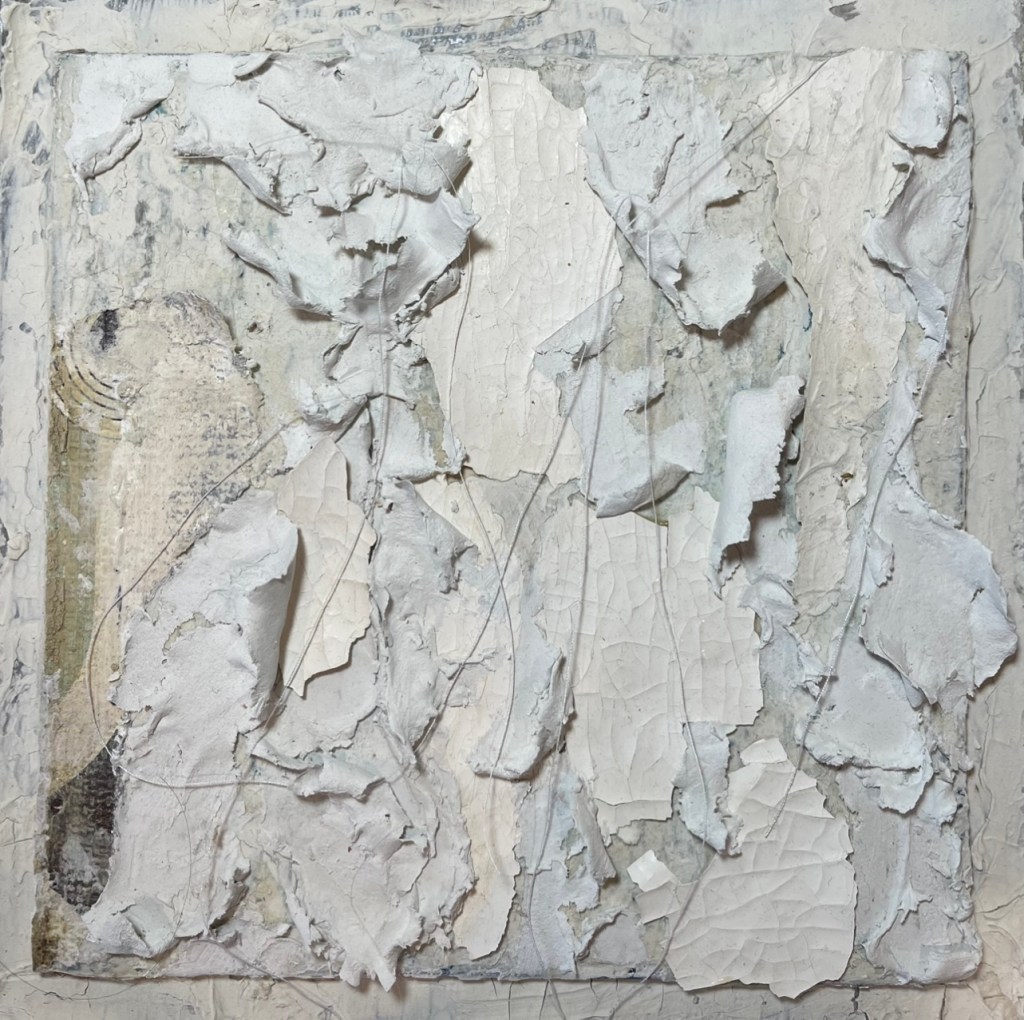
As yet I am not able to pinpoint any particular moment of failure as a stand alone positive practice. I have had many unsuccessful attempts at work and I think I have readily discarded these attempts, only to work harder, better or smarter at the next. In conclusion I would say that it is a continual desire to do better and trying to understand where a work has failed that drives me on to the next work or project.
Reading Point: If at first you don’t succeed, celebrate. by Lisa Le Feuvre and Christy Lange
The positive actions of failure and connections to my own practice: Explore artists below in relation to this:
Benjamin Robert Haydon:(1786-1846), History painter and diarist.
‘The history painter Haydon was intensely ambitious and opinionated. He studied under the artist Fuseli. He was an ardent campaigner for public patronage of the arts and for the purchase of the Elgin Marbles in 1816. A friend of Wordsworth, Keats and Lamb, Haydon was convinced of his own towering genius, but apart from a couple of successes, his career as a history painter was ultimately a failure. Unwilling to compromise his ideals, he was endlessly in debt and was driven to suicide in 1846.‘ ( Tate )
Haydon’s confidence and unwillingness to compromise for the sake of artistic fashion was a tragic downfall. Passionate about his art and his representations and style did him no favours. Despite being an advocate of some excellent causes he was not able to make enough of a living with out courting the the individuals who had the money for his services. It does not appear to be the era for strong artistic voice where courtly fashion dictated the artistic scene. Todays artistic fashions are also dictated by media frenzy around a style or celebrity ‘artist’. Cultural and ethnic shifts also play a large part in what the art world wants to buy and look at. Not all artists stick to their guns like Haydon and styles and narrative will be led, taken advantage off and manipulated by artists, galleries and buyers.
Domonique Gonzalez- Forerester
Each participation was lived as an impossible dialogue with the city and the exhibition itself, each attempt marked by a feeling of frustration.The fifth and latest attempt consists of returning to the sites of the previous projects and turning this journey into a film: ‘De Novo’.Rather than approaching the exhibition with the illusion of yet another new idea, this work retraces each previous contribution to turn it into a narration.The film will act as a ‘time machine’ taking us to 1990, 1993, 1999, 2003 and 2010; in the Prigioni, on a vaporetto, in the Giardini and in the Arsenale respectively. Through the palympsest generated by the previous contributions it will be possible to identify a relationship to art that is temporal rather than spatial.
This more complex narrative focusses on the notion that art and ideas are time based narratives and dependant on context and a previous history. Nothing can be seen out of context or as if past narratives and experiences have not happened. we are changed, scarred by history we can not re – see something with new eyes if it as been viewed once before. We will have our views altered and changed by what we have seen before and experienced. The artist is frustrated with the need and desire for newness and originality in a place/context so often visited and experienced. Grappling with the notion of this she creates a work that explores her dilemma as an artist and the journey she must take to try and find her inspiration. This is certainly a central theme for many artists, including myself. The need for the original idea, the slant the angle of narrative the newness that alludes us. The desperation for originality!
Fischli and Weiss
How to Work Better //1991
- DO ONE THING AT A TIME
- KNOWTHE PROBLEM
- LEARN TO LISTEN
- LEARN TO ASK QUESTIONS
- DISTINQUISH SENSE FROM NNSENSE
- ACCEPT CHANGE AS INEVITABLE
- ADMIT MISTAKS
- SAY IT SIMPLE
- BE CALM
- SMILE
- ( test of the artwork’ How to Work Better; (1991-/2000) editioned screen print on paper)
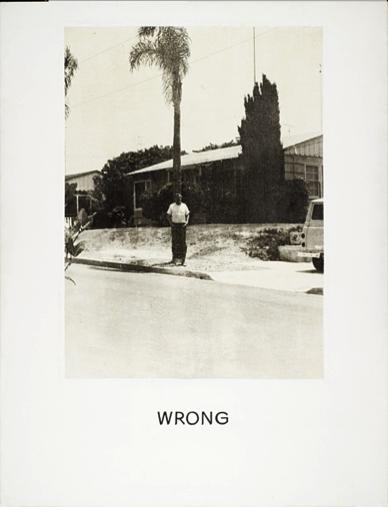
John Baldessari. ‘Art comes out of failure. You have to try things out. You can’t sit around, terrified of being incorrect, saying “I won’t do anything until I do a masterpiece”.’
This turning away from assumptions of what is ‘right and wrong’ our social constructs the assumptions of art history that art must be ‘le beau’ or beautiful. We are amused by ‘Wrong ‘ because we assume an art of ‘rightness’ an ‘elite visual culture’. ‘ We assume art to render the beautiful , however defined’
‘Wrong offers a different range of pleasures: the jouissance of anarchic subversion, the liberation joy of upsetting rules, hierarchies and conventions’ ( Abigaiil Soloman- Godeau. The Rightness of Wrong //1997)
Paul Barolsky” The Fable of Failure in Modern Art’//1997
‘We should not forget that 99 per cent of all art -making attempts are failures’
Comforting to read the fears of all artists and their individual doubts and anxieties in Barolsky’s essay concerning Balzac’c the novel ‘The Masterpiece’ the story of the rejected painter who took his own life ( rewritten by Emile Zole) but to hear Picasso speak of Cezanne’s ‘anxiety’ that was his legacy to all artists.
Robert Smithson -‘ Failure is endemic in the creative act, leaving the question not if something is a failure, rather how that failure is harnessed. Some failures are structural: in architecture this would be the moment when a supporting part of a building meets its limits. Robert Smithson’s Partially Buried Woodshed 1970 is one such structural failure – in both literal and abstract terms.
.’.. the power of the failure to remember and in the failures for the facts of events to be written into history, all the while re-engaging Smithson’s work through the present. As with Gonzalez-Foerster’s recollections, the references build to draw attention to the moments of forgetting and to the ways in which recollection is a process clouded by mistake, misrepresentation and the failure of verisimilitude.‘
Investigate and question failure. Is a lack of research into the materials, the subject matter the perceived end result that causes such happening in the work. Documenting these will help going forward, reflecting and not being too hard on ones self.
Carole Bove
A little nostalgia can be unfruitful if lingered over too long – the ‘what if’s ‘ are for the past not the future. A rich artistic theme but not one to be taken on board by means of practice.
Joel Fisher- Judgement and Purpose/1987 – recalls that some failures are not obvious during the creation process, it may take time to recognise an issue – so to say perseverance is important n art creation is also a necessary process. Not to discard immediately but allow time for deliberation, reflection and adaptation before “failure’ is announced !
Eercise 2.2 Beyond ‘Failure’
Drawing on the body of work, develop a work or study, taking it to a point where
you think it may be complete. Instead of leaving it at this point, use what you
have learnt about risk to work on it again until it starts to ‘fail’. Continue working
on the piece to ‘recover’ it and repeat the process again.
I wanted to work with found material from my home and for some time have collected the dust and fluff collected from the filter in my tumble dryer. It is most usually always an array or grey and white in various of shades. It layers up as it collects in the filter and is a mix of various fibres, wool. cotton and other man made fabrics, the odd feather, hair, ( often from the dogs) sand ( we live on the beach) and the occasional thread, button that pops off or label. It is soft and tactile and seems infinite in its production !
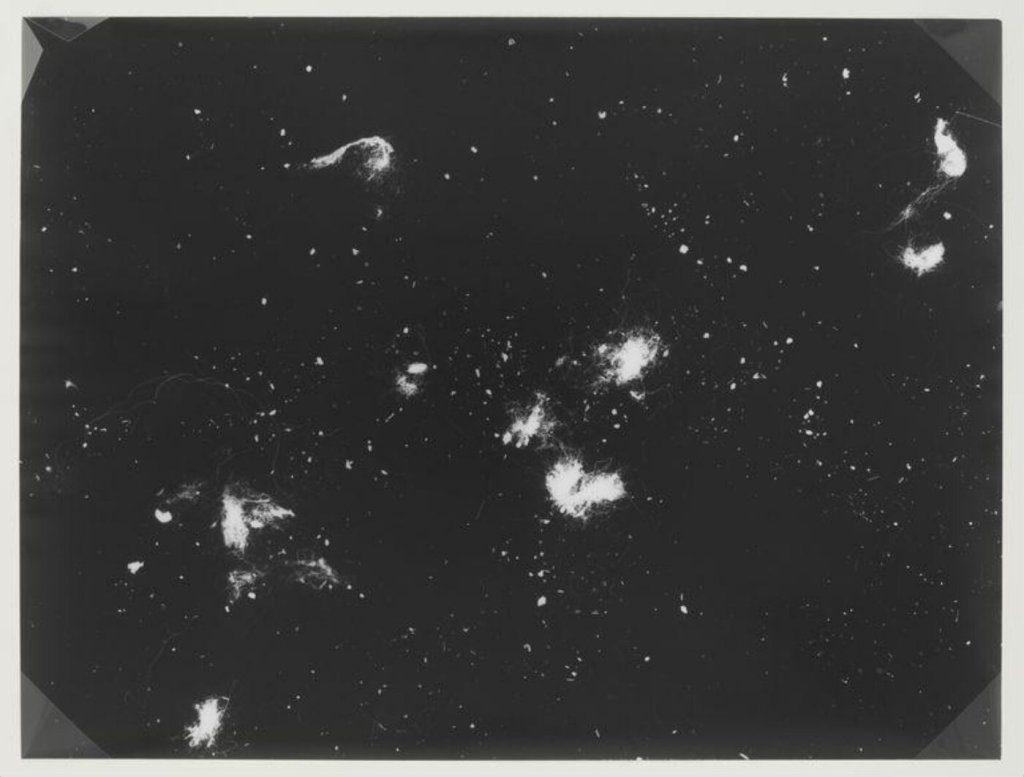
Cornelia Parker:Bated Breath: Fluff and Dust from the Whispering Gallery, St. Paul’s Cathedral, London, 1997
I have been interested in it as it contains a narrative/history of my families clothing choices, when they wore these items, where to and what they experienced wearing them. It is part of the detritus of modern living to some extent. If not filtered and collected it would flow into our drains and water systems and ultimately some tiny flecks and molecules escaping to further pollute out environment. It is systemic of the volume of clothes we have, our need to wash them frequently and dry them with out consideration or concern for the weather. The whirring drone tumble dryer is an all too familiar sound in my household and many others. It depicts a mundane drudgery of domesticity, a 20th century task master, a hungry machine that is always being fed by clean wet articles requiring an instant dry. I repeat the phase ‘ A womens work is never done’ when I pass it , beckoning to me to add the wet load from the machine next to it.
My current concern with female mental health and empowerment seemed a topic that would sit comfortably with the detritus of the home environment and a task that was traditionally seen as woman’s work. The older commercial laundries having very negative historic connotations in Ireland, specifically The Magdalene Laundries. These state sponsored church run institutions forced women to work for no money, kept in silence locked up for their promiscuity many were abuse and rape victims.
I gathered my collection of ‘fluff’ and began to develop a body of work..
Spiralling out of control …..
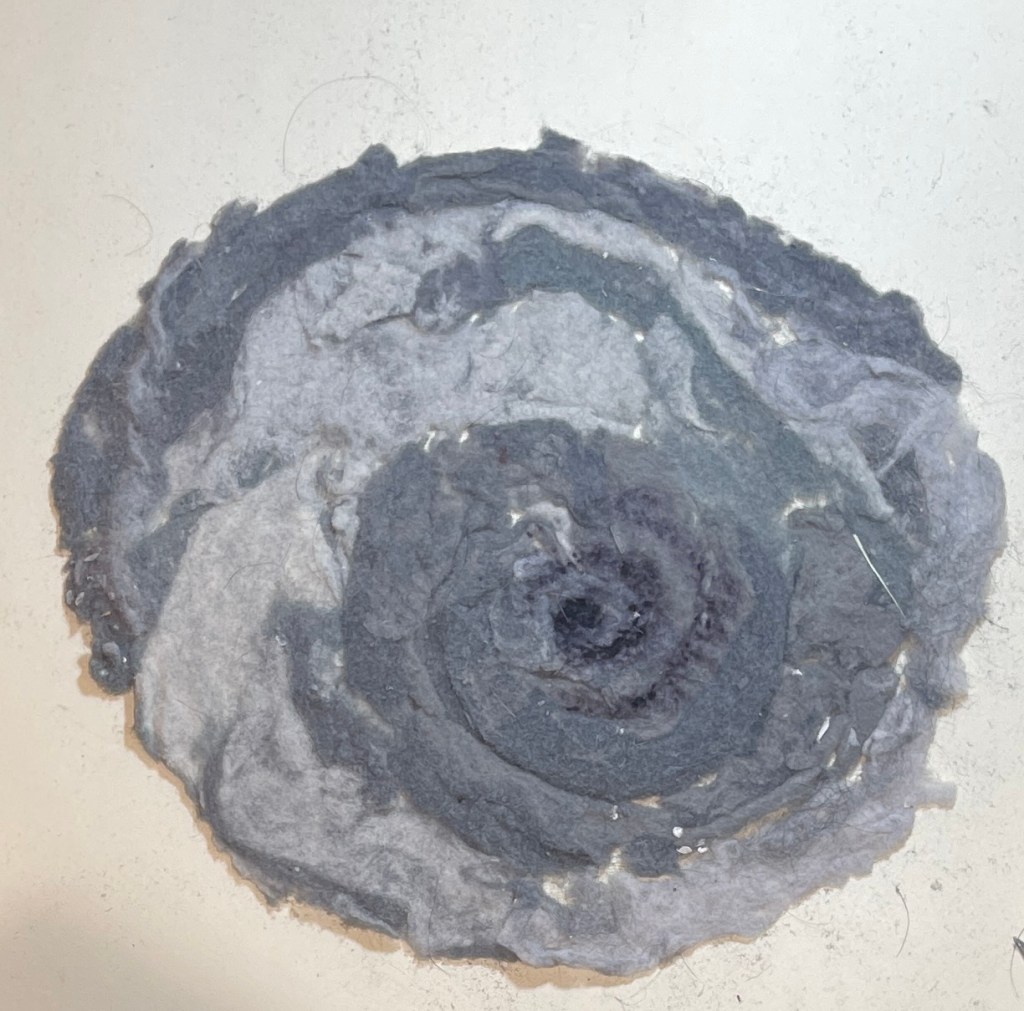
This is my initial enquiry – a heavy mass of material with a spiral configuration with the very darkest colours arranged in the centre (Approx 30cm x 30cm).
It allowed me to experience the materiality of the work and its mailability. However the pice is a little too heavy and uninteresting.
A more recent wash produced a green fluff in the filter so this addition led to another dilution of the work. I worked in within th econfines of a square to contain and restrain the material, hinting at bars and cages surrounding it…The paten created is less obviously a spiral but it portrays a bleak abstract emotion , the colours dull, unreflective and absorbing of all light and hope. The smaller side square perhaps depicting a loss, another victim…?
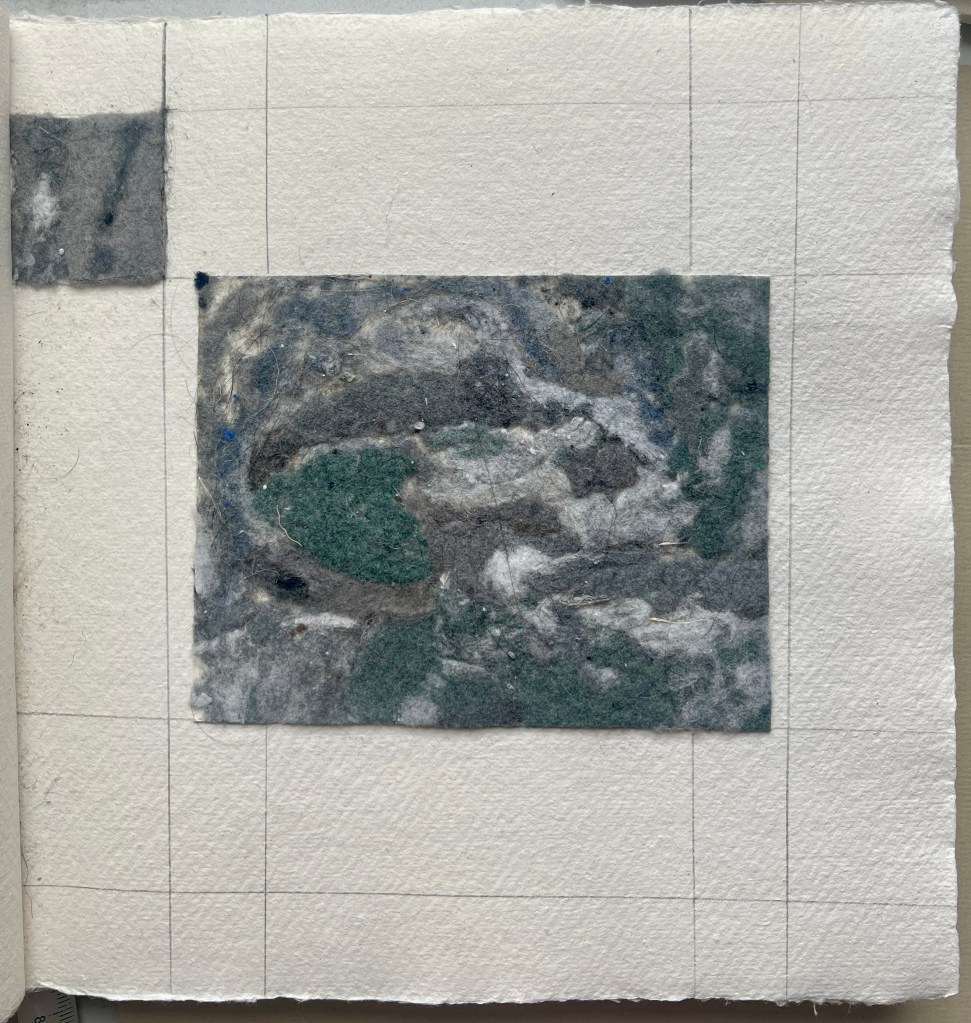
( (A5 approx square )
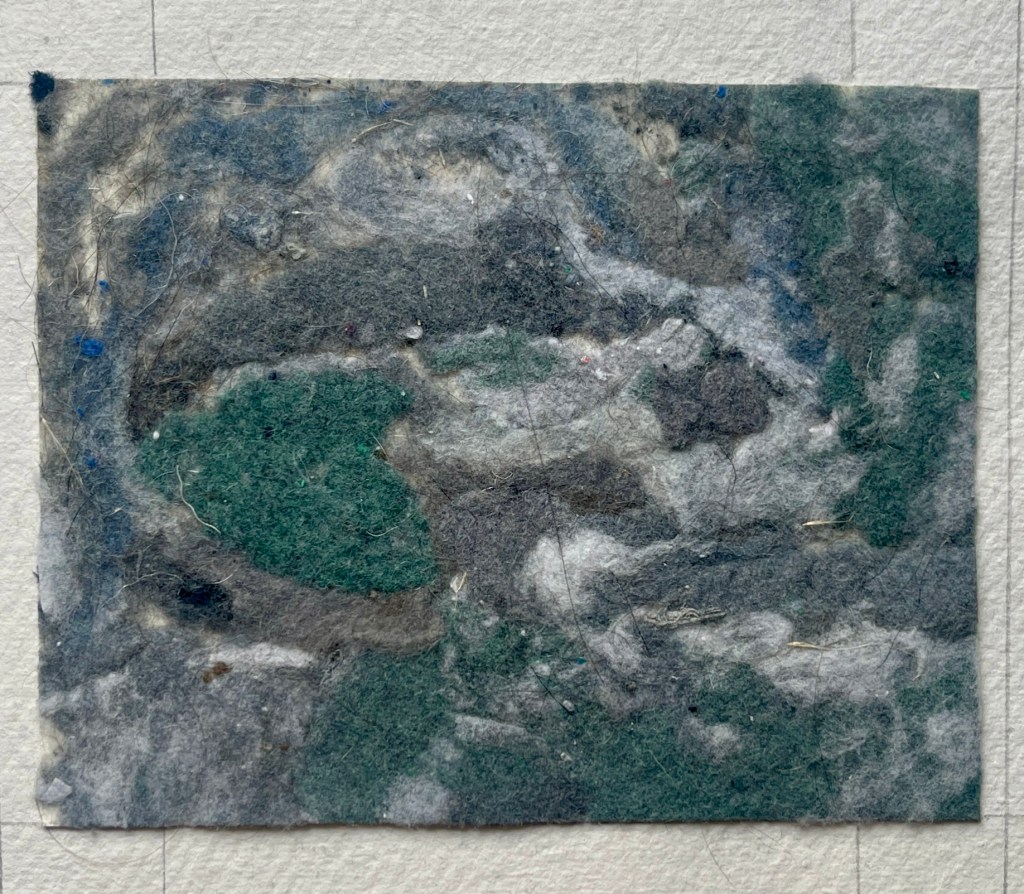
Furthering the work I wanted to convey a greater sense of emotion, anger, pain and a hint and what might lie beneath the surface of this narrative ..
Rearranging again , taking out the coloured green detritis and adding in some blood red pen behind the work, seeping out from the edges… captured within the confines of the square, juxtaposing the fluid layering and flow of the material.
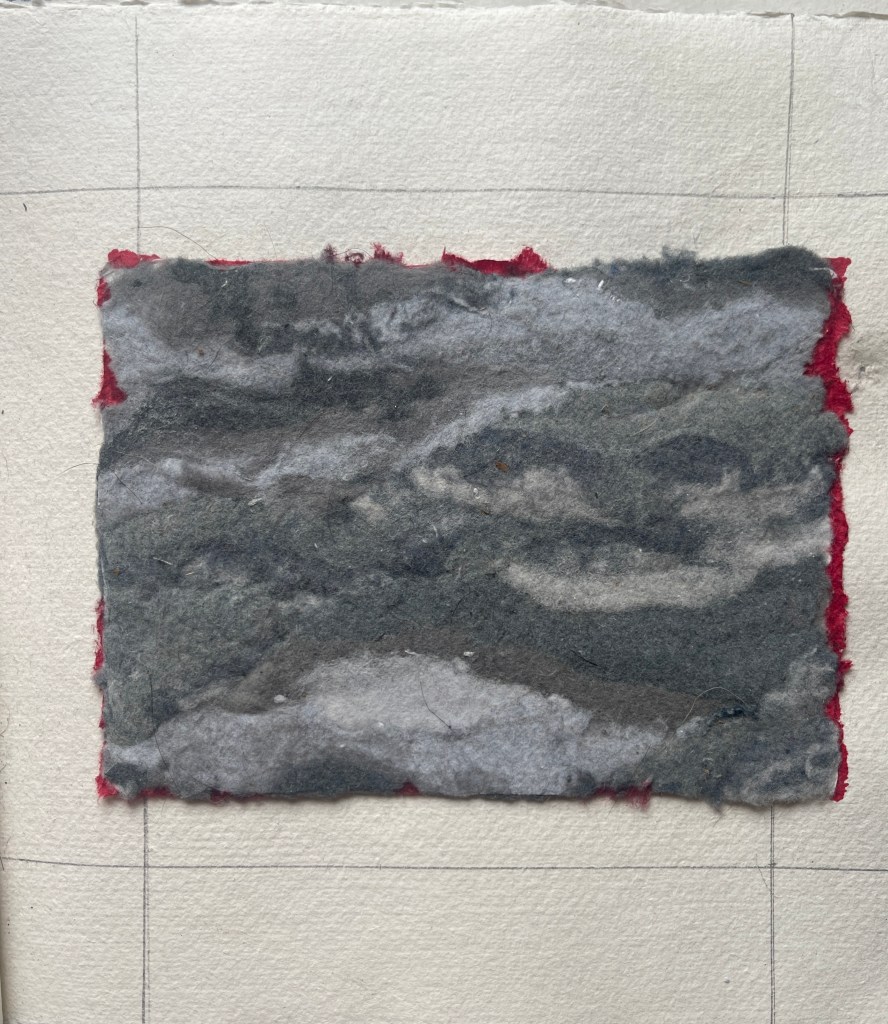
Finally looking to break up the piece again and create a larger scale work that would bean exploration of my ‘ Murmuration’ topic. The narrative of the detritus becoming heavy, overwhelming and all encompassing as the context of the materiality begins to emerge to a greater extent. Looking at communicating a sense of being overwhelmed, anxious, all consuming out of ones depth. The spiralling waves of thought creating a murmuration like image ..
Material manipuation…
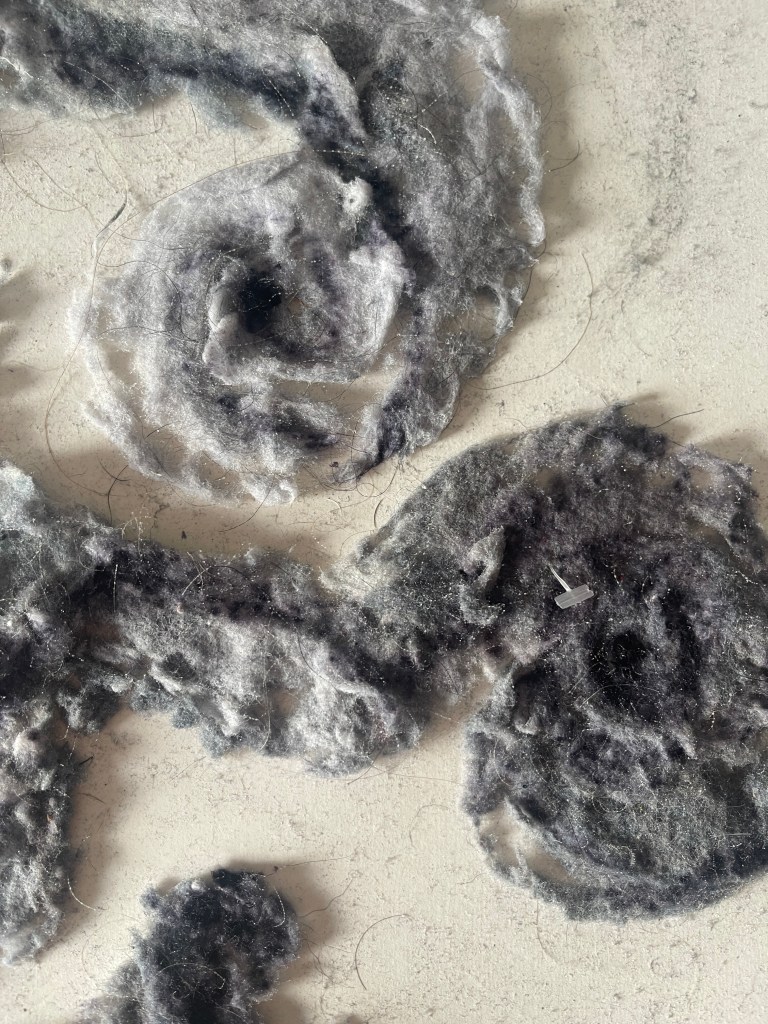
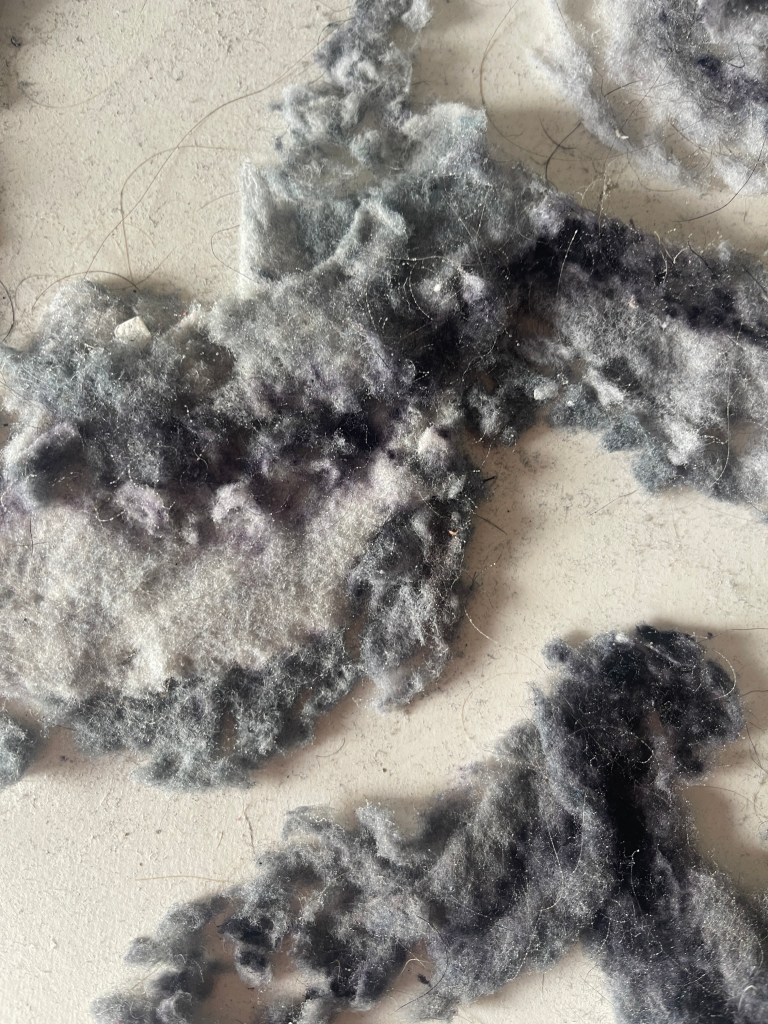
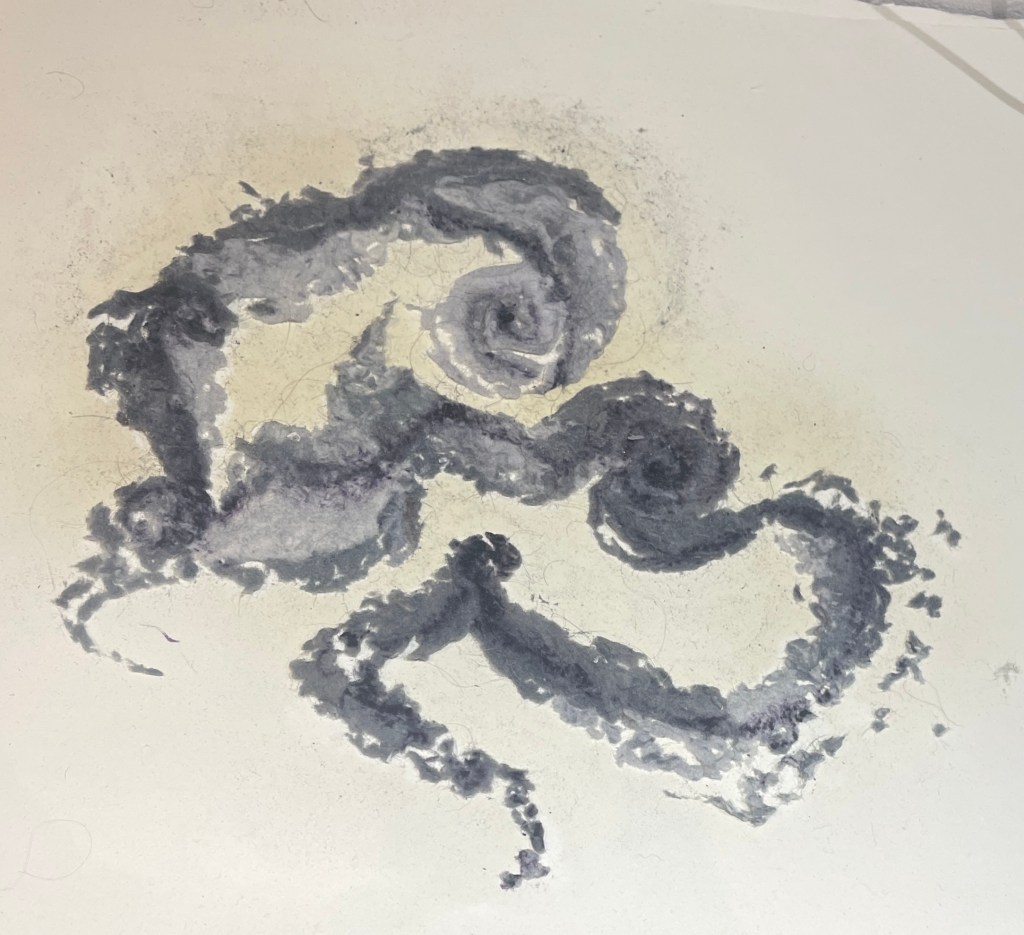
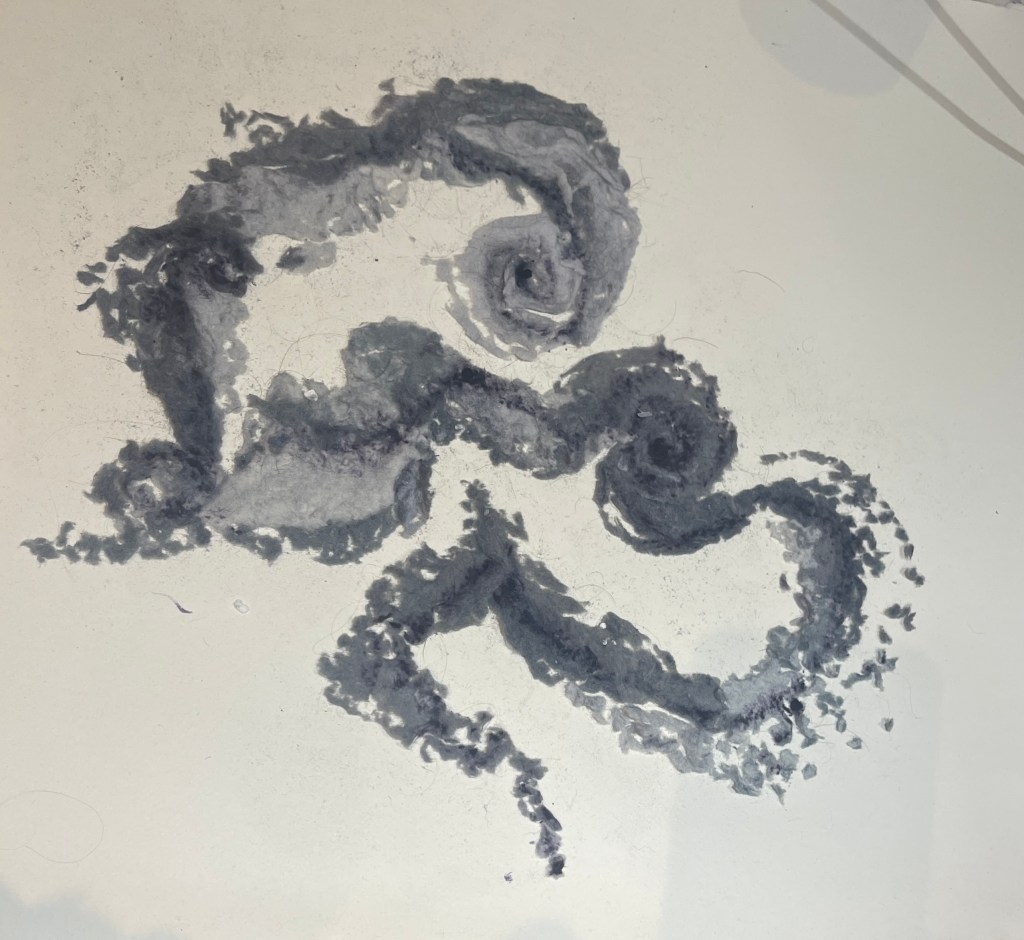
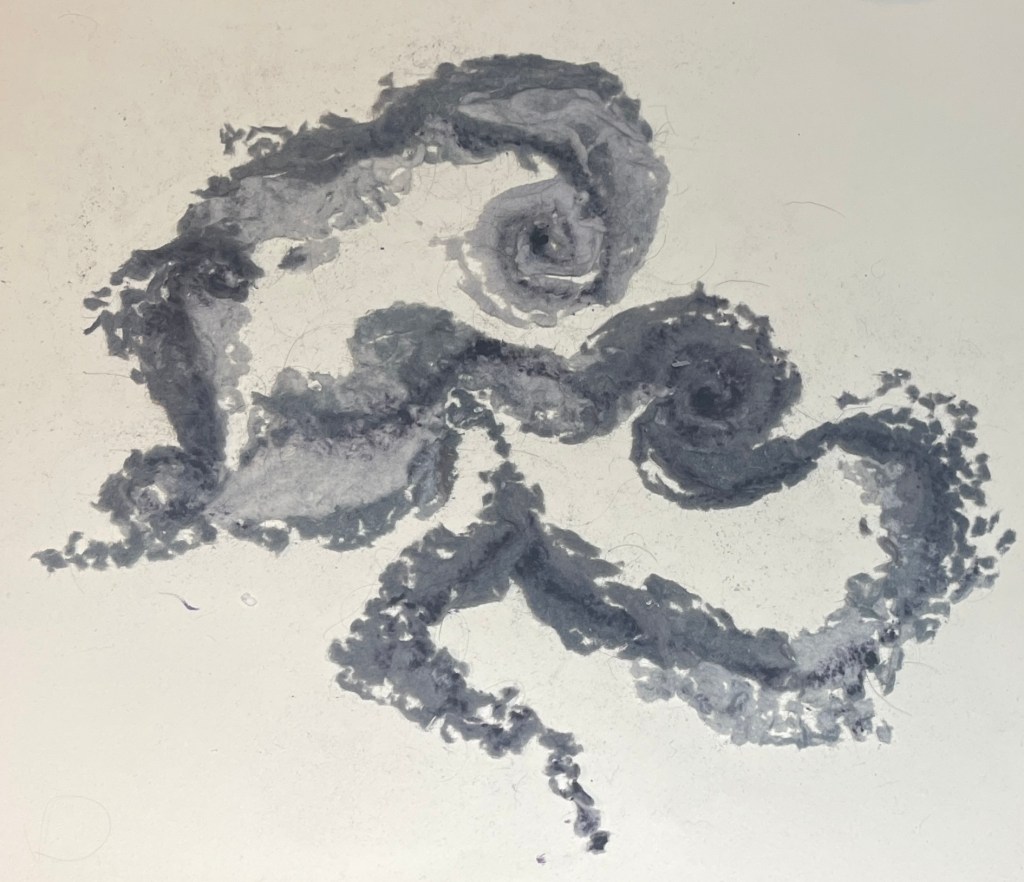
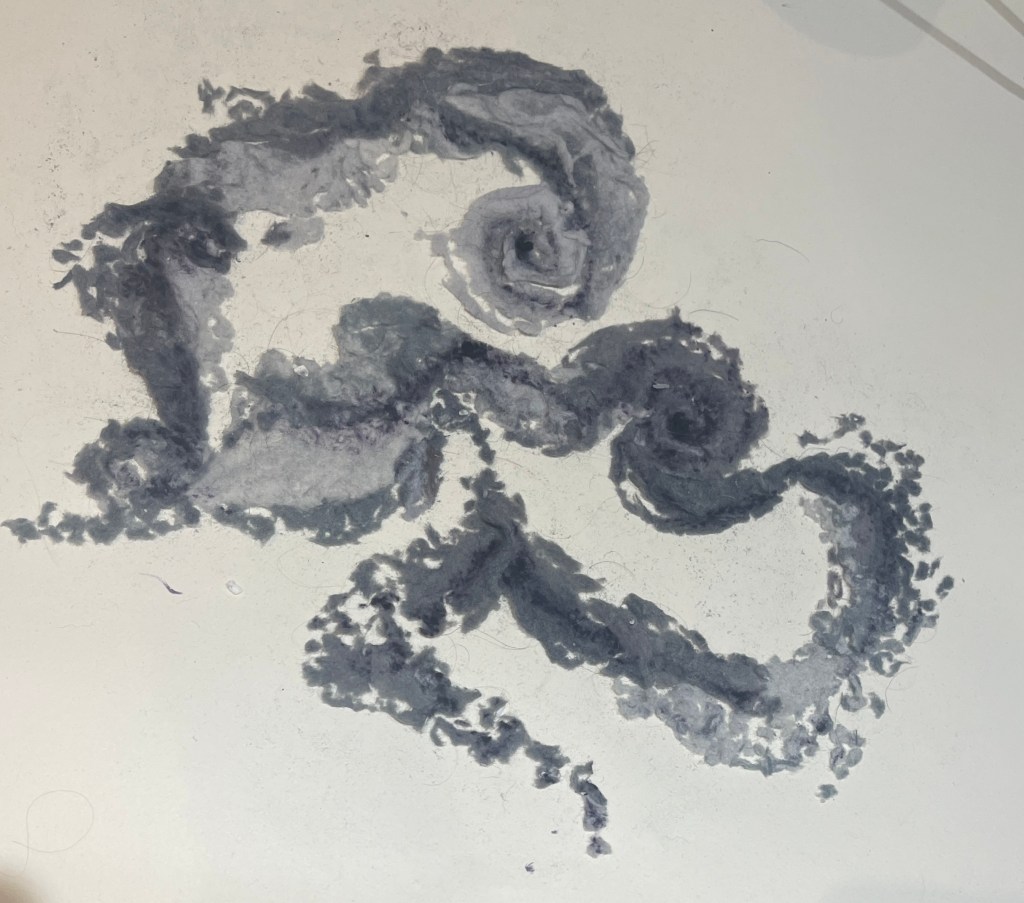
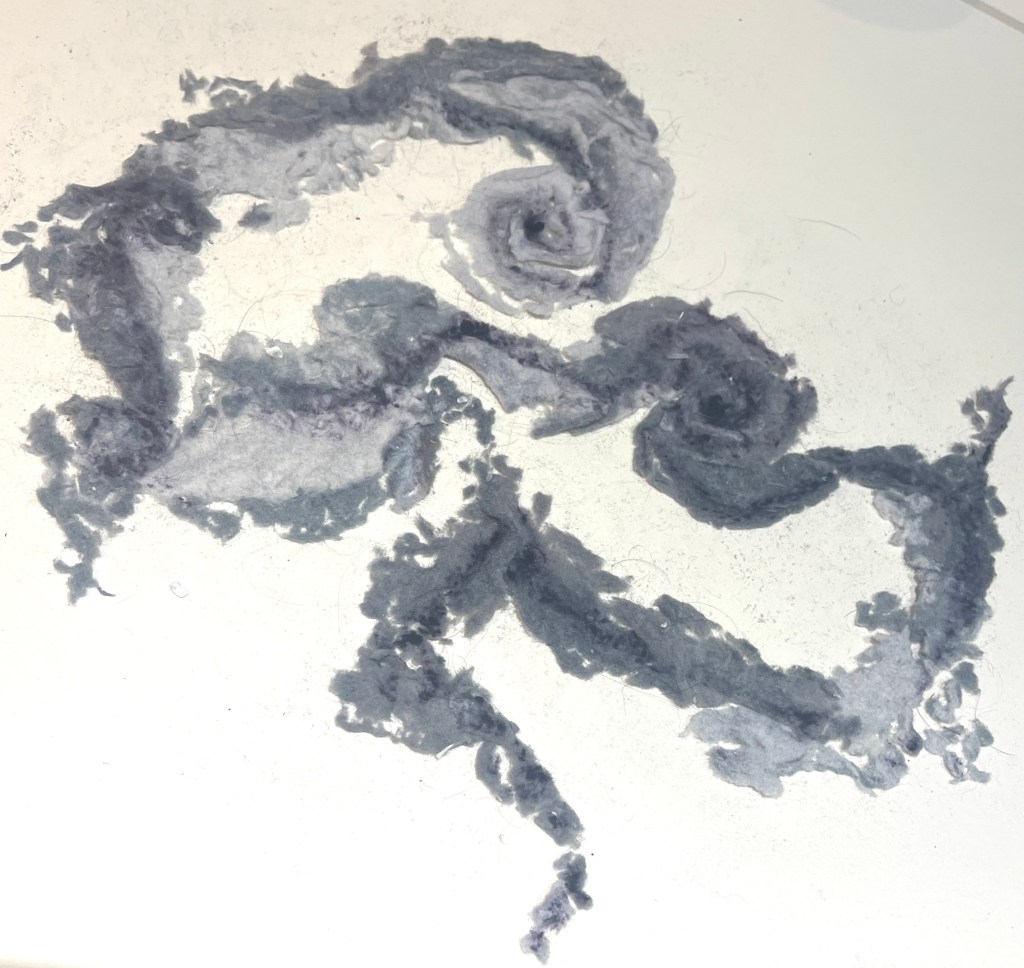
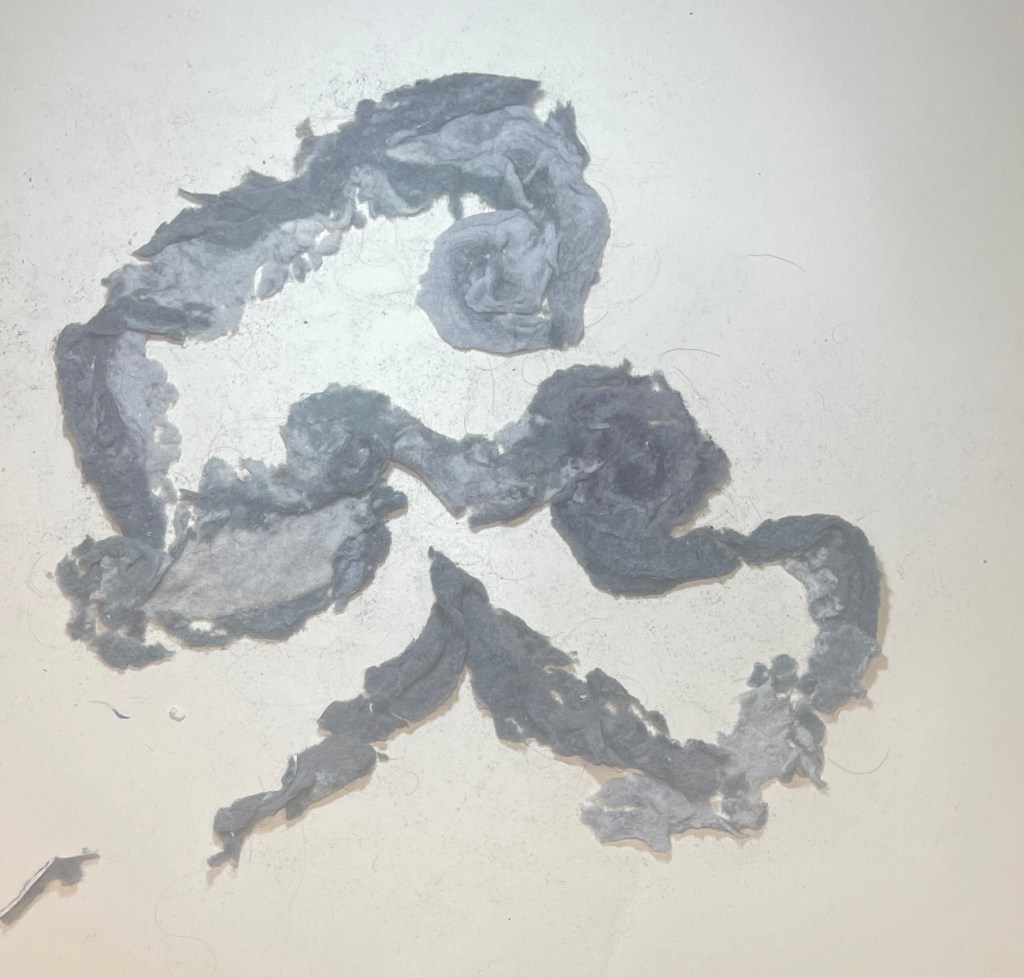
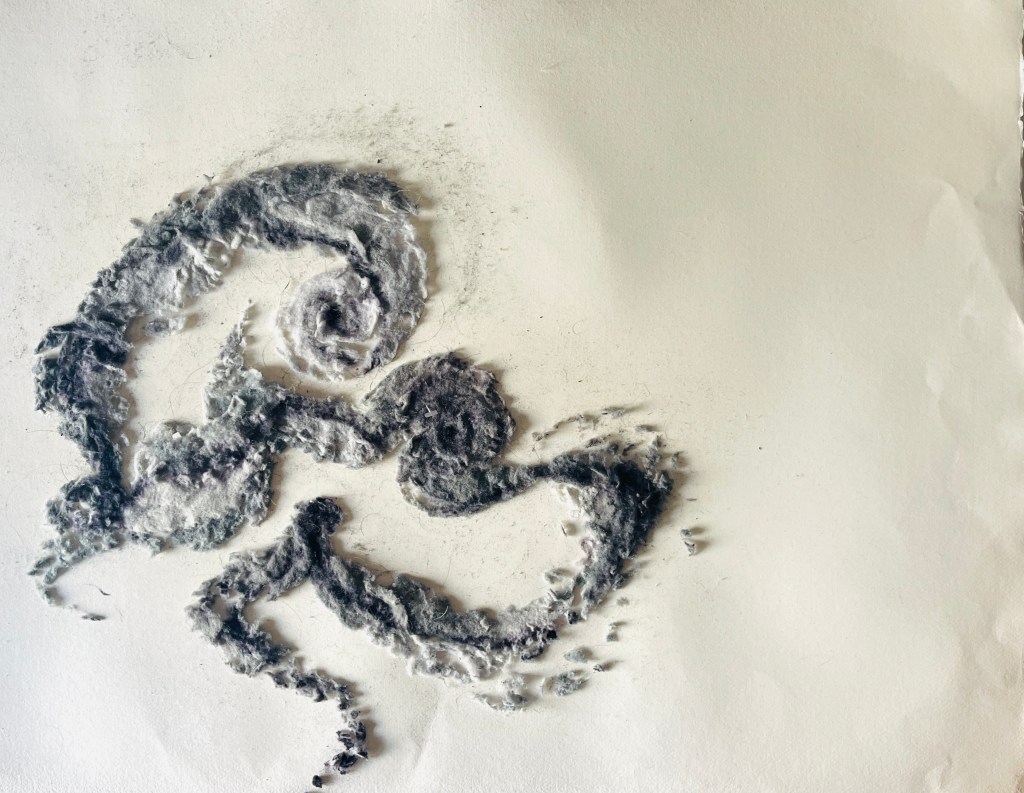
Above: I manipulated the material more thinning it out to look lighter but also convey the flying starlings. The piece is much larger A1 size and the detritus is clearly visible amongst the material debris. Spending so long trying to arrange the work to the best depiction was frustrating, small tweaks and additions were endless. The material not as forgiving as I had hoped it might be when pulling it apart. I stood to work on this pice for over 2 hours coming back continually to re tweak. In hindsight I would have changed the background from the off while Khadi paper to something else but as yet unsure… Im not convinced this work is actually resolved. Looking back I am now more drawn to the smaller works within the squared framing.
This exercise was a challenge to my process, working with new materials and continually thinking about what is ‘complete’. I believe I could spend more time on this project using this materiality as a further concern. It holds a good narrative in keeping with a project theme.
Coming back to this work some days later I created a very different work that I found more concise and and bold in some ways. It related back to ‘women in the laundry’ but more domestically as a ritual of home-making:
A Woman’s Work…
Project 3 Working with Chance
Challenging and brave as it might be to throw caution to the wind and create to create an artwork a number of artists have taken up this artistic process. The degree to which chance is involved does vary. To conceive and start a piece of work predetermined decisions have already been made by the artist. In regards to location, material and tools. So does the element of ‘non making‘ or as Ellsworth Kelly stated to eliminate the “I made this ‘ from my work ‘ even truly exist? What is possible to to rid oneself of a preconceived idea in its entirety. Allow the element of chance to play a role in the artistic production. I am reminded of Picasso quote :
‘It took me four years to paint like Raphael, but a lifetime to paint like a child.’ It is almost impossible to remove all we have inherently absorbed, our social constructs , what is considered a success or failure in artistic terms. To recover an innocence and pureness in the making process a chance elements can help to recover a sense of newness or innocence in the making process.
Andy Goldsworthy often creates art out in nature from what he might come across or find and gather, these elements are not known to him on as he strides out into the wild to create. He will be aware of some material aspects that will behold him but only on site and working with the material will ideas emerge. Chance encounters of site and available material will be addressed as encountered. This I consider to be the essence and excitement of Goldsworthy work.
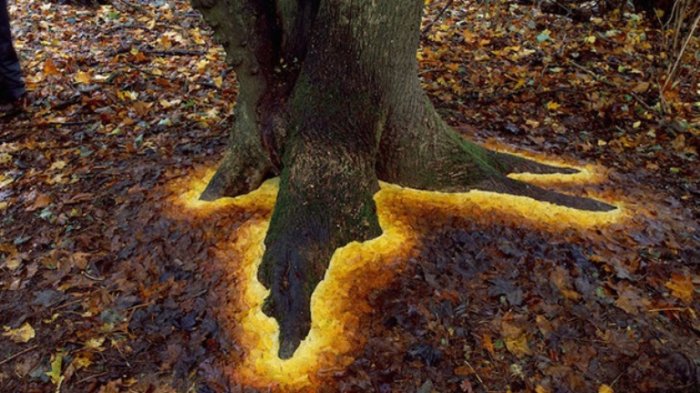
Sycamore leaves edging the roots of a sycamore tree, Hampshire, 1 November 2013
(Andy Goldsworthy)
Jackson Pollock famous Abstract Expressionist work that sees him dribbling and flicking paint onto enormous floor situated canvas will also involve elements of chance. Although the paint colour, canvas situation and possible his physicality will have been considered the actual paint falling onto the canvas and the marks it made would have been left to chance. Gravity, momentum and viscosity would be part of these chance elements. The end results do reflect an immediacy of energy, open, emotive and raw compositions.
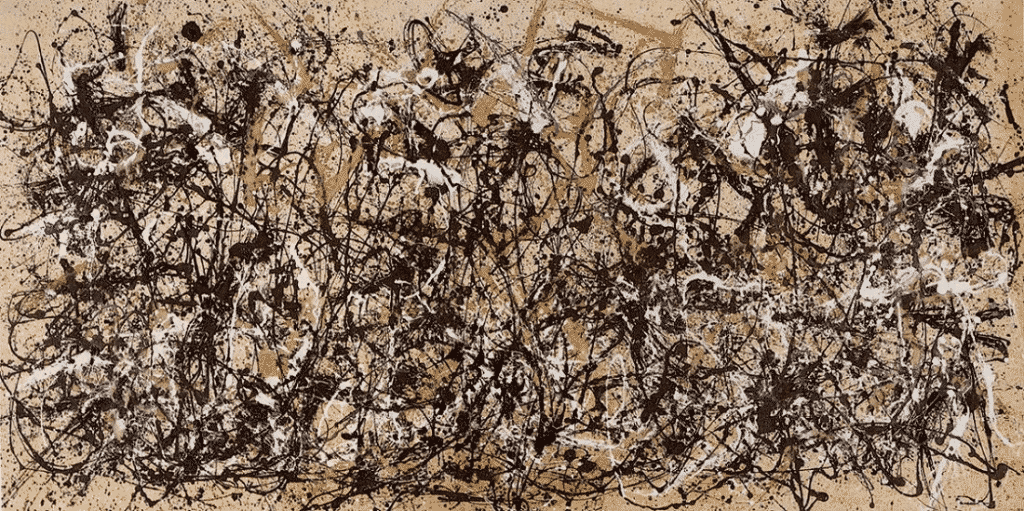
Jackson Pollock, Autumn Rhythm, 1950. Courtesy The Metropolitan Museum of Art
Hans Arp wrote : “The ‘law of chance, can be experienced only in a total surrender to the unconscious.” The Dadaists favoured the random and accidental than intention and authorship in ar. Arp created collages in this way by throwing paper scraps into the air and pasting them down into the positions they fell. This ideas seems less visionary and experimental now but in context of the time this removed the artistic curation and development by the artist.
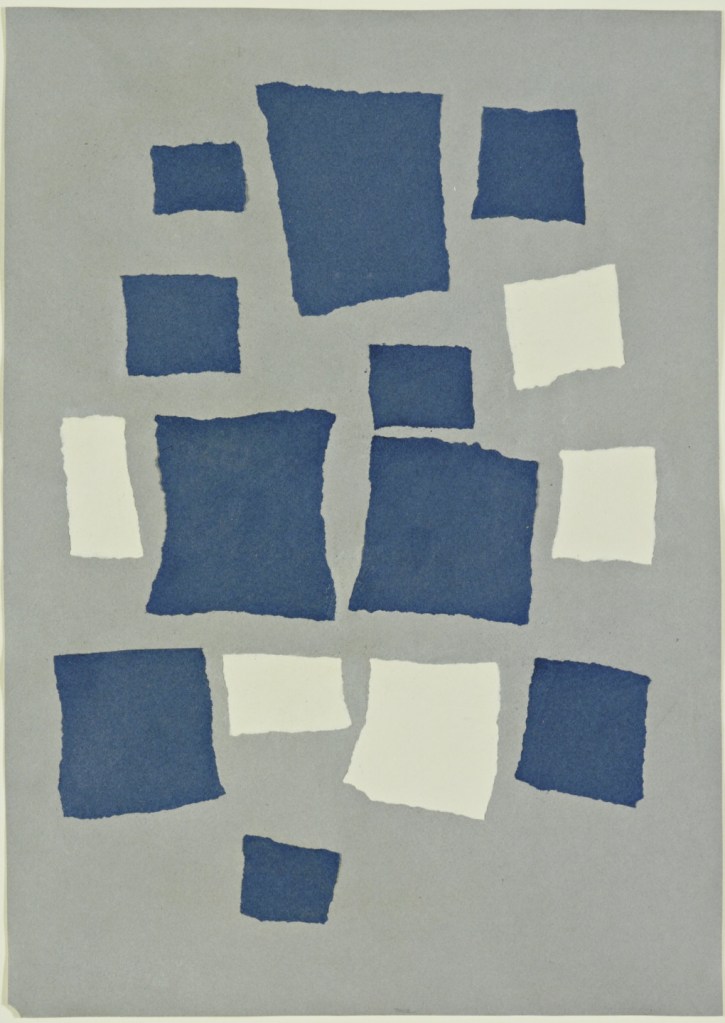
Jean ( Hans) Arp. – Untitles. Collage with Squares Arranged according to the Law of Chance ) 1916 -1917
My own experience of chance has most likely been whilst using the process of cyanotype photography. Working with the sum or an ultra violet light and my prepared paper was awash with chance. The concentration of the chemicals, how damp the paper, ( often intentional for a varying result) the strength of sunlight, the chance of shadowing, exposure times, temperature, type of paper to name a few. It was a thrilling process that offered such a varied outcome. This diversity of process and material offered an array of options to make the final cut.
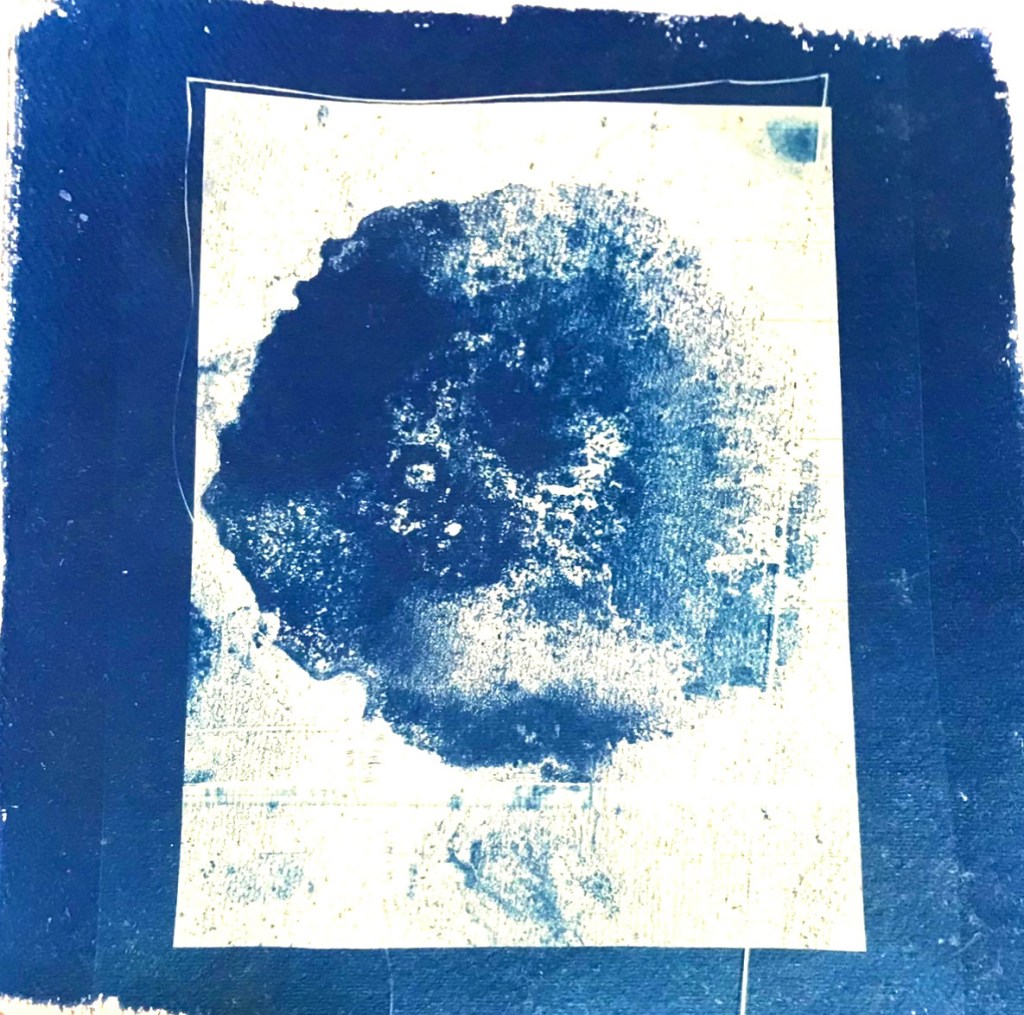
Traces of moulded Apple remains – Cyanotype 2022
The intricate production of cyanotype process work did allow for much variety that would be lost in some other mediums. My interest in found objects however is also non-dictated with a random curation that relies upon chance finds and offerings. It has certainly shaped bodies of work and narratives, the chance encounter being a gift at times to help open new thought processes and pathways of investigation. Chance elements of production will continue to be considered in my artwork going forward perhaps as a way of opening up when artistically tight and or suffering from an artistic block. I will look to incorporate it current projects more thoroughly.
Exercise 3.1 Staging Chance:
I selected my semiotic work on “Shrines’ to begin this experiment of chance. Partly because I was looking to further this image and was unsure as yet how to progress it fully :
Firstly I used some heavy oil pastels and coloured in a gradient effect surrounding a printed image of “Shrine’ .
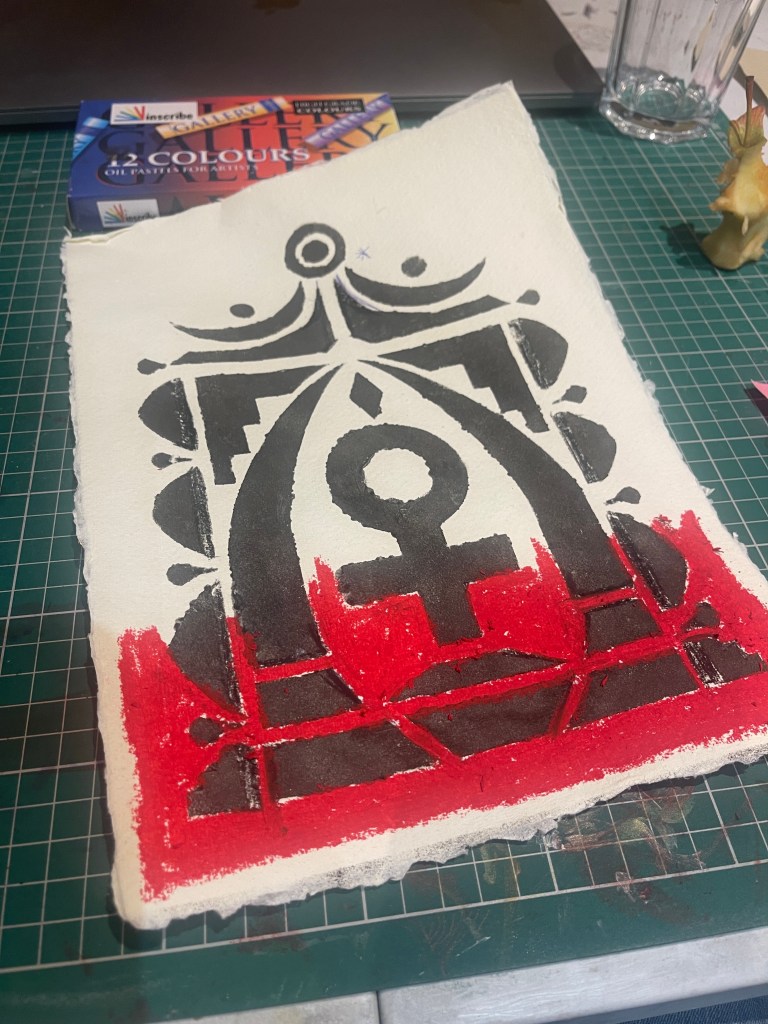
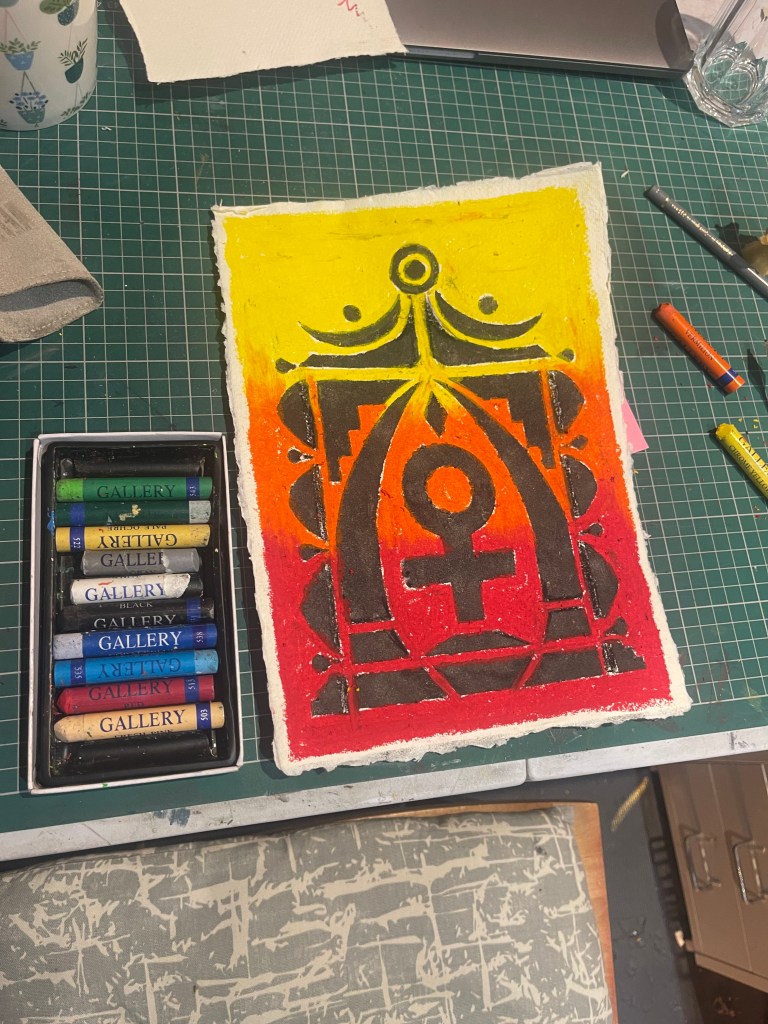
I placed a pice of paper on top of this and covered it so the image below could not be seen.
I then asked the younger members of my family to doodle and create all over the piece of paper with heavy pencil marks. This would ensure that an imprint of their markings would appear on the sheet below. I gave no direction or specification of the mark making, only to cover the paper:
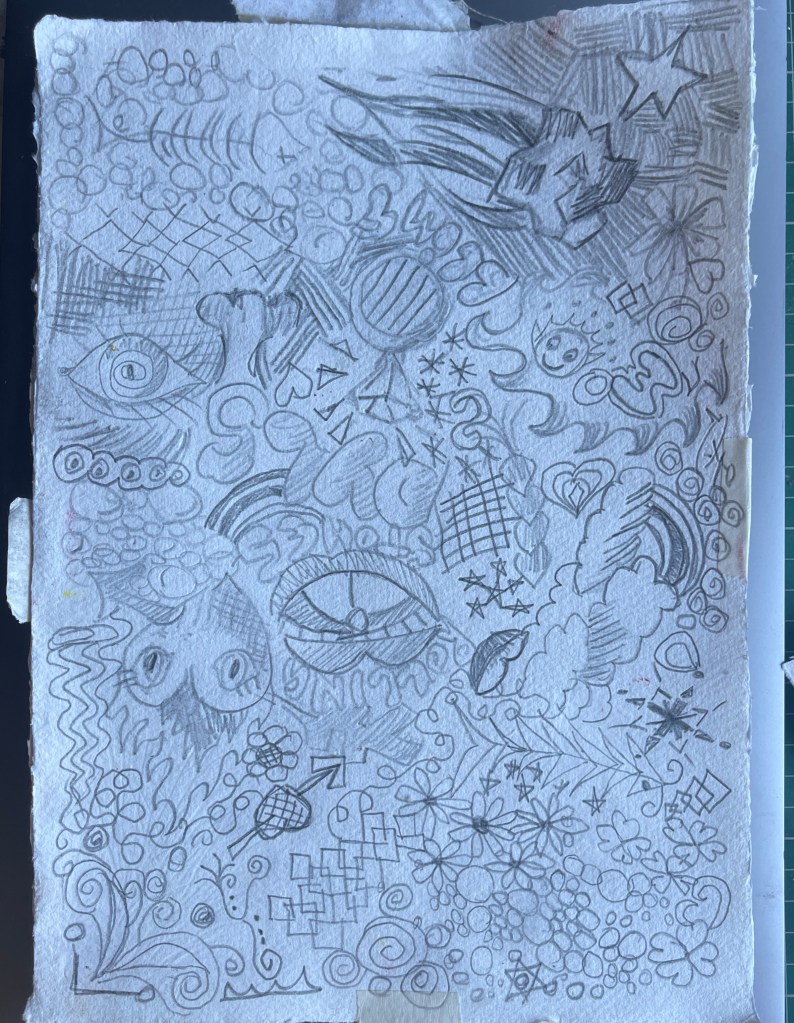
This was the end result.:
Having lifted the paper from the one below this is the imprint it gave – realising yellow was not a an ideal choice of colour:
A slightly messy and certainly unexpected out come. However I found it inspired me to think about the mark making on further works. There was something quite raw and tribal about the marks that made me consider including non specific elements of folk art and ancient art whin this project. I had wanted to add symbolic images of the female to the ongoing work but placing them in and around this work was a new consideration.
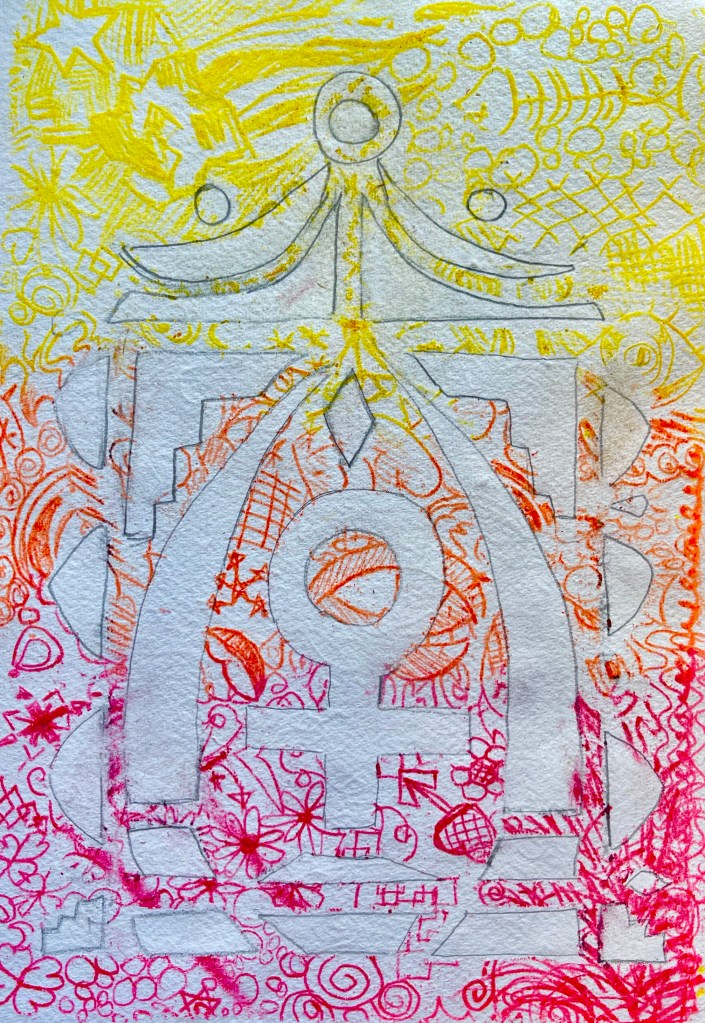
Looking to work this back into m project I carefully noted the marks and symbols that lay on the sheet and decided to replicate them using a black fine line marker onto an existing printed card of the Shrine image.

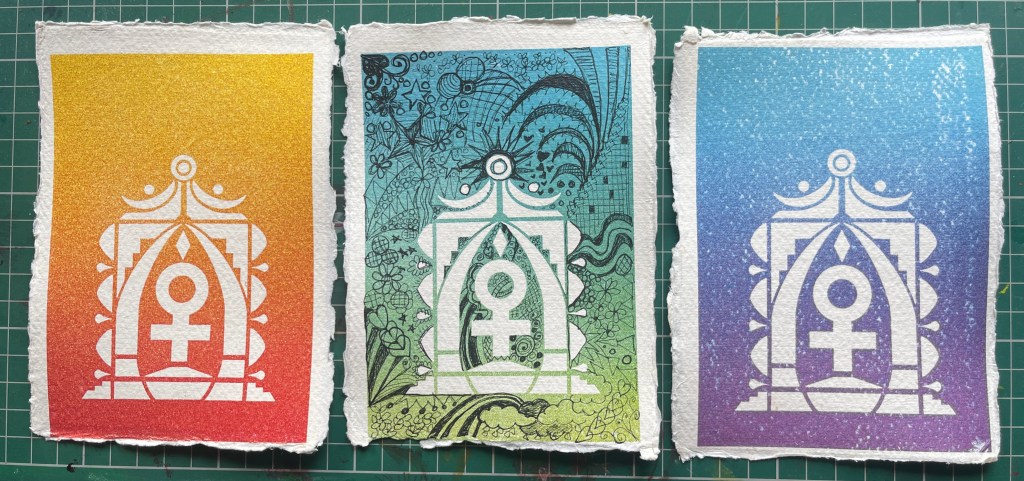
‘Shrine’ Printed onto Khadi paper.
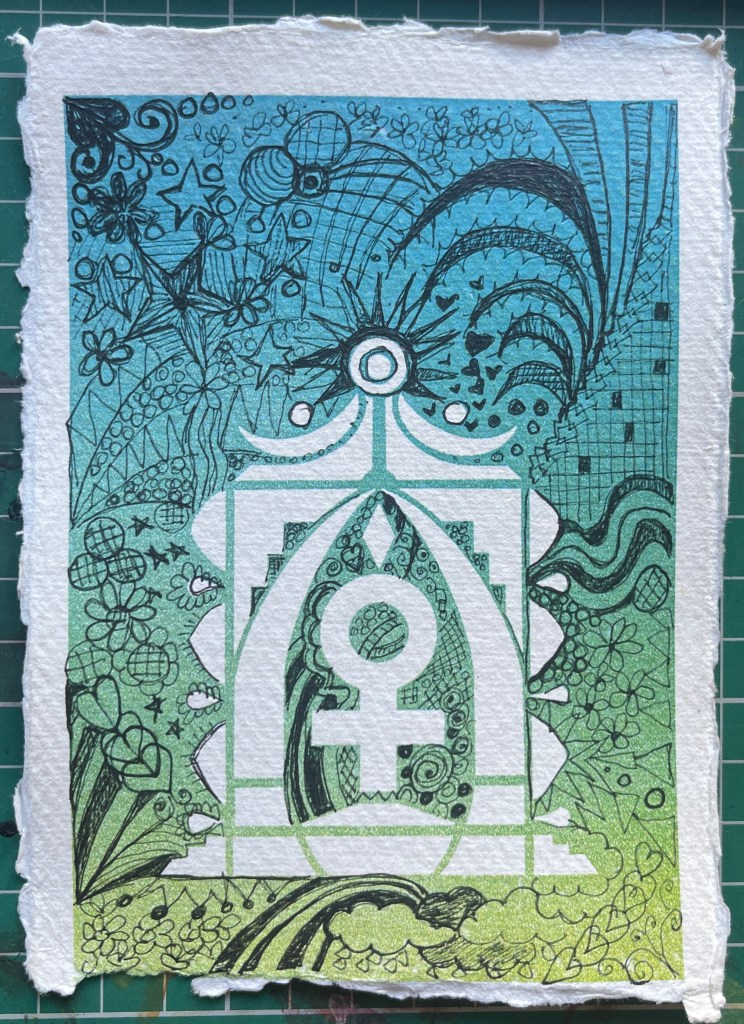
This first attempt to recreate some if the images produced by the family members has certainly offered me another dialogue for the work going forward. Not fully decided on what this might involve, adding images to the work directly surrounding it or incorporating the images and marks onto the white area of the Shrine shape. It has certainly brought some more life to the flat image and allowed for the white image to stand out from the background and intrigue beyond the immediate image to another level of narrative.
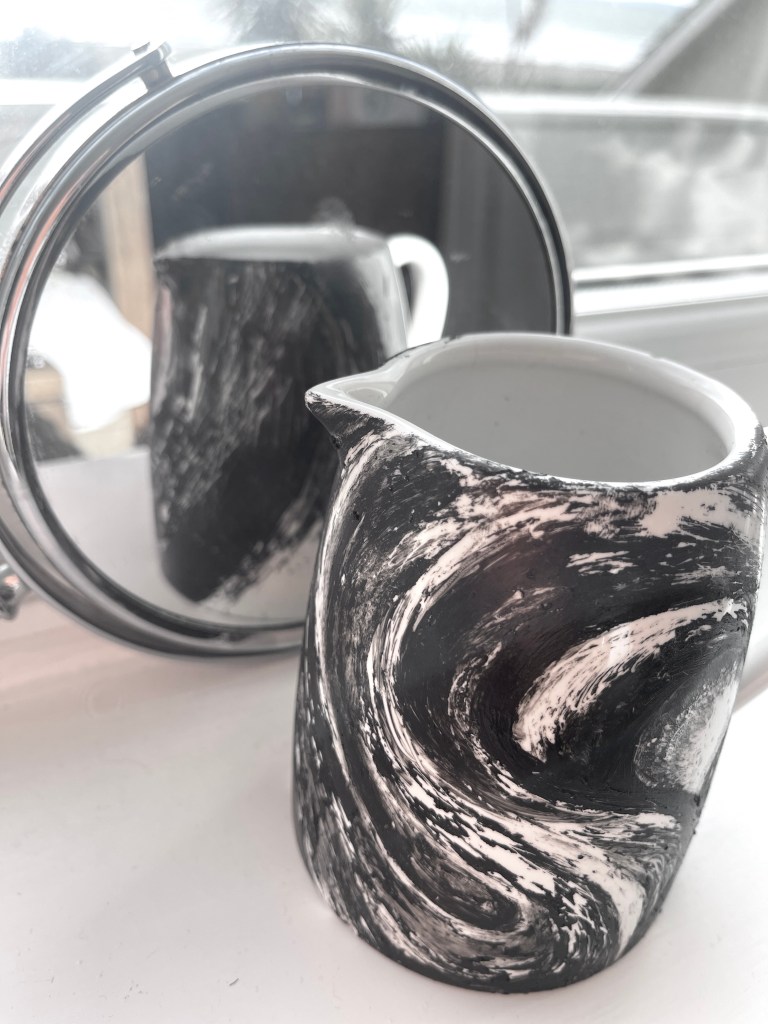
This next piece is a work I had recently completed concerning ‘Murmuration’. I had wanted to bring the imagery and metaphor of this image to a range of every day objects. Illustrating the narrative of worry, anxiety, depression can seep into our lives at any time, even a little. They are natural human emotions and are part of a wide range of emotions we may encounter on a daily basis. They are not to be shrouded away under the pretence of them not being valid or ‘normal’.
To add an element of chance to this work I decided to hand the object, a small white jug painted with a murmuration image over to my family to photograph it in various locations. I explained what the imagery meant and that was all. I wanted them to bring the image to life in away that was relevant to them and so hopefully to a wider audience. My ‘helpers’ included my 17 and 20 year old son, my husband and a good female friend.
I hoped their studies would allow me some more reflection on the narrative and show some new lines of enquiry..
Here are the pictures I received: ( edited )
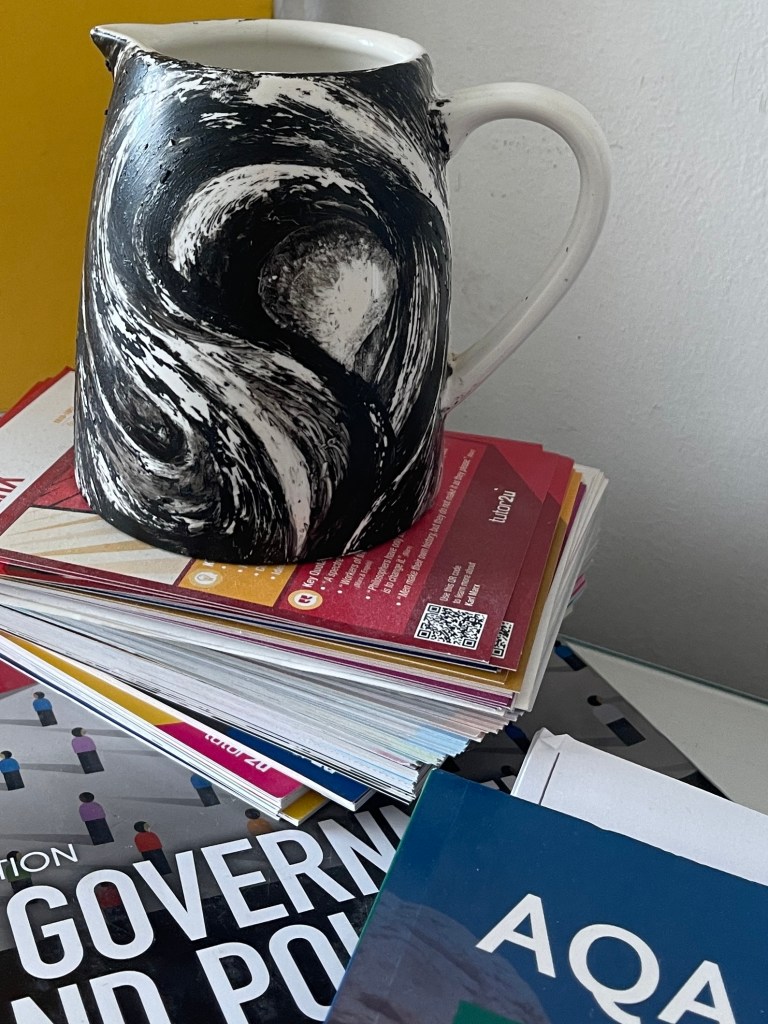
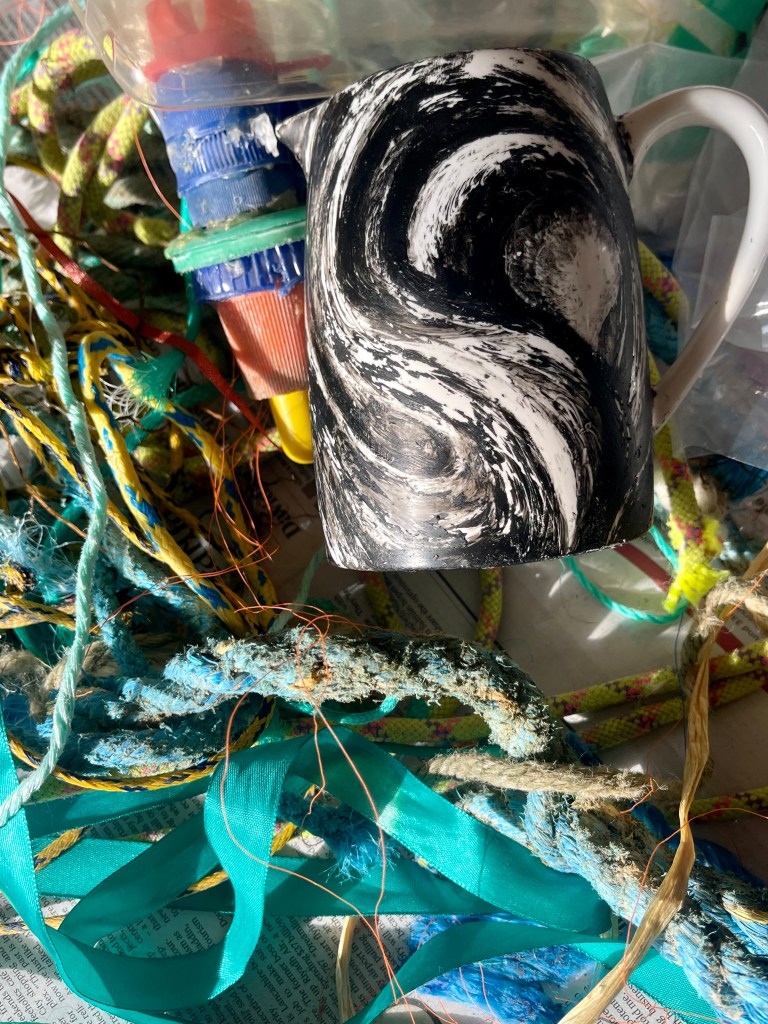
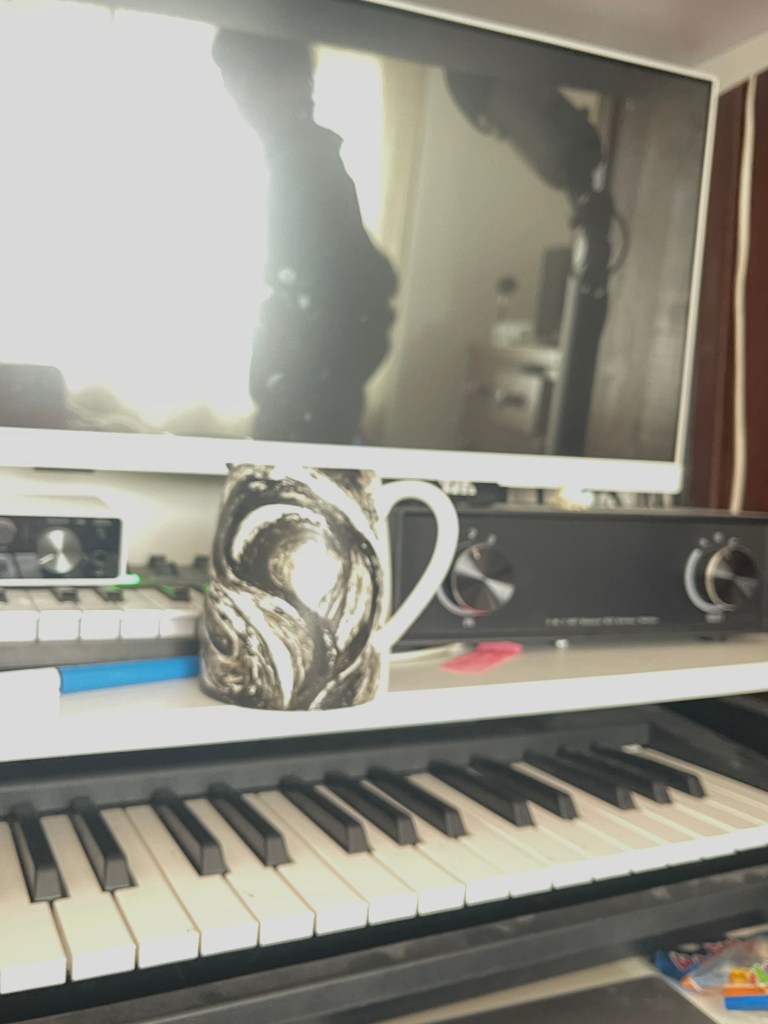
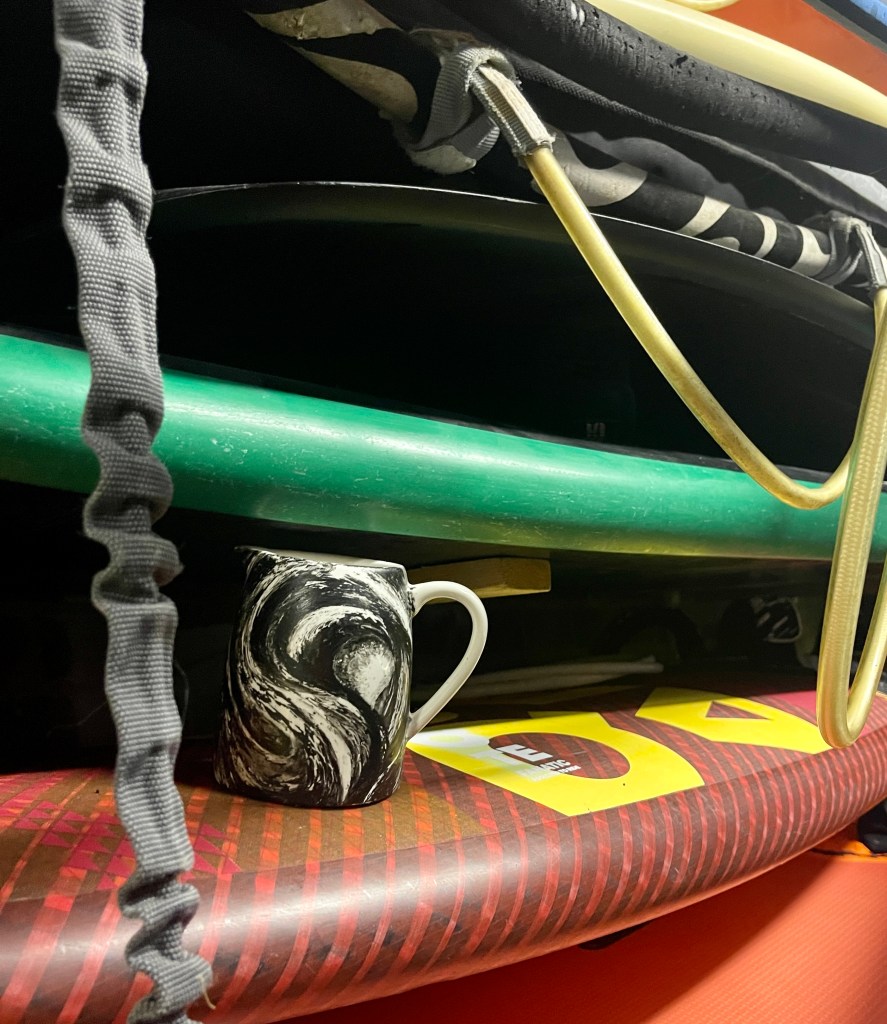
The photographs reflect a variety of emotions that can allign with my concept of Murmuration:
Reflection – the worry of ageing.
Exams – stress of passing A levels.
Pollution – the state of our planet.
Work – anxiety of achievement.
Water sports – maintain standards and keep fit enough to compete.
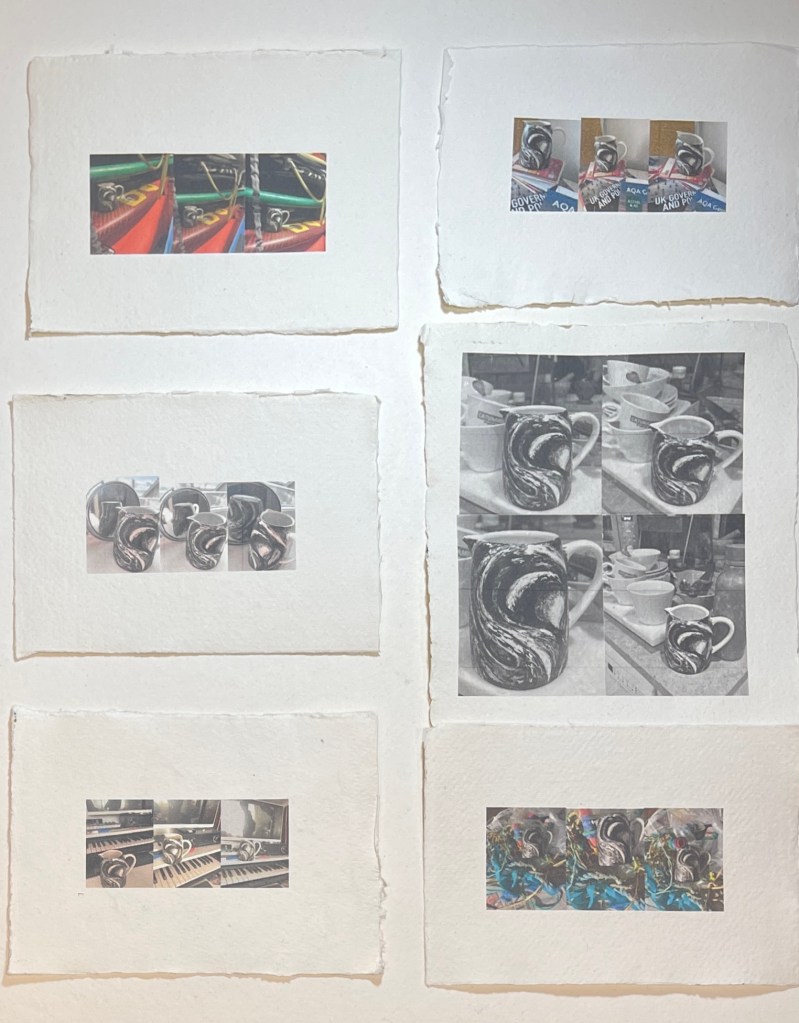
I curated the pictures into a format onto A6 paper – I selected 3 of the images from each person as they had photographed them using their own i phones.
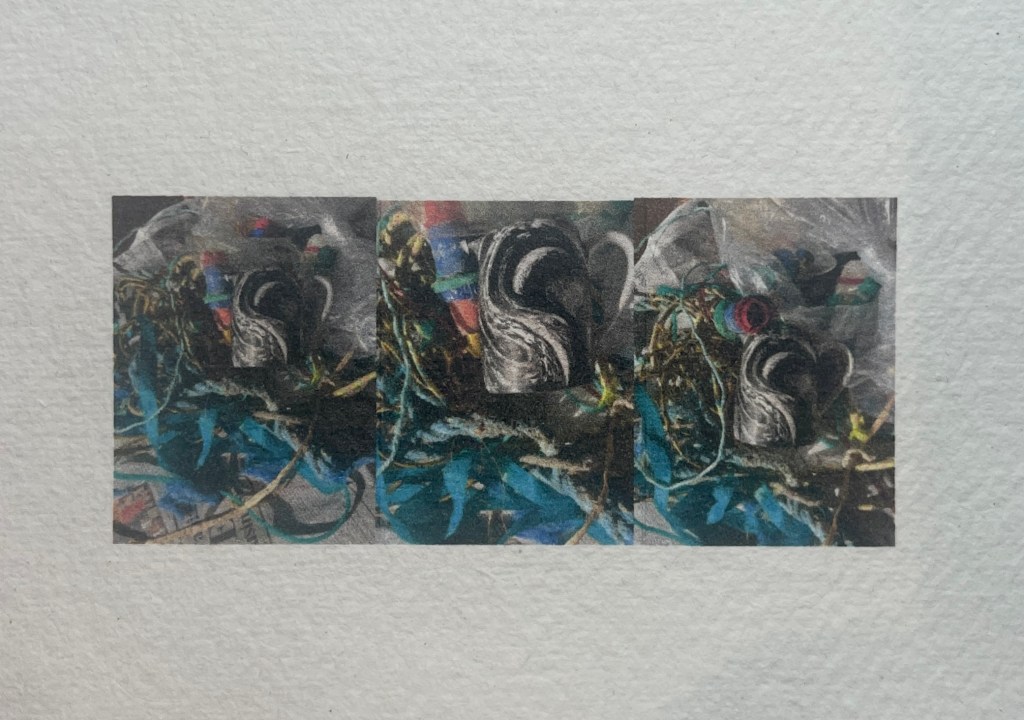
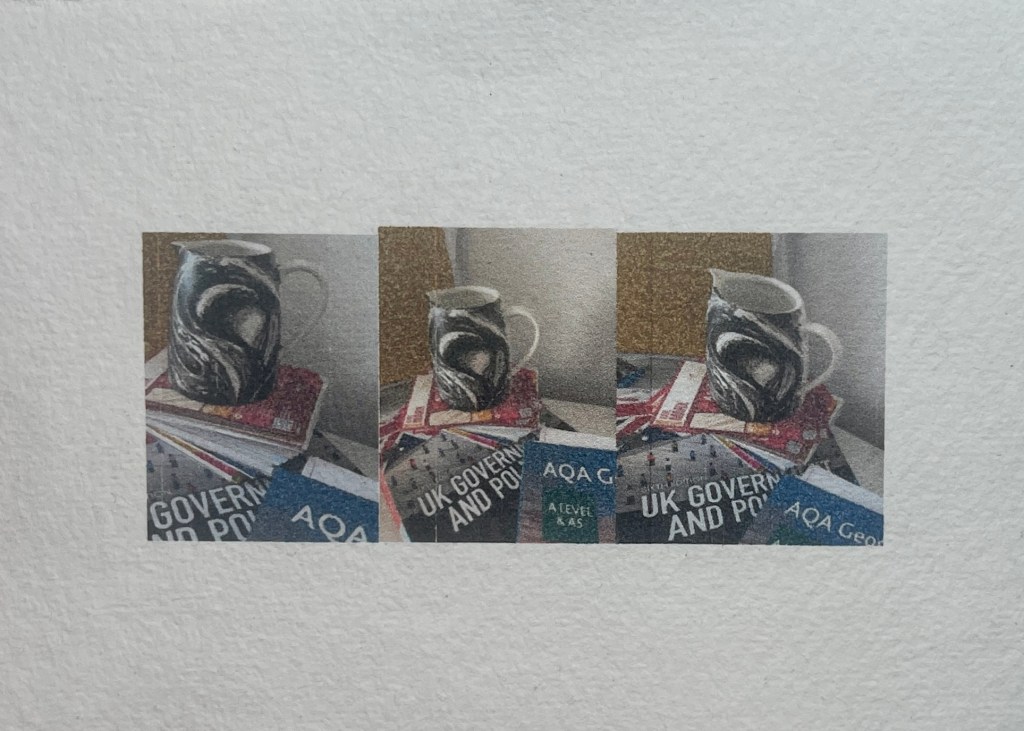
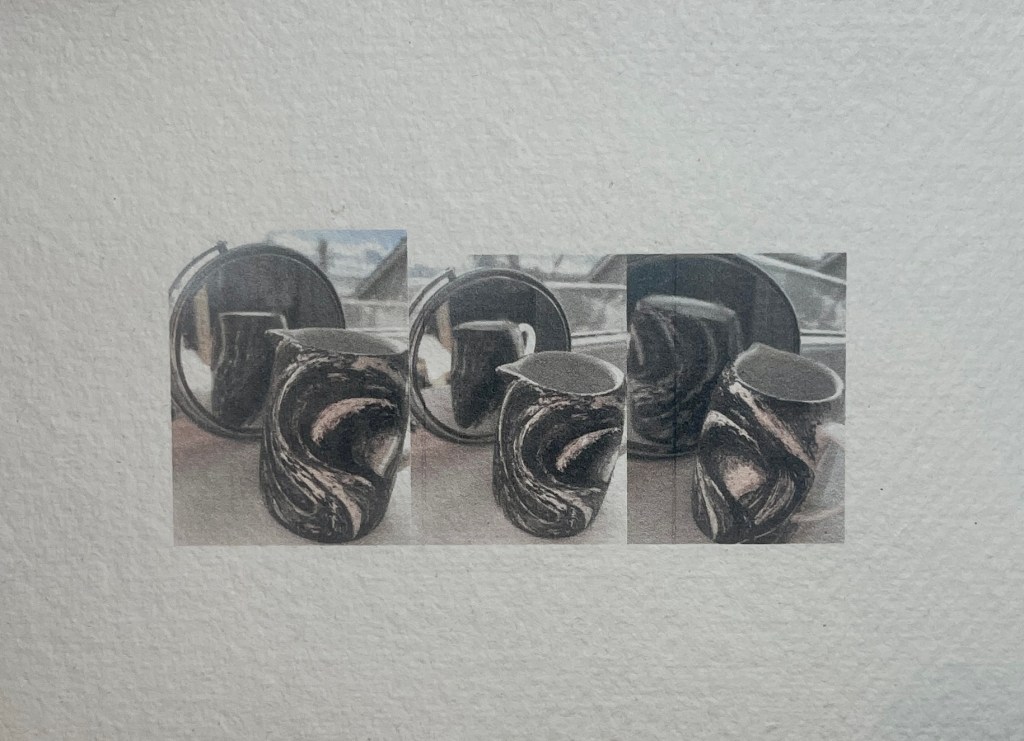
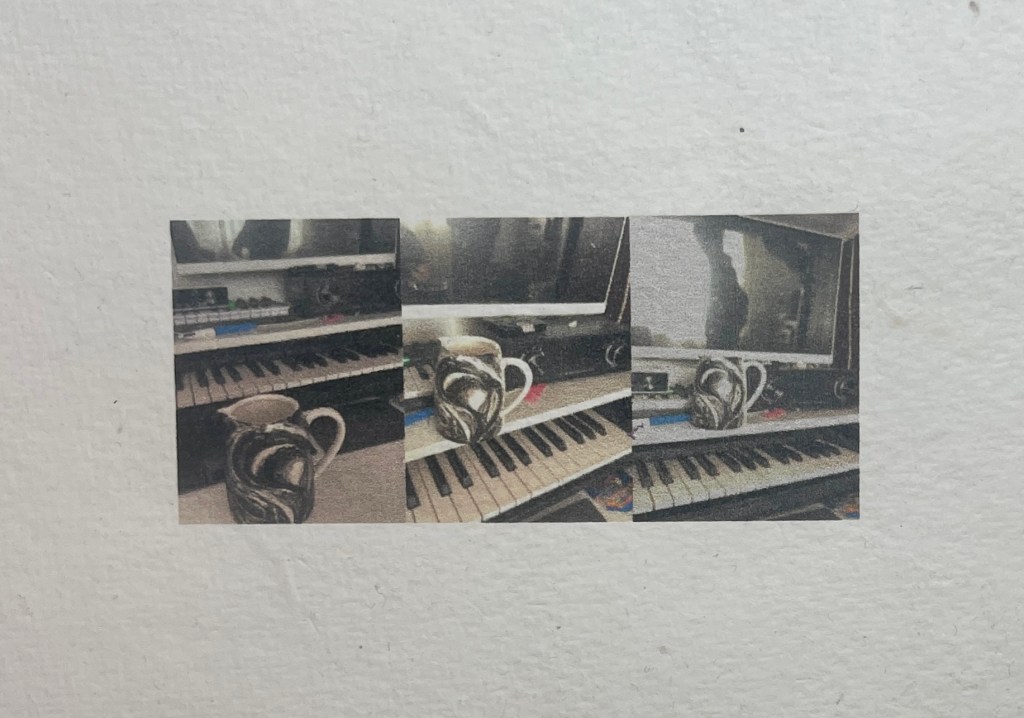
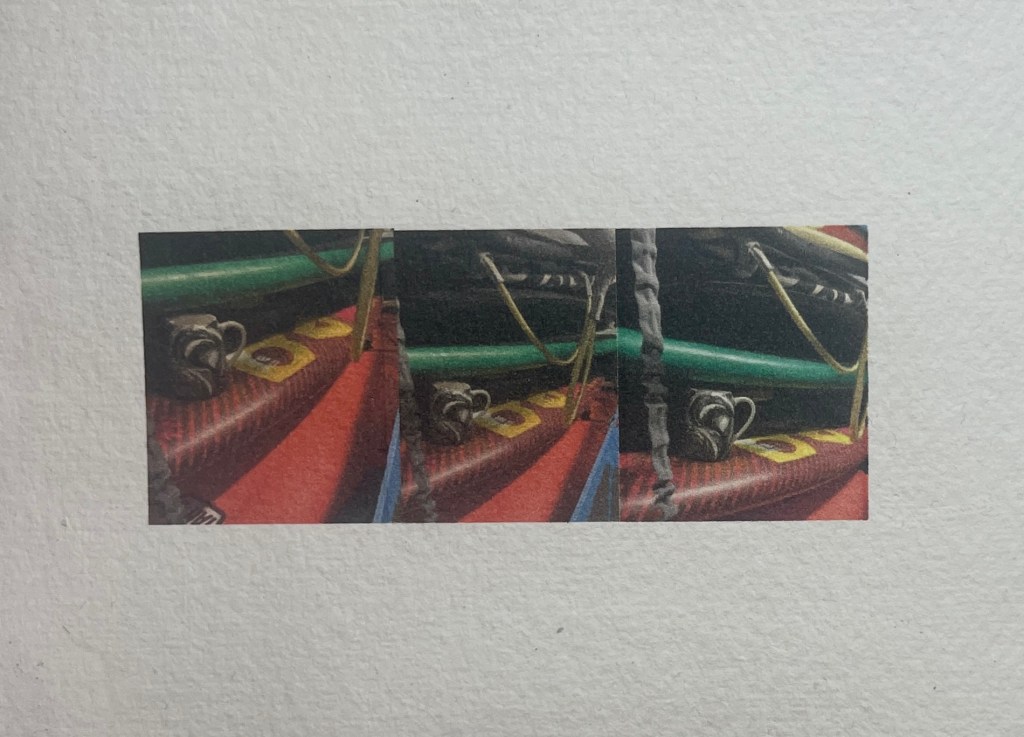
My own photograph in situational placement was the following:
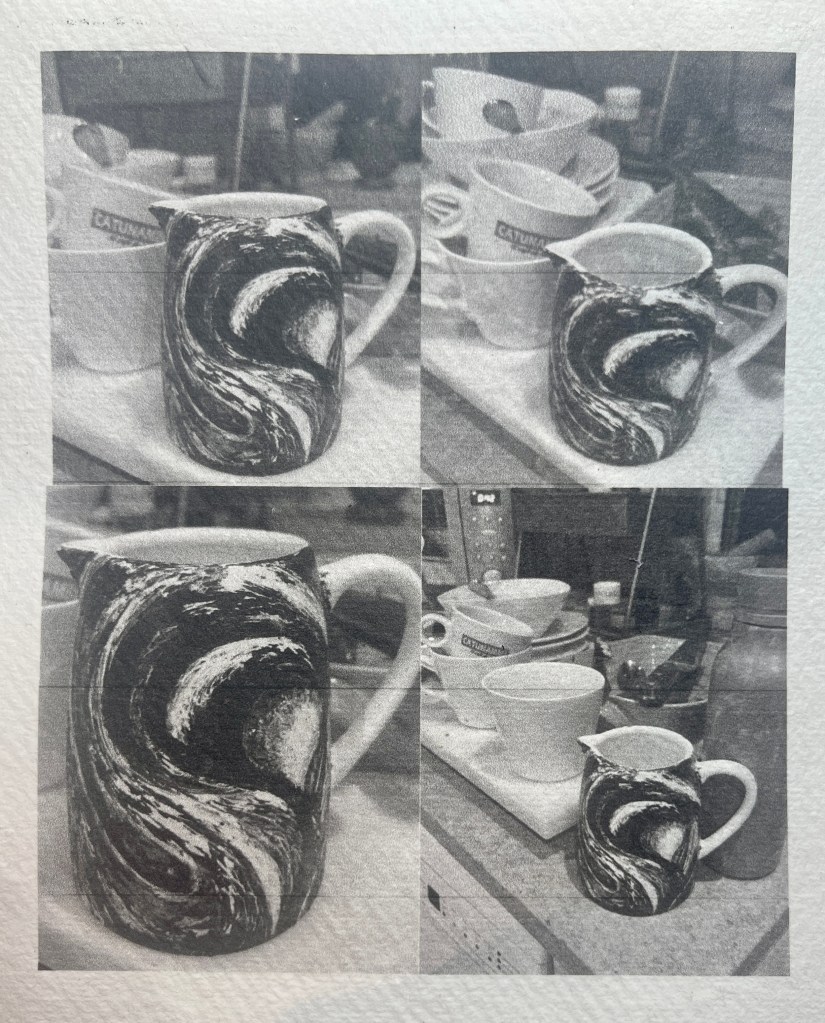
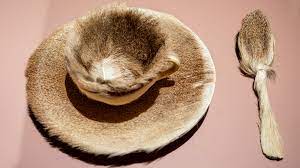
This was another reflective chance intervention that aligned the this narrative with a wider audience. Whether I stay with this or continue to work with female mental heallh as yet I am unsure. I would like to develop this work and create a work inspired by Meret Oppenheim with her definitive surrealist object of cup and saucer. Using the murmuration imagery – perhaps more subtly as part of a set, hinting at hidden social angst and depression.
The situational placement of the ‘jug’ certainly brings in a new dimension to the work, relatable and visible unlike the night time references I have explored in ” Fear like Starlings’. I have also played with the notion of the white jug being part of a past etiquette of service and female homemaking, a time seems incongruous in this Anthropocene and perhaps will never be repeated in quite the same way. My collection of these objects was concerned with this narrative.
This time will never come again: ( below)
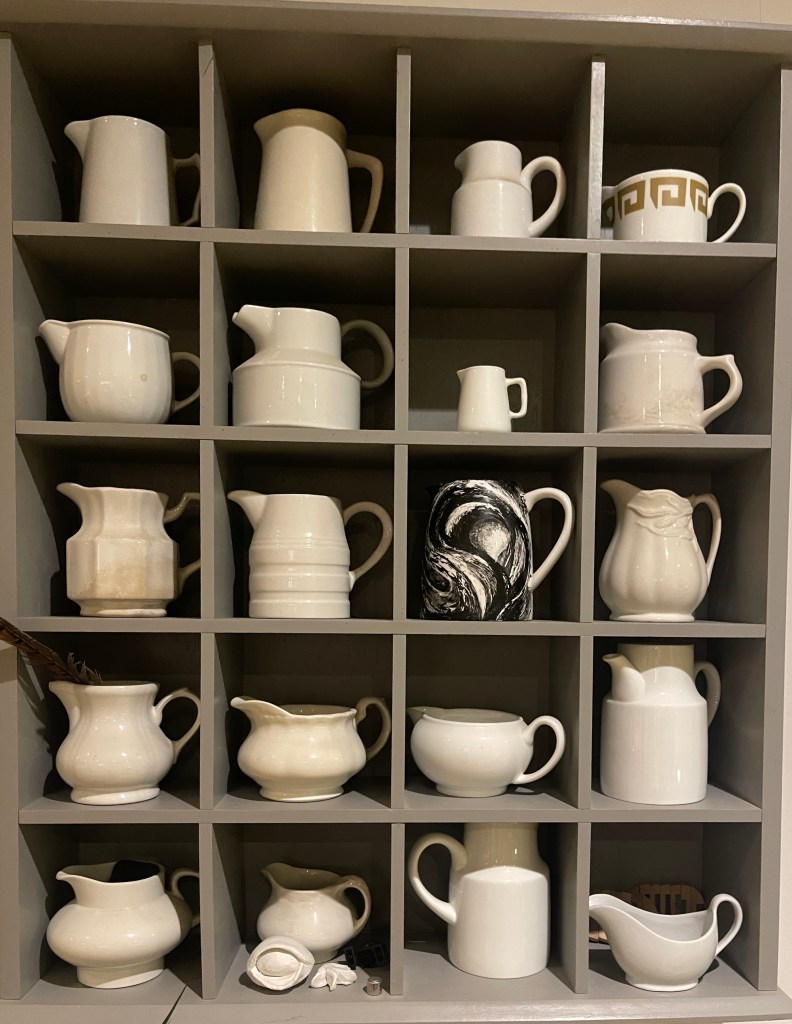
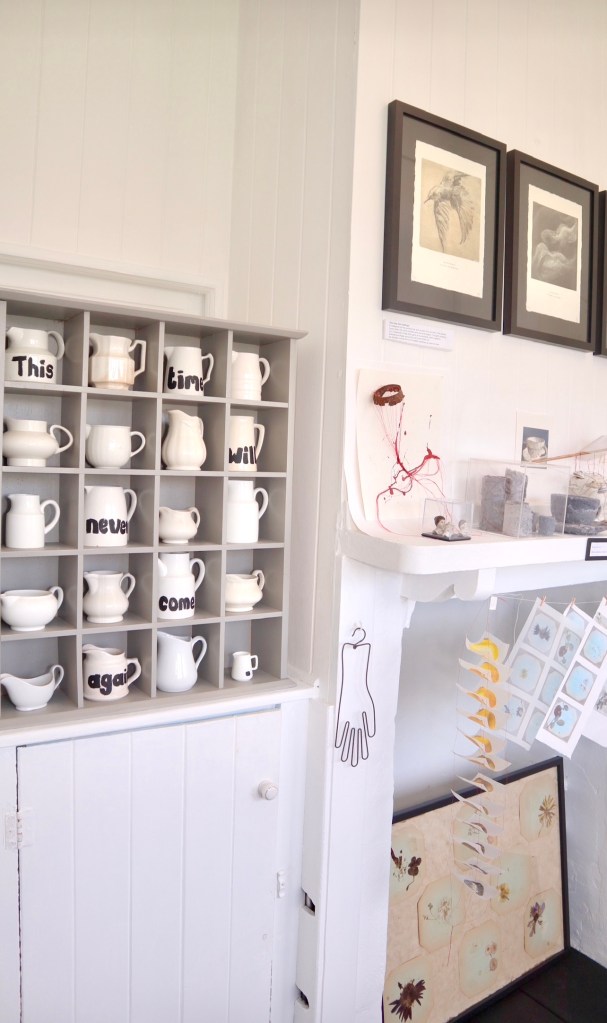
Exercise 3.1 Stage 2,
Alex Pearl – Breakdown – Mechanical Dysfunction and Anthropomorphism
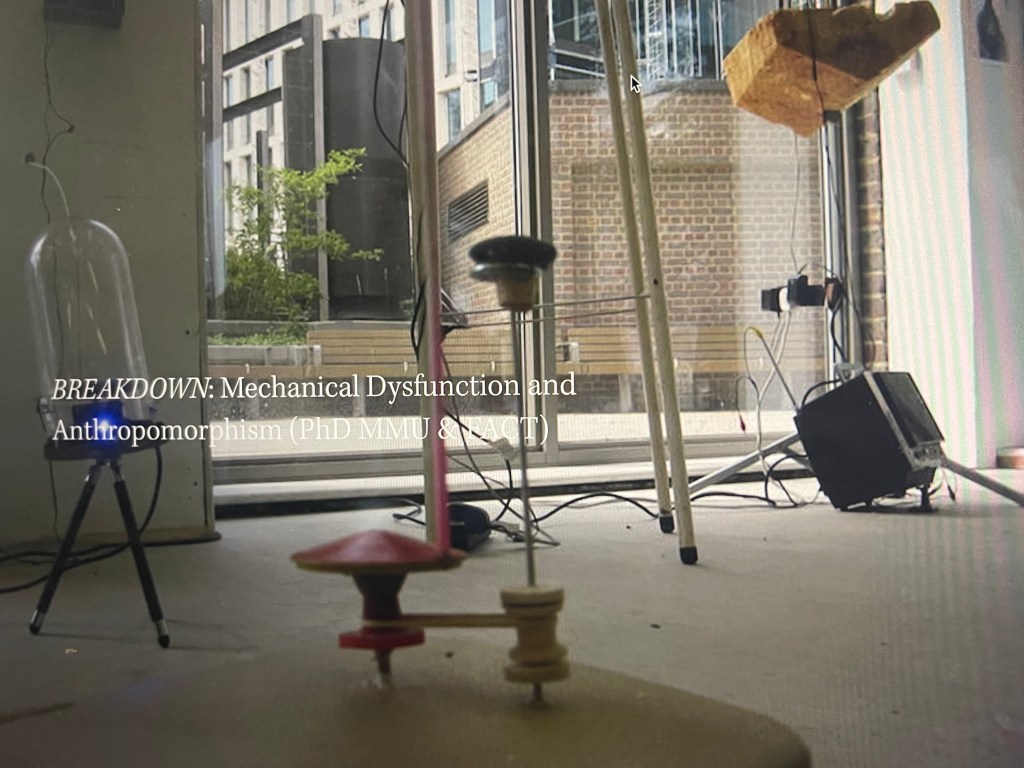
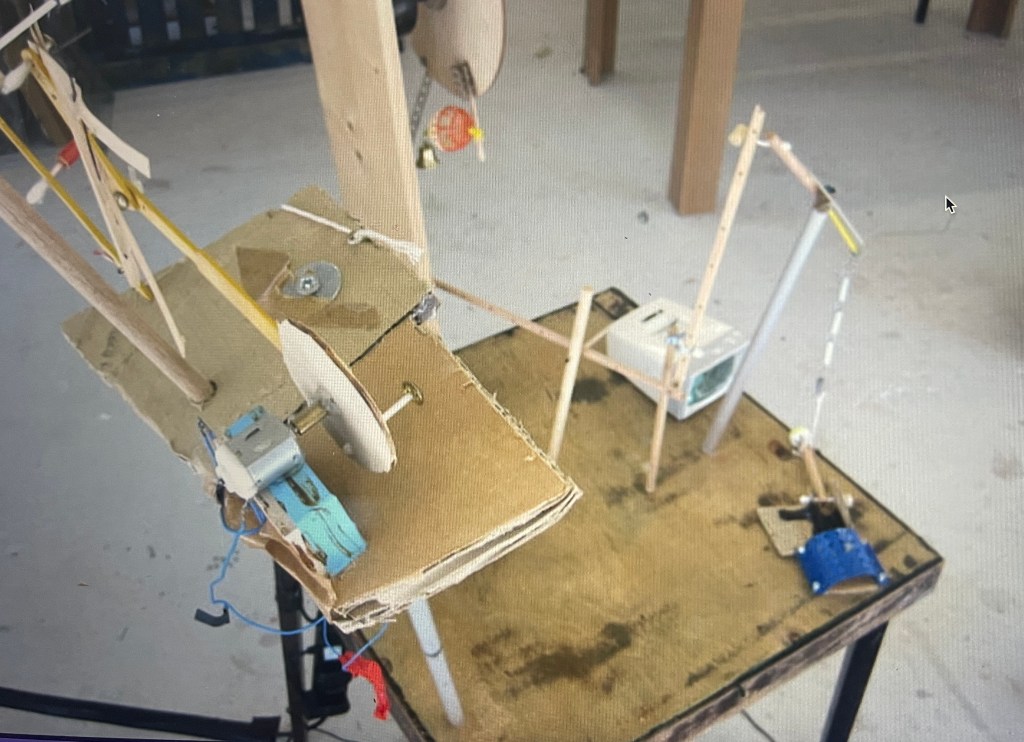
The Heath Robinson like machines produced by Alex Pearl seem to ache and creek with personality. They seem aged rather than new perhaps as we are so used to looking and admiring machine perfection. They almost hang on by a thread , sometimes literally, and need to be continually attended to and cared for. The anthropomorphic feelings towards the machines is understandable. The continued performance by the artist to tend to the machines as they fail with their built in obsolescence would be akin to watching a medical professional rushing round a ward to care for their patients. The same sense of chance, the unknown ( to some extent) fuelling the variety of ways in which the artist interacts. We live in a society where often when a machine breaks there is little or no chance of repairing it -it is not built to be repaired – so this gentle process, a historic process of repair might be seen as novelty and nostalgic even.
In regards to my own work and the previous exercise I have enjoyed the element of chance ( and its collaborations). It has allowed for further exploration in the narrative and visual content. I set controlling parameters for each exercise. Firstly I had already coloured the work that was used as an imprint in-keeping with the palette of the printed work. In hindsight I could have relinquished this aspect of control and allowed the colouring in process to be left to the chance preferences of my family. I had also asked for the whole sheet of paper to be covered in mark making and had of course specified the sizing of the work. These ‘controls’ were in expectation of the type of result I had wanted – something that worked with and fitted into a bigger project. Int his way perhaps I was too tight in allowing a greater handover of chance to occur.
The second work concerning photography and placement of my symbolic ‘jug’ seemed to allow greater freedom of choice from the helpers. The brief was wide, ‘to take the jug and place it in an area ( indoor or out) that gave them cause for concern, anxiety and other negative related emotions. This is allowing the work to get inside the minds of another individual, to allow them to relate to the object and document it for me. The screen shots from the iphone were not an ideal to capture the imagery. I manipulated the images slightly by cropping and printing them in a tryptic on some Khadi paper. This gives them a more visceral feel and seems more connected to the images and the connotations. Perhaps a video project of the images would be more stark and cold in feeling in a an age where we are bombarded by the screen image.
Working with third parties either by way of discussion or actual collaboration will play a part in work going forward. The element of chance seems to be an essential part of the process of idea and narrative development, taking the idea outside of the artists head and into wider space for dissection, adaption and influence. Ultimately enriching the artistic process and outcome.
Research Point: Make work and make work again.
Warhol in his Factory.
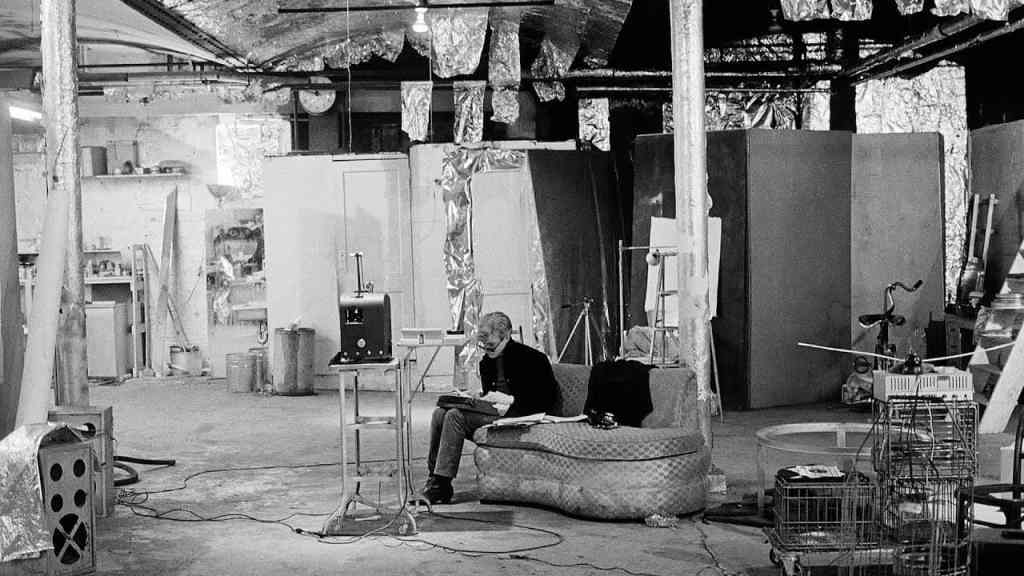
We can see from the photograph the Factory in New York ( 3 locations during the era between ) is an expansive space. Away from the confines of a home studio Warhol was allowed to fully explore the process of mass production. With assistants and a plethora of stimuli from other artists, celebrities and the high end social side of the era you can see how this hub of activity allowed for a grand scale of mass production. Now days we area aware of the massive studio’s ( factories) set up by Damien Hirst and Jeff Koons for example where numerous artists and crafts people collaborate with these iconic artists to expand, develop and ultimately create on their behalf under their names. It seems Andy Warhol was one of the first artists to fully exploit this process of mass production. Aware of his continuous success he recognised his out-put could be prolific within such a studio set-up. Wahol’s actions and artistic direction would no doubt have been influenced by those around him allowing greater experimentation, time saving processes, peer positivity and management.
Assignment 2 :
New work found – https://sharpe.gallery/body-of-work/
Initial Work Plan: – to continue to work on :
Working Title: The Complexities of the Female / La Complexite d’etre une Femme.
Explore : Several pieces of work as Body of Work ( BOW) using – mixed media / found objects/ natural media
Working with 2 D collage on canvas horizontal / vertical
Possible 3 D sculptural – mobile structure concerning balance of objects and forms .
Jigsaw/ Puzzles format of description and narrative . ” Woman Deconstructed but Operational ‘.
Craft material – embroidery of the past / juxtaposed with new start imagery.
Every Day Practice of recording self – emotionally, physically, expectations etc
Develop:
2D/ 3 D concepts ideas of work. Create macaques of forms and structures. Formalise what the work might look like. How many pieces or a collection of pieces to form a BOW.
Materials to best describe the narrative.
Site specific or general?
Research:
Artists working in similar fields of concern . The Gorilla Girls of today. Past works and narrative.
Male gaze
Barbie Culture – Outward perfection.
Strength /Fragility
Balance of wife mother, provider, male equal, indipendent. Cultural divide and less equality in other countries.
Art and Mental Health – the female artists , the work, the stories behind them;
Art Collaboration – Susan Cutts – paper sculpture ( susancuttspaper – instagram)
Articles: How Female Artists are Subverting Mainstream Portrayals of Women .(Salome Gomez -Upegui – Jan 18th 2021 )
Female artists pushing identity norms and stereotypes .
Kicking against the ‘nice girls’ wall. Destroying expectations of agreeability/sensitivity and expected niceness. ( Matthew Syed – July 2023)
Women Seeking Mental Healthcare still dismissed as “dramatic’ ( Georgia Aspinall – Grazia Magazine July 26th 2023 )
Reflection:
Refine Ideas and body of work to be produced.
What will it actually look like and what form will it take?
What is the key theme and message ?
What are the materials needed?
Can I include video and or photography…to present the idea?
Evaluation:
Does the piece say something new/different? Can I enhance it ?
Does the medium and form work ?
Is it ambitious enough? – Look back over work and research.
Is it relatable or too fuzzy?
Does it make sense?
Is the material ephemeral / vulnerable? How can I stabilise it ?
Outcome:
A B.O.W or single piece that is impactful, visceral, unusual , diverse and relatable.
Current and long lasting theme.
Site flexibility.
Timings:
T.B.C – with help from tutor.
BIBLIOGRAPHY:
Briony Fer, extracts from ‘The Scatter: Sculpture as Leftover’, in Part Object Part Sculpture (Columbus,Ohio: Wexner Center for the Arts, 2005) 228, 231-2.Fer//The Scatter: Sculpture as Leftover//187
The Art Forum. https://www.artforum.com/features/extracts-from-the-studio-notes-211723/( Accessed October 2023)
The Tate Museum . https://www.tate.org.uk/research/tate-papers/09/perspectives-negotiating-the-archive ( Accessed Oct 2023)
CAIN. A / MOMA . NewYork.https://www.moma.org/explore/inside_out/2013/05/24/dramaturgy-and-gut-inside-claes-oldenburgs-mouse-museum/ ( ACCESSED OCTOBER 2023)
A Century of the Artists Studio: 1920-2022 The White Chapel Gallery London (2022)
Lange-Berndt. P Materiality .Documents of Contemporary Art White Chapel Gallery. London. MIT Press (2015)
This is Tomorrow. Contemporary Art Magazine; AT: http://thisistomorrow.info/articles/dominique-gonzalez-foerster-de-novo ( Accessed Oct 2023)
Le Feuvre . L Failure. Whitechapel Gallery. MIT Press ( 2010) Cambridge .
 The Sharpe Gallery