Project 1 – Working Space- The studio as a subject
Ex 1.1 – Francis Bacons Studio.
Scenes from the Studio…
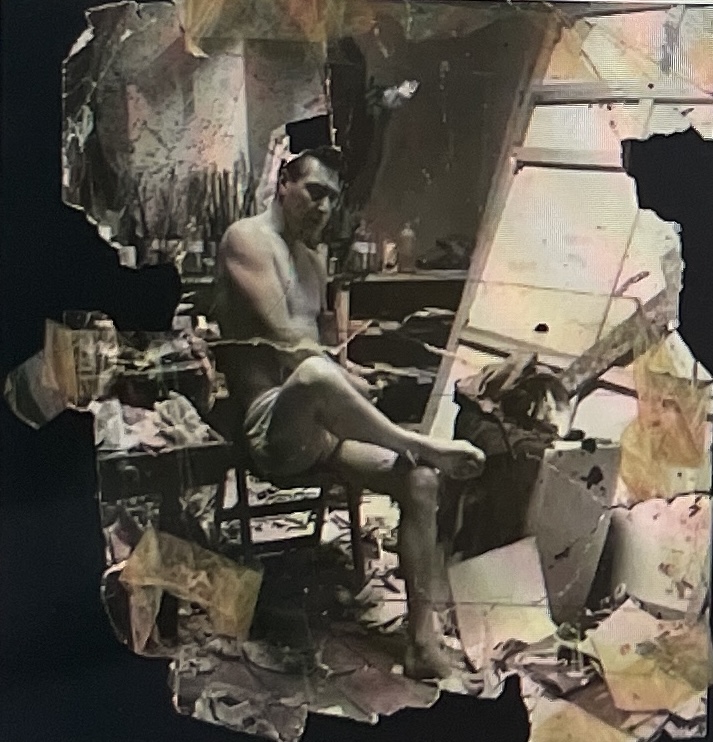
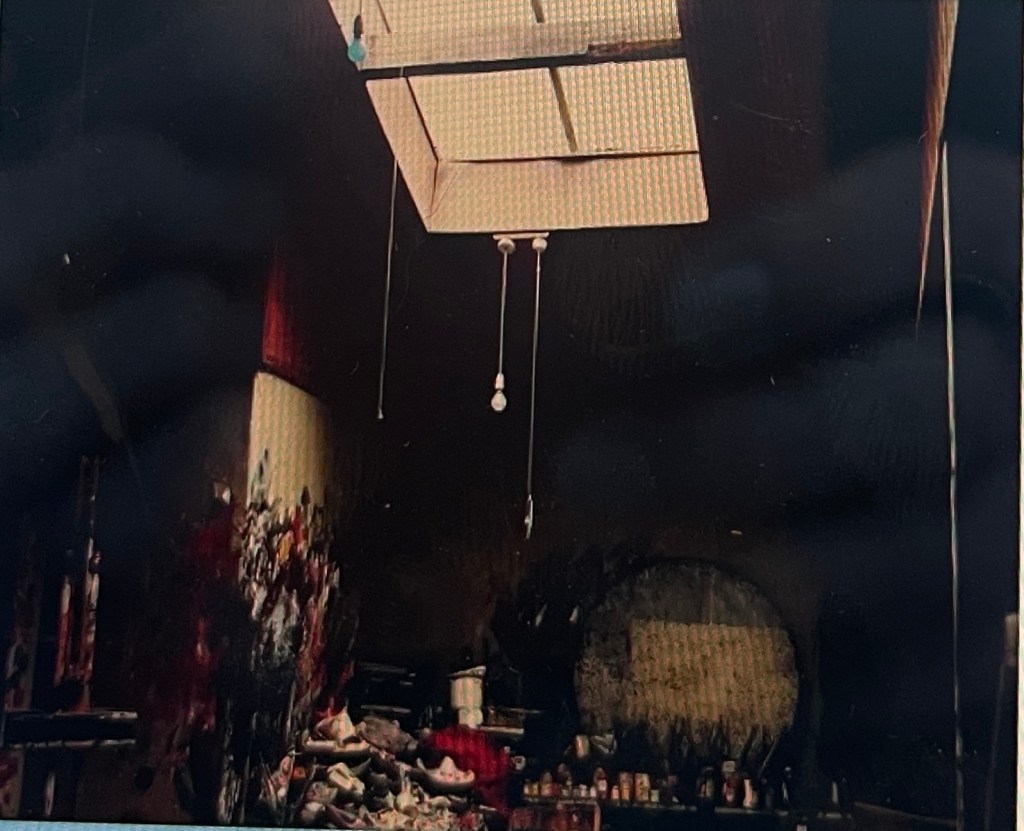
To consider an artist such as Bacon to have a pristine, soulless and organised studio would be to totally misunderstand the man and his work. A creator of disturbing and grotesque imagery that demanded attention, revulsion and admiration alike surley could only come from a an environment that equally mimicked the artists canvas.
Bacons childhood sense of displacement, his expulsion from the family home and his need for freedom of expression that was crushed by his father and needed to find a mental and physical resting place. Bacons first London studio, a ground floor apartment was also home to the illegal gambling den he set up with a former nanny. It reeks of naughty school boy antics and a sense of rebellion and disregard. His next and final studio for some 31 years became the sanctuary he craved and he thrived in It was an unnecessary harsh environment he chose to live in, despite not being short of money. His intimate studio space allowed for his liberal lifestyle, free of judgement and boundaries. The compost heap of material such as magazines, books, reference material, letters, vinyl, books, paint tubes, brushes and canvases festered in piles surrounding his cramped space metamorphosing into new provocative narratives and creative fodder. His studio was akin to a mad scientists laboratory where his creative ideas and physical outpourings festered and came to fruition uninhibited. He existed in a primal lair surrounded by what was solely important to him, his art materials and research, it seemed little else mattered.
Now a famous art attraction, his studio was meticulously moved inch by inch to Dublin. With over 7,000 items carefully catalogued with walls and ceilings removed from their original London site to their new Dublin home it is the best we can hope for to begin to understand the mind and the process of such an iconic creator. We are able to immerse ourselves in a direct copy of the studio Bacon occupied amongst the detritus that is now considered artwork in itself as is the paint splattered walls. I wonder if it is able to recreate the ‘ charged and intense ‘ atmosphere that Barbara Dawson ( Gallery Director of Hugh Lane ) spoke of when she was lucky enough to visit the original studios in London or does it sit becalmed and hollow as a shrine to the great Bacon.
Research Point :
Artists Studios
EX 1.2 Your Studio
My studio space is a sanctuary. Slightly removed from my house in a coveted garage it is a step, albeit a short one to the other me. Not the wife or mother, the daughter, the family business runner, the homemaker, the friend, but the pupil and ‘the artist’.
I can just about hear the whirr of sounds from the house, washing machine, dishwasher, the dogs, the doorbell, the telephone etc but I’m almost hiding out when I’m here, ‘out of office’ so to speak and in a cocoon of creativity. My laptop is my aid and my distraction. I pour out information into my blog, research, creative writing and degree exercises get ticked off but I also deal with the mundane school, business and life administration from this studio desk. Often getting this out of the way as early as possible upon entering the studio. I need to clear the decks before I to begin to wear the proverbial artists hat. On occasion I do fall into the online rabbit hole attracted by the shiny sparkly notices about my favourite designer shops, things to do places to see and that must have seasonal essential.
I’m usually sitting down to type on a not very comfortable cushion that I must change , but havn’t got round to, I have a thick cosy cardigan on the back of the chair as it gets chilly in here. My chair has been with me for years, an old kitchen favourite past being fashionable but its practical and a good height.
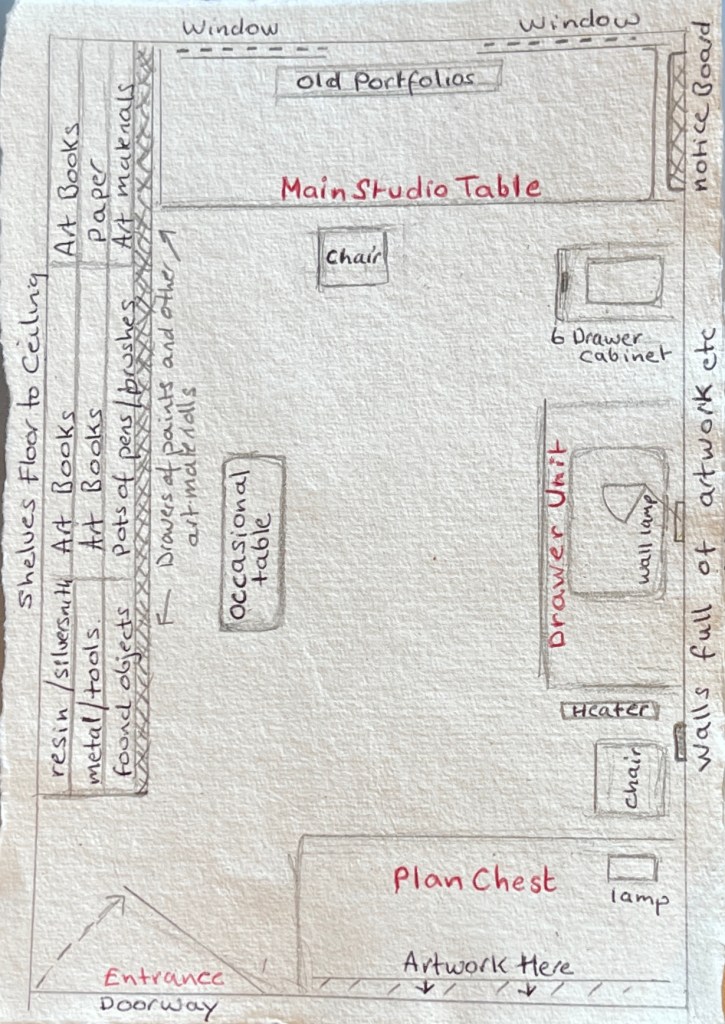
I have rearranged in here a few times, my latest addition was a much coveted plan chest. Its actually too big and I have lost some valuable working top space – but I love its warmth and history and ts beautiful patina. It makes the studio feel like a real artists studio. I use it for all my past works. On top is a collection of art I have produced, some I have bought and some are my sons from his “A’ level artwork, his gorgeous portrait of my mum takes centre stage.
The studio space is s filled with floor to ceiling shelves to my right as I stare out onto the front garden – an occasional pet rabbit hops by. On my left is a smaller work top on top of a mini modern plan chest full of research material and art props and past work.
Underneath my long trestle table are portfolios also filled with past work and a small multi – drawer tin cabinet. The top drawer of this is most important and contains a bar or two of very dark organic chocolate that anchors me here and helps me get through tired sticky, moments in artistic production.
The remaining wall space is full of old and new art, its left there as creative inspiration, as a reference plus its decorative and adds to the warmth and being of the studio. There is a lot of my own of my creations on display, some that have not come to conclusion, others experimental and unsuccessful so the studio space is very personal and I feel it is not just my art that is on display. I am very careful of who sees in here, there are some people I would never want to let in, good friends even who see another side of me. Ultimately the fear of the artist is to be judged and considered not good enough and It is this I want to protect against in this space. I expect that judgement day will have to come again if I am to put any more artwork ‘out there’. I am my own harshest critic of course.
My contents:
- A portrait of my mother by my son.
- Antique wooden watercolor box – full
- Beach art and driftwood
- Bag of wooden play blocks
- Bags of fabric
- Beach glass, box of found
- Box of found beach glass
- Boxes of poster paint
- Clay head and metal dolls mold head
- Cleaning solution
- Collection of rusted objects from the beach
- Drawer of badges
- Drawer of small costume dolls
- Drawer of small plastic toys
- Extra chair
- Flower press
- Found objects from the beach
- iPhone
- Jar of novelty erasers
- Jointed artists’ dolls (various sizes) – five
- Jointed wooden artist hand – one
- Kitchen roll
- Large jar of buttons
- Large wooden letters
- Laptop
- Mini engineers’ drawers on shelf – Full of found objects
- Mini shelving stack
- Mobile (made by me)
- Numerous black portfolios
- Old sketch books
- Old wooden small wall cupboard
- Organic dark chocolate
- Pile of old CDs
- Plan chest
- Portfolios (numerous)
- Rainbow of pencils, brushes, and mark-making tools in vintage clay jars – ten
- Random jigsaw pieces
- Reams of paper all sizes, color, and texture
- Sewing kit
- Shelves and drawers full of art materials
- Six-drawer tin unit
- Speaker
- Stained vintage linen cloths
- Tin of marbles
- Ultraviolet Lamp
- Vintage butterfly boxed frames
- Vintage Dolls heads (small)
- Vintage squash racket
- White 6-door small plan chest
- Wooden Horse object
- Wooden window frame
List of actions:
- Balancing
- Brushing
- Burning
- Cleaning
- Collecting
- Comparing
- Cutting
- Drinking
- Drawing
- Eating
- Erasing
- Guilding
- Hoovering
- Inking
- Listening
- Making
- Moulding
- Painting
- Pasting/gluing
- Pinning
- Printing
- Researching
- Rummaging
- Scraping
- Sculpting
- Sewing
- Singing
- Sitting
- Smearing
- Sorting
- Spraying
- Standing
- Stippling
- Talking
- Threading
- Typing
- Watching
- Washing
Map of Studio Space :
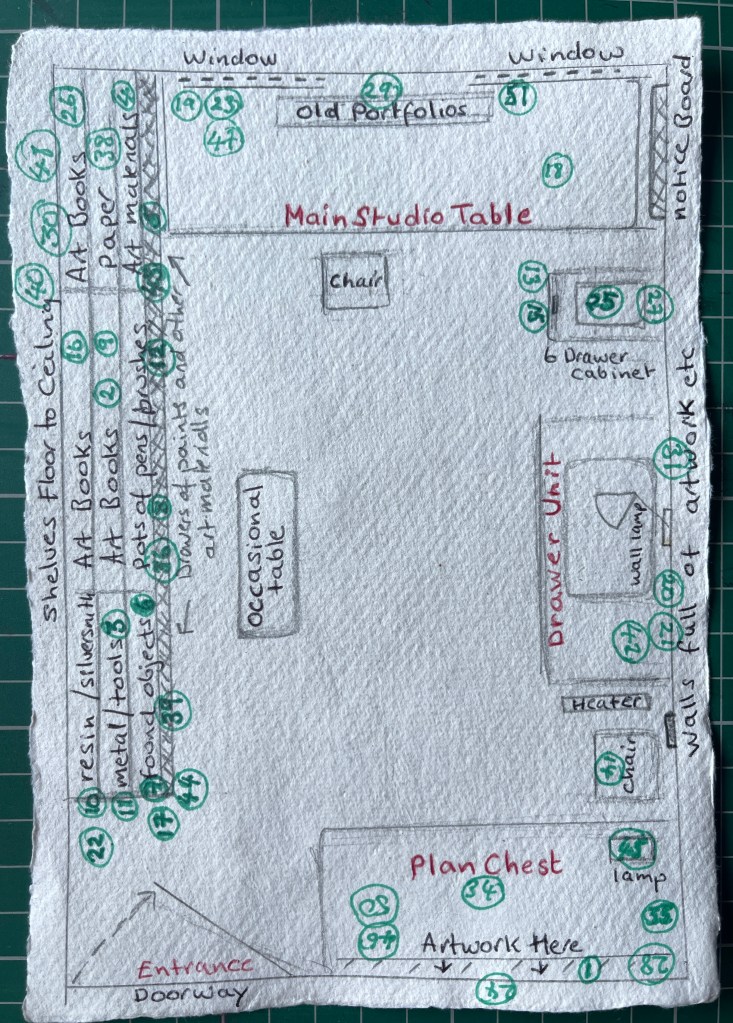
- A portrait of my mother by my son.
- Antique wooden watercolor box – full
- Beach art and driftwood
- Bag of wooden play blocks
- Bags of fabric
- Beach glass, box of found
- Box of found beach glass
- Boxes of poster paint
- Clay head and metal dolls mold head
- Cleaning solution
- Collection of rusted objects from the beach
- Drawer of badges
- Drawer of small costume dolls
- Drawer of small plastic toys
- Extra chair
- Flower press
- Found objects from the beach
- iPhone
- Jar of novelty erasers
- Jointed artists’ dolls (various sizes) – five
- Jointed wooden artist hand – one
- Kitchen roll
- Large jar of buttons
- Large wooden letters
- Laptop
- Mini engineers’ drawers on shelf – Full of found objects
- Mini shelving stack
- Mobile (made by me)
- Numerous black portfolios
- Old sketch books
- Old wooden small wall cupboard
- Organic dark chocolate
- Pile of old CDs
- Plan chest
- Portfolios (numerous)
- Rainbow of pencils, brushes, and mark-making tools in vintage clay jars – ten
- Random jigsaw pieces
- Reams of paper all sizes, color, and texture
- Sewing kit
- Shelves and drawers full of art materials
- Six-drawer tin unit
- Speaker
- Stained vintage linen cloths
- Tin of marbles
- Ultraviolet Lamp
- Vintage butterfly boxed frames
- Vintage Dolls heads (small)
- Vintage squash racket
- White 6-door small plan chest
- Wooden Horse object
- Wooden window frame
All of my work is conducted in this space. My key working times seem to be late morning through to early evening – with a low gap of productivity at about 3pm. The main areas of productivity are the large main desk across the back of the studio, this table is flooded with light from the windows, my mood board and notice board are directly to my right and papers and art materials are literally just an arm reach away – I hardly have to get off my chair. It is in this way I feel cocooned and surrounded by all I could possibly need to create. Perhaps a danger of becoming too comfortable to think about creating in another space or venue currently. In my role as a props maker, set designer I have to immediately become comfortable and competent within a new space – often a pure white photographic studio. This bleak space has to become much more than that and it is the objects or backdrops I have created that allow this transformation. When I was able to design my own studio arrangement I had a need to be surrounded by many objects and materials that evoke creativity immediately, a far cry away from the soulless studio spaces I can work within.
I rarely stand when making for myself but often will for photograph work for obvious mobility and distance. Going forward and looking at larger 3D objects I expect I will become more dynamic with my own art work. Certainly for work purposes I am very physical, crawling, kneeling climbing etc to arrange and curate objects on set. As yet most of my own work has been containable at a desk unless the exercise has demanded it. The exception is floor work is great for research, as spreading visual material onto the floor allows for a larger space to be covered and a high vantage point can be taken which can offer new possibilities of collaboration and or juxtaposition.
As yet I do not consider any space outside my studio as a hub or personal working environment and not virtually engaged in the space only physically. My own work is not currently site specific so generally I create on the basic of the work being mobile and adaptable to any viable ‘gallery’ white cube space. My considerations of work would also include the physicality of the space occupied by my work be it hanging, on a plinth, on a wall or the floor, I am aware of the practical implications of produced work in my studio. Also its potential limitations for large scale work.
More open table top space is a premium requirement in the studio as prefer to have various work in progress continually visible. It helps with the creation process and allows for creative crossover and inspiration to occur. Seeing different works, colours and objects from various projects on mass adds a new dimension of possibilities and emergence to occur. My studio is light and north facing which is ideal working conditions, an extra heater in the winter is much needed though!
Exercise 3.1 Visualising the Studio:
Below are a collection of photographs from my studio as it stands Sept. 2023.
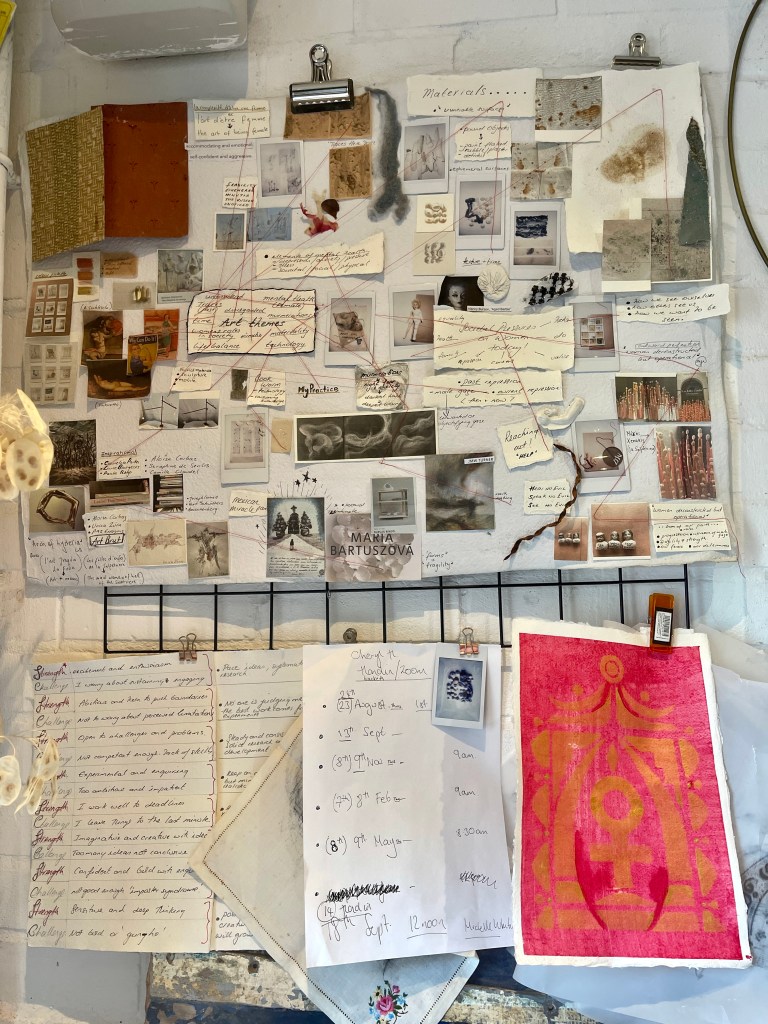
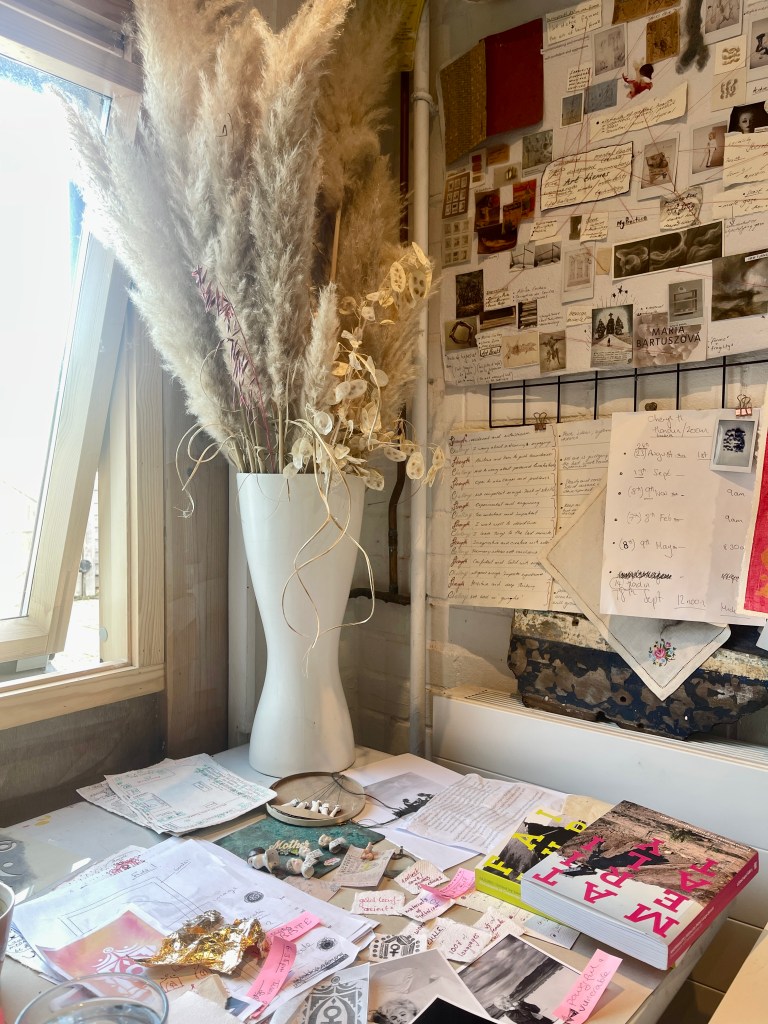
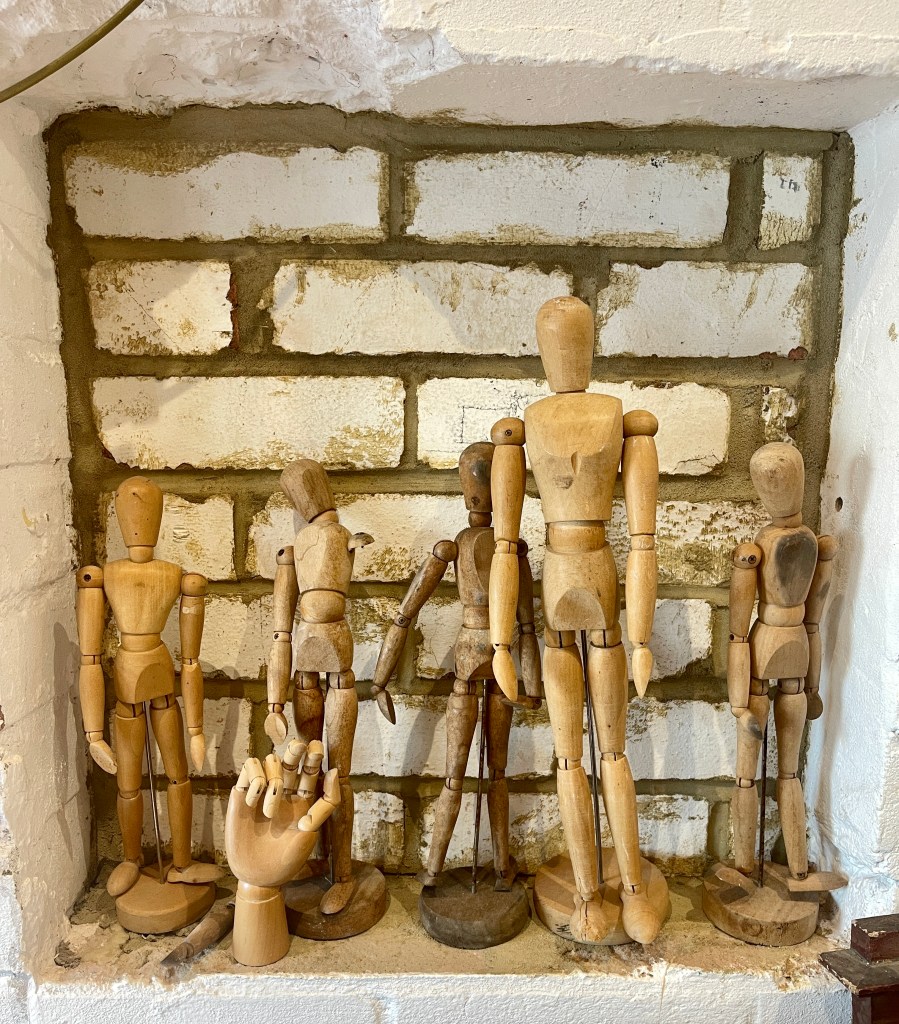
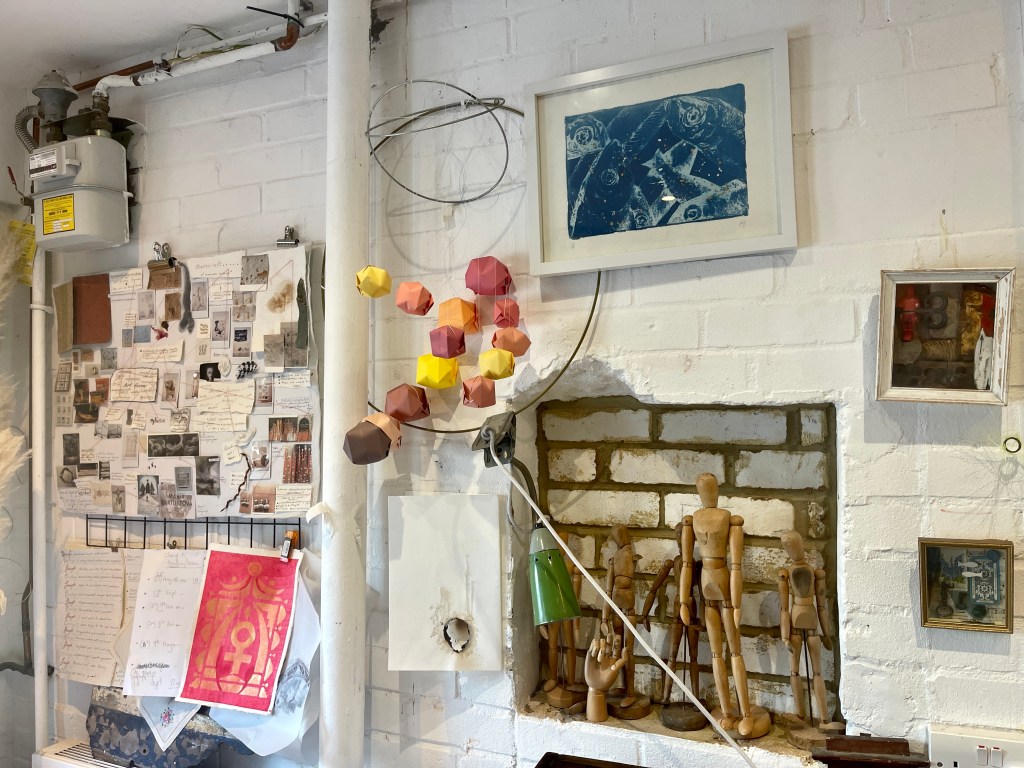
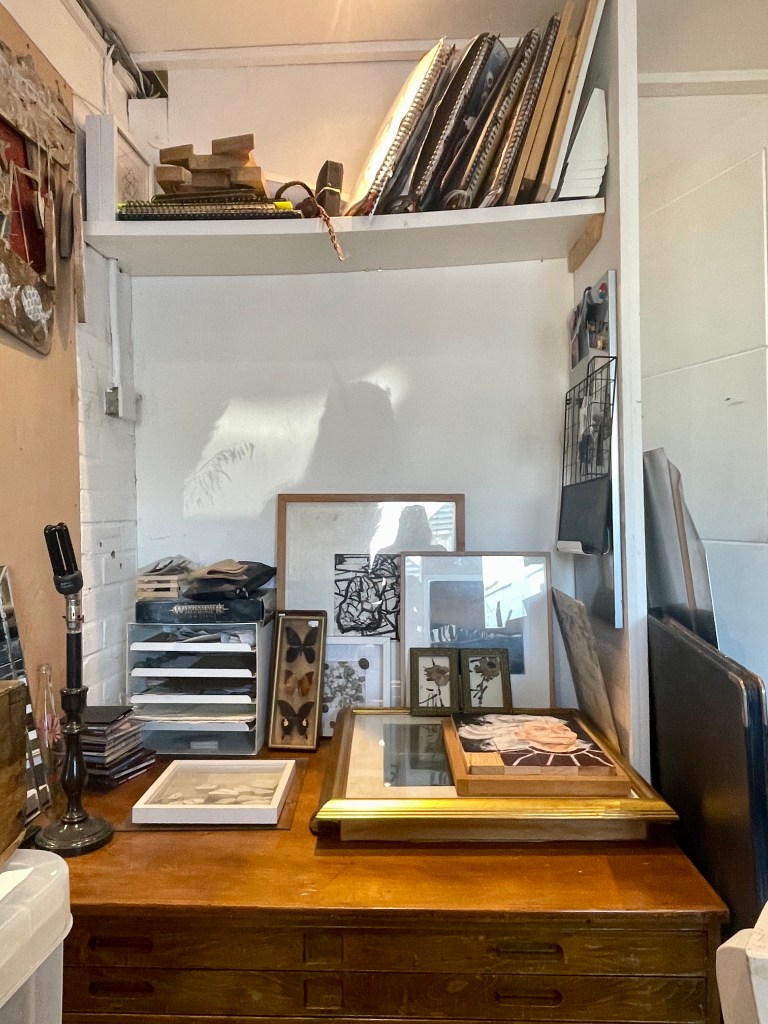
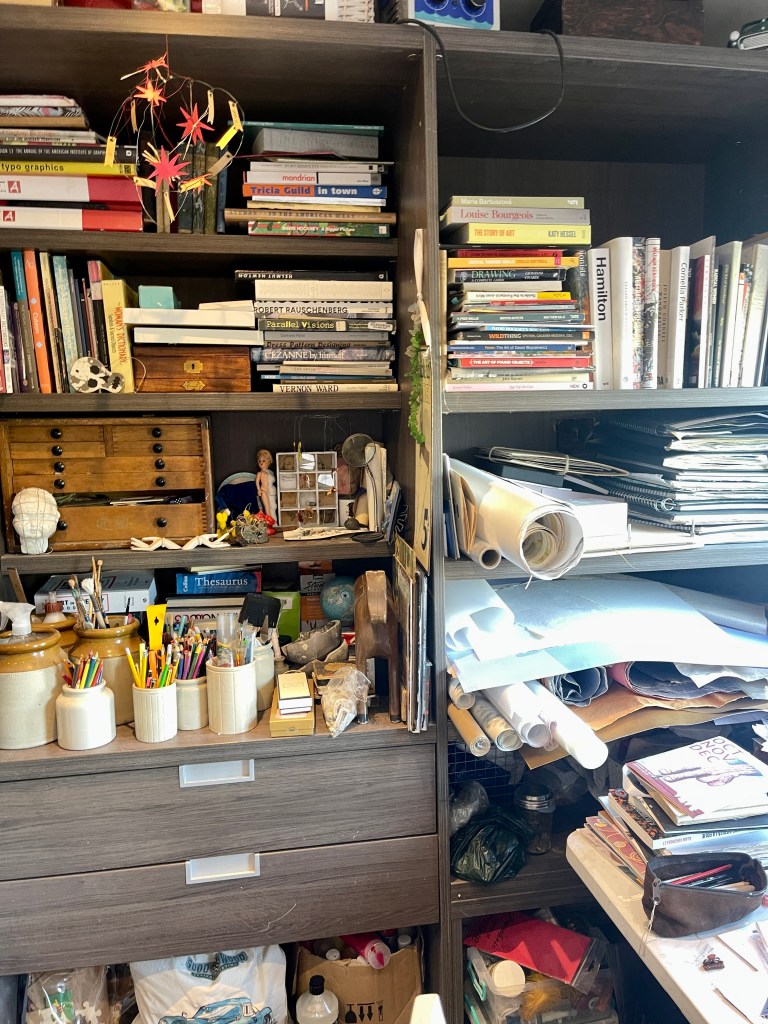
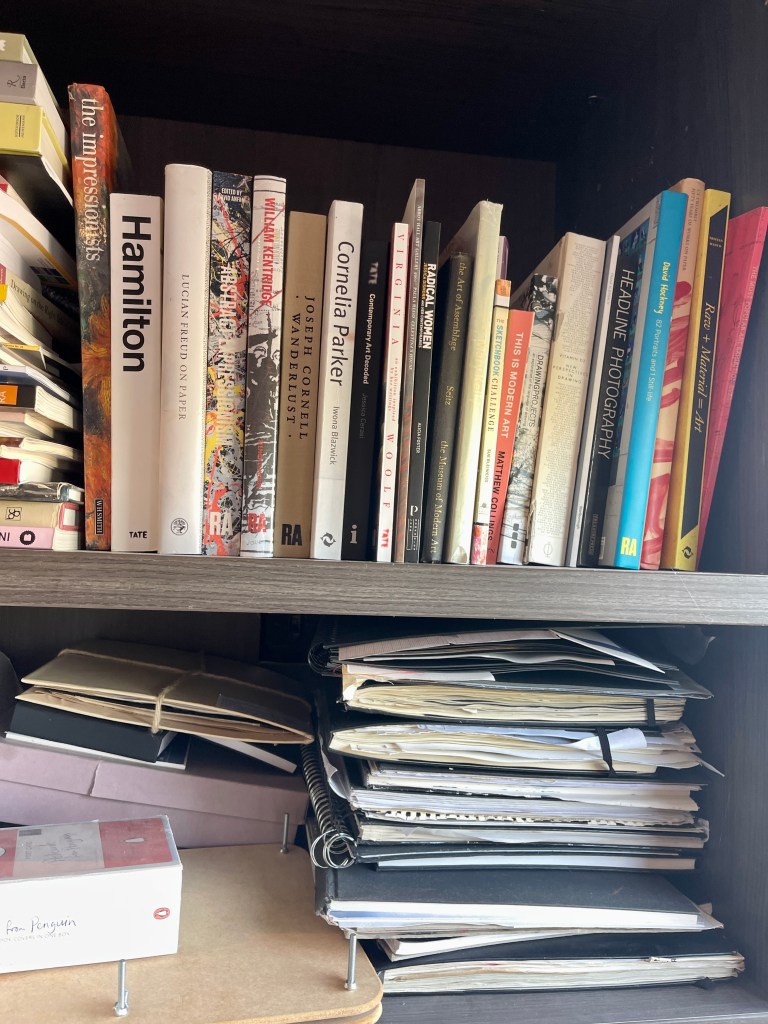
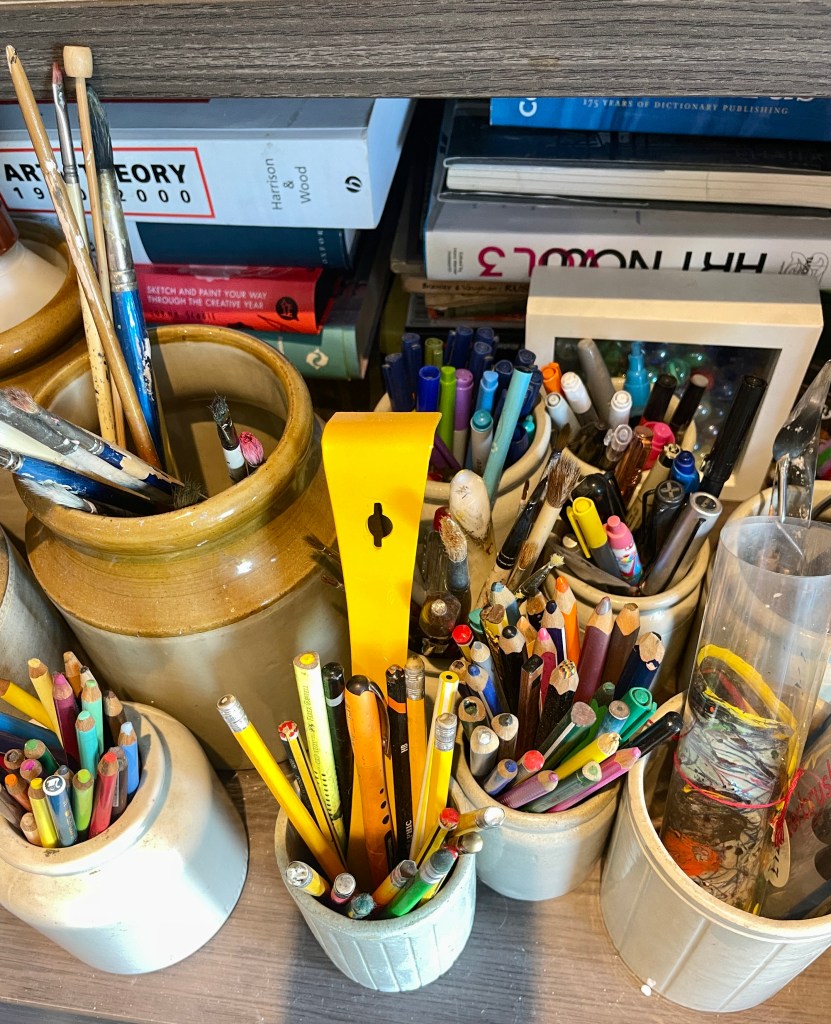
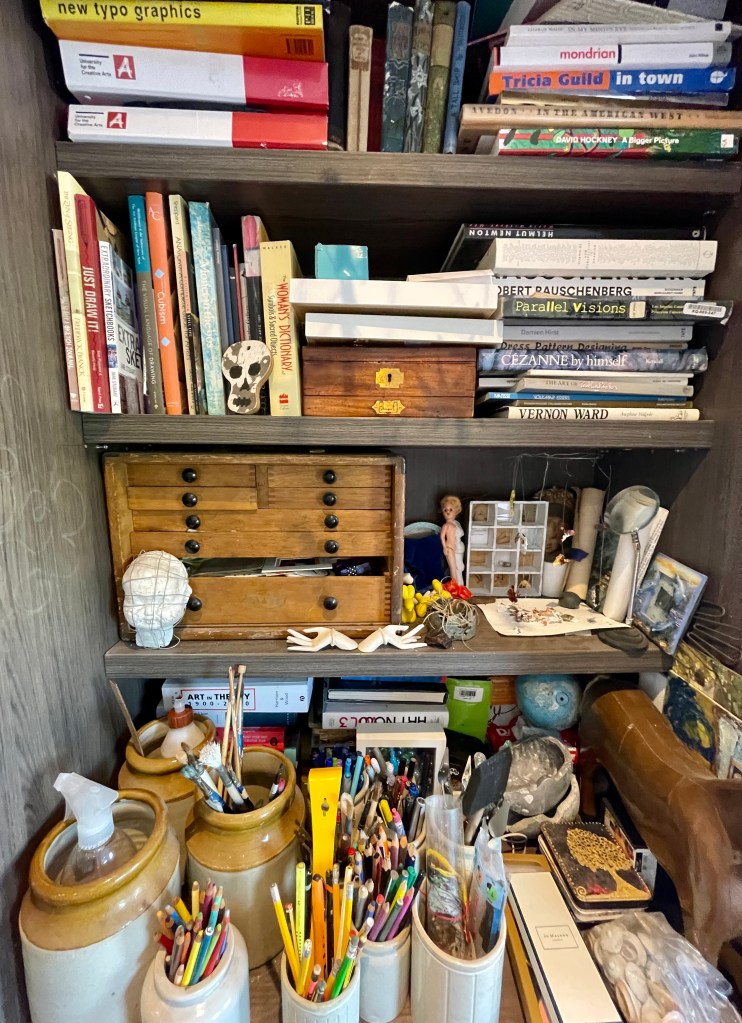
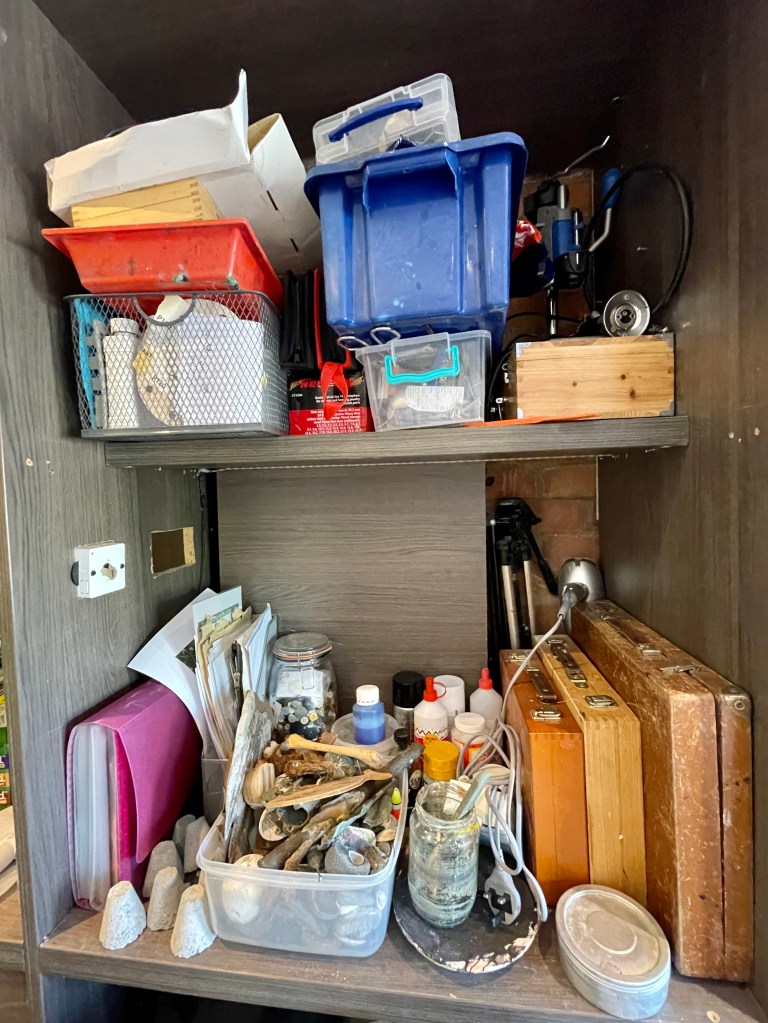
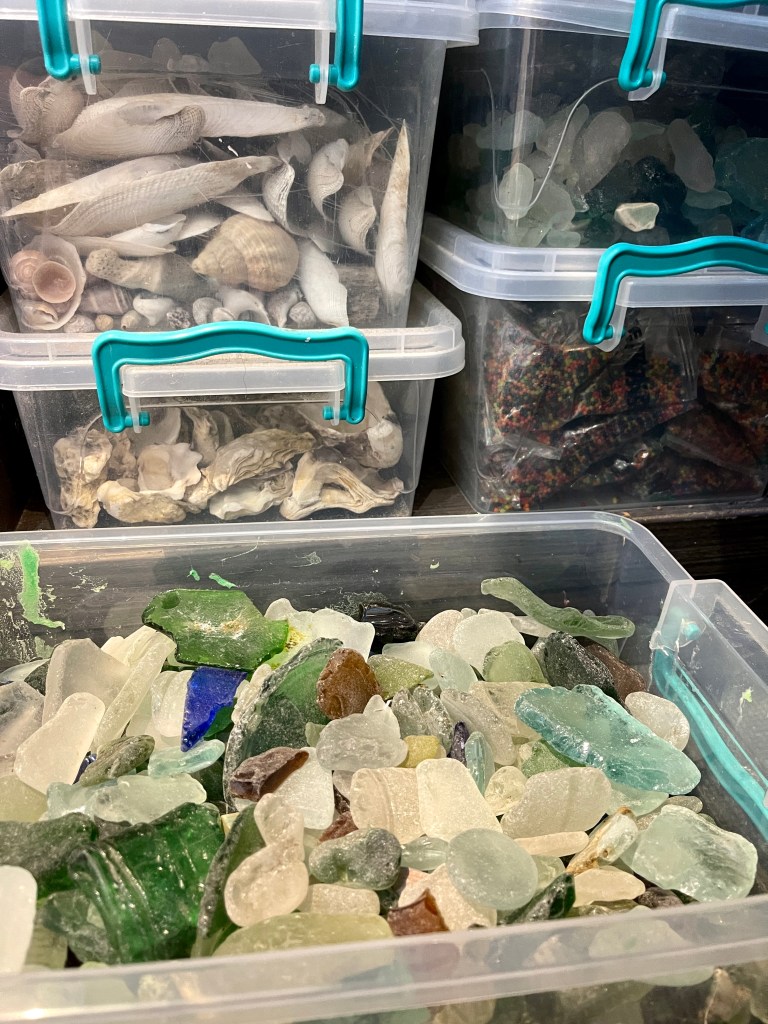
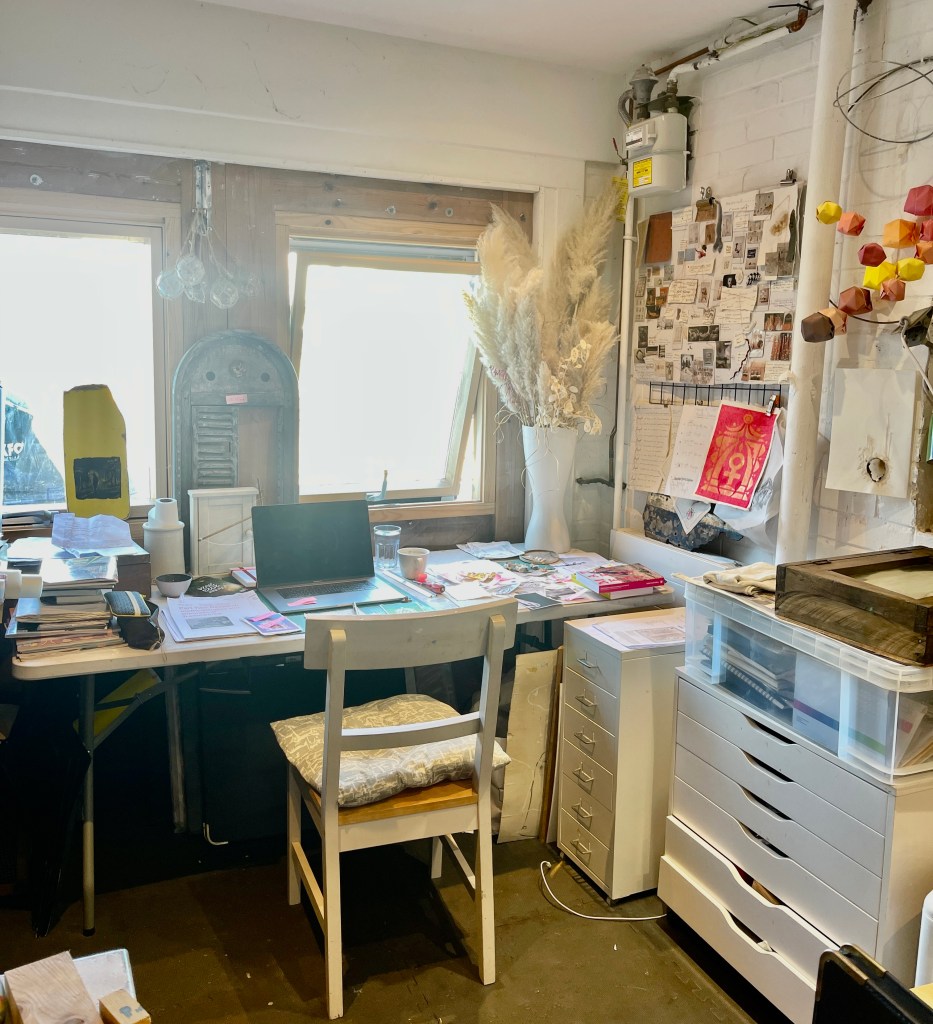
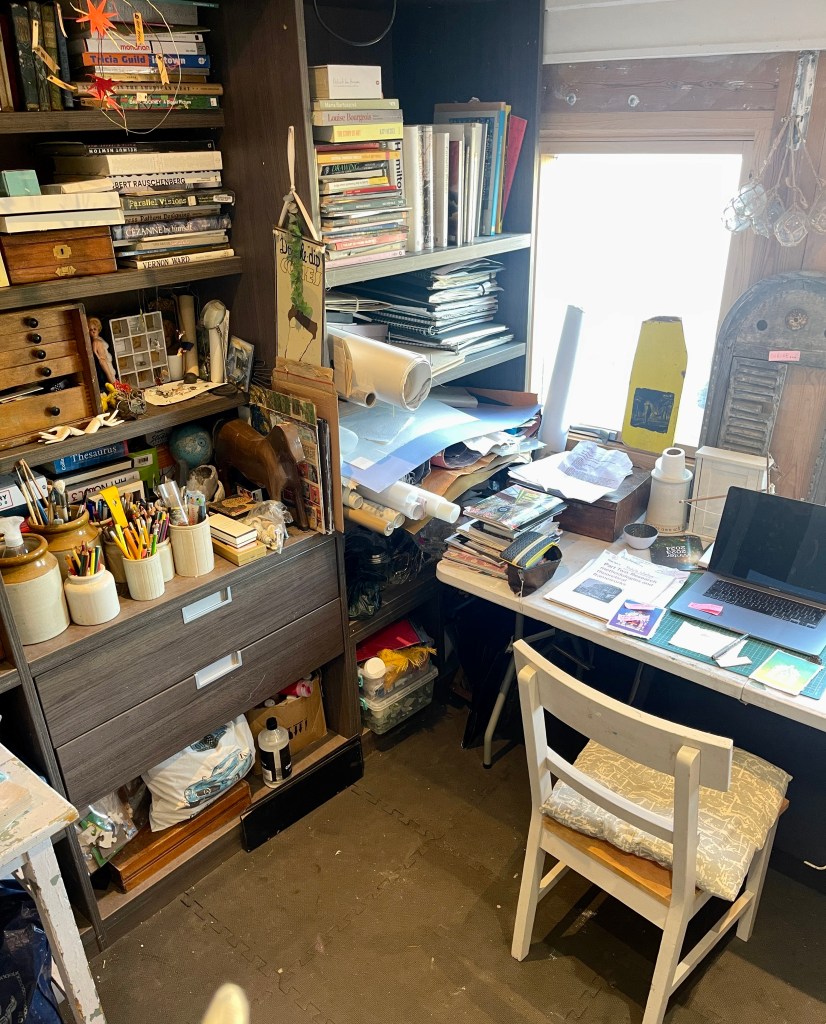
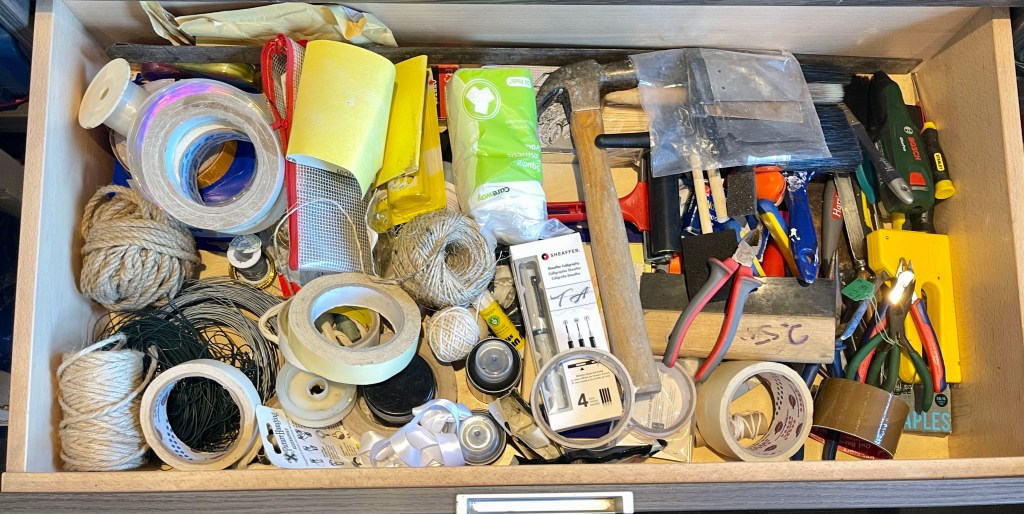
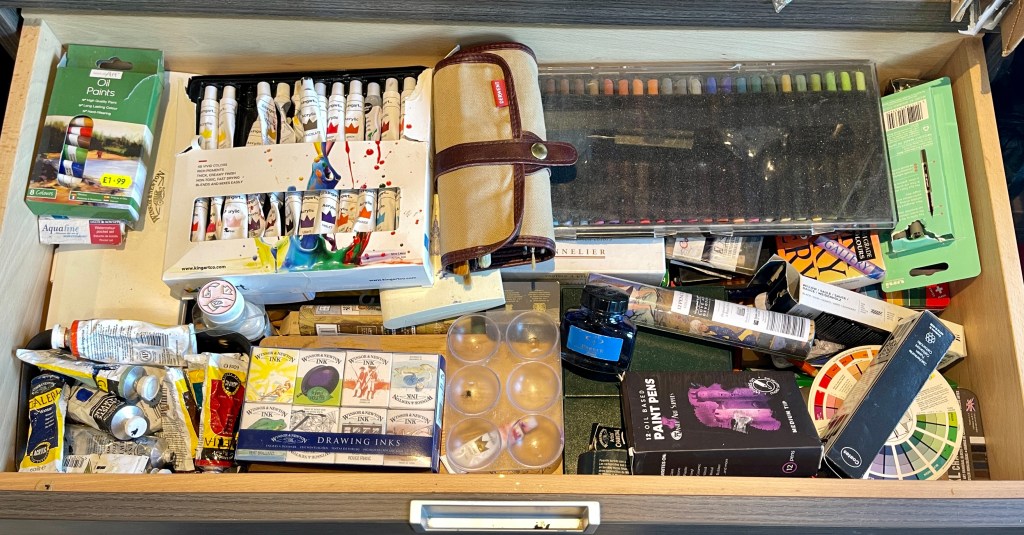
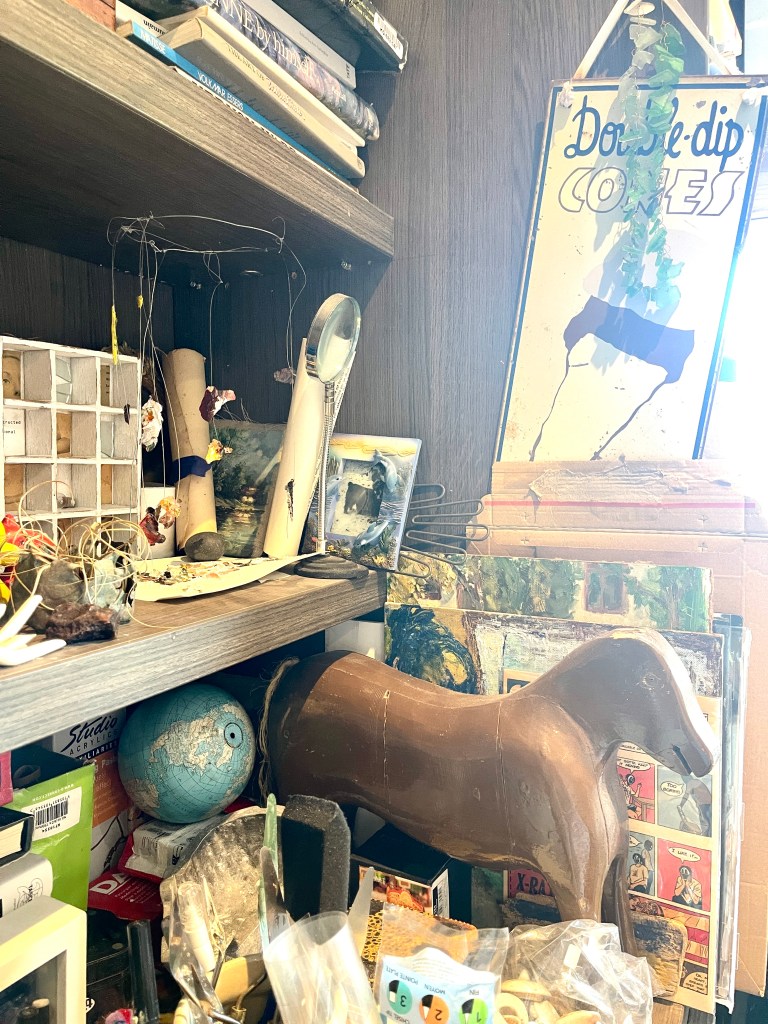
I have included pictures of open drawers and boxes to give a full view of its contents, most of which were listed.
The cocoon like feel I have of my studio space was prevalent t me in this exercise and I came up with a number of concepts to represent this;
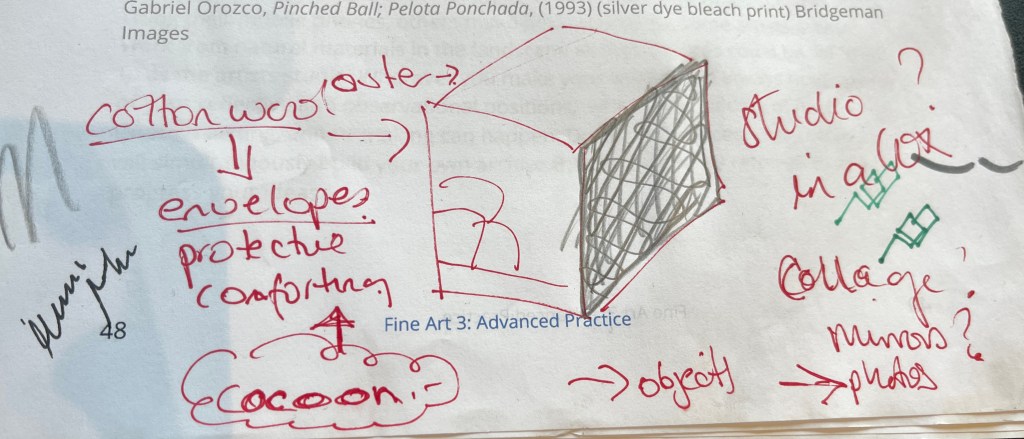
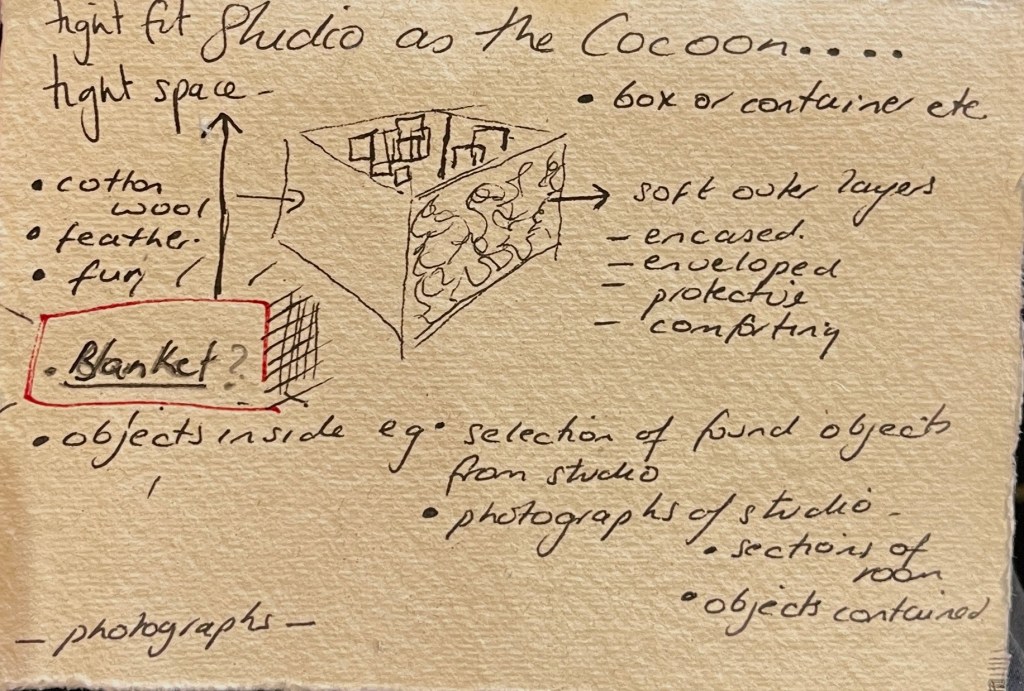
The one that seemed to most suit the visual representation of my work environment as it related to me was to include visual imagery of the studio in a ‘blanket’ TYPE format. Something that wrapped around me, comforting and tactile.
I placed the photos into a programme that generated a length of fabric with the pictures printed on them.
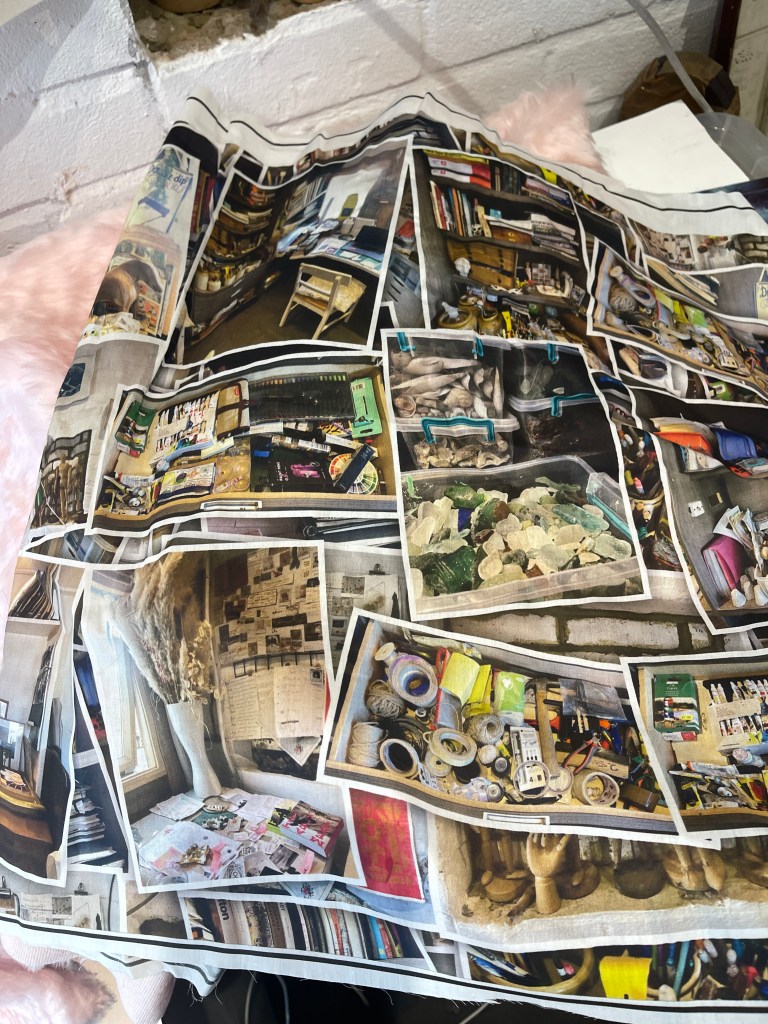
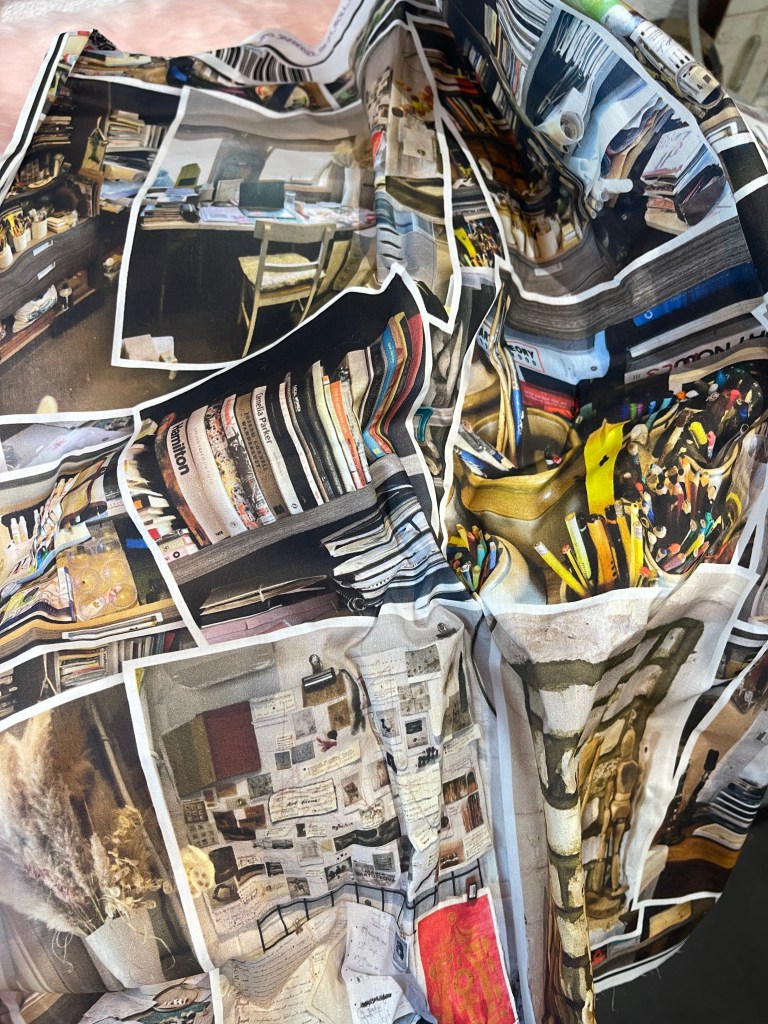
The material was jsut over a metre long and 0.5 metre wide. It was quite a thin unappealing texture so to create the sense of cocooning and warmth that I wanted to associate with my work space I order some skin pink fur to attach to the back of this to create a cosy wrap / blanket.
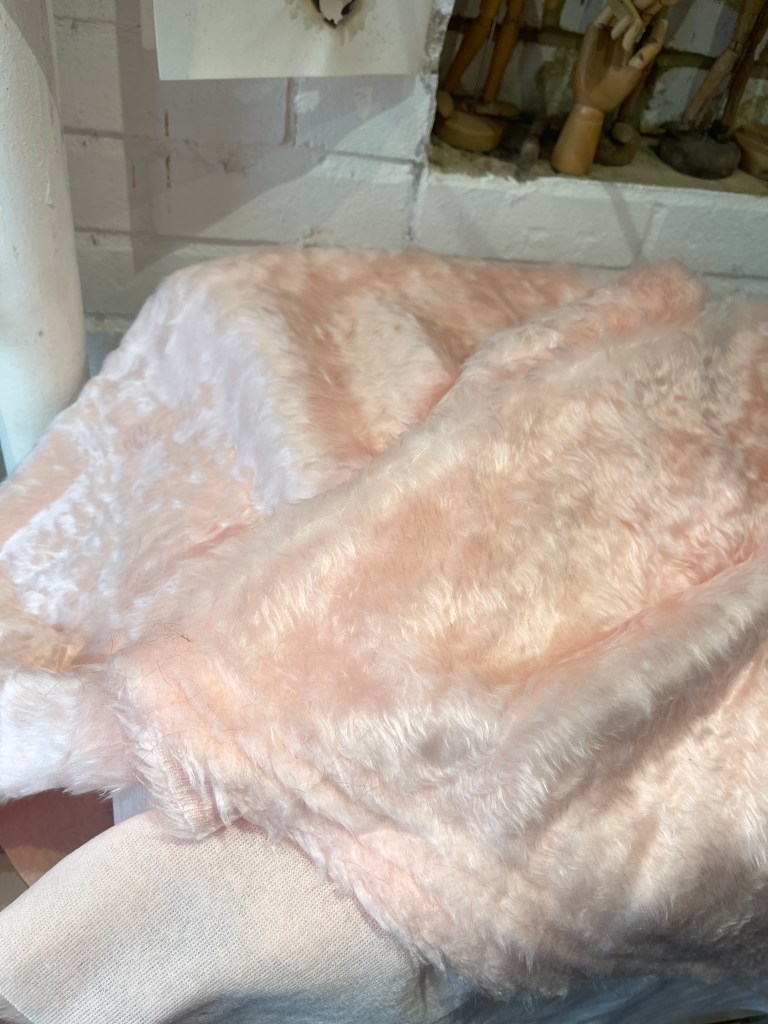
I would then sew this onto the back of the photo printed material:
Understand the complexities between what is regarded as craft and art and wanted this to remain a visual and interactive art piece and not an exploration of sewing, or other skilled practices of craftmaking. I have kept the construction very simple.
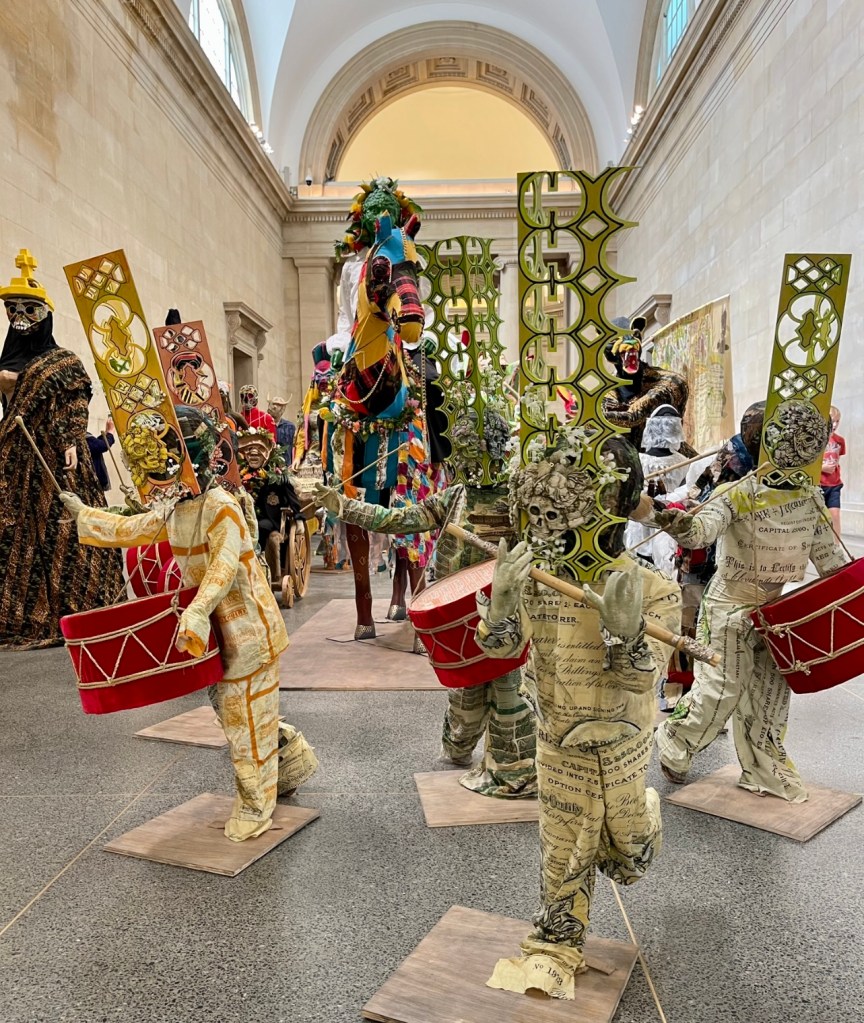
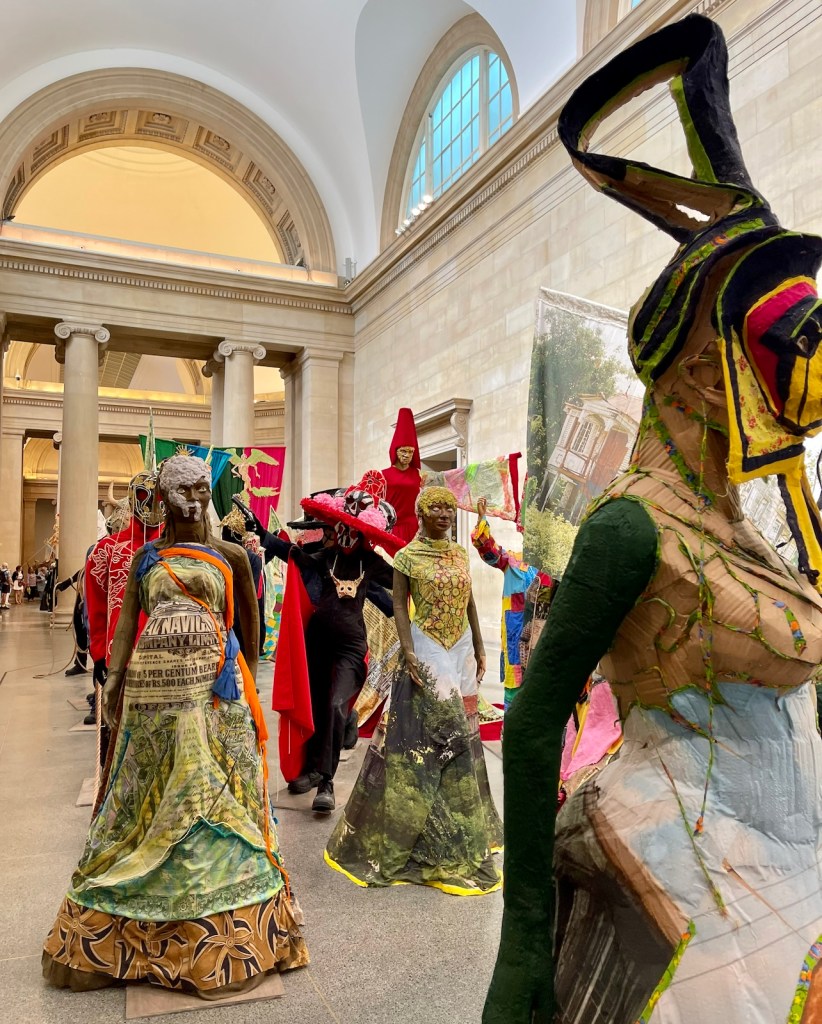
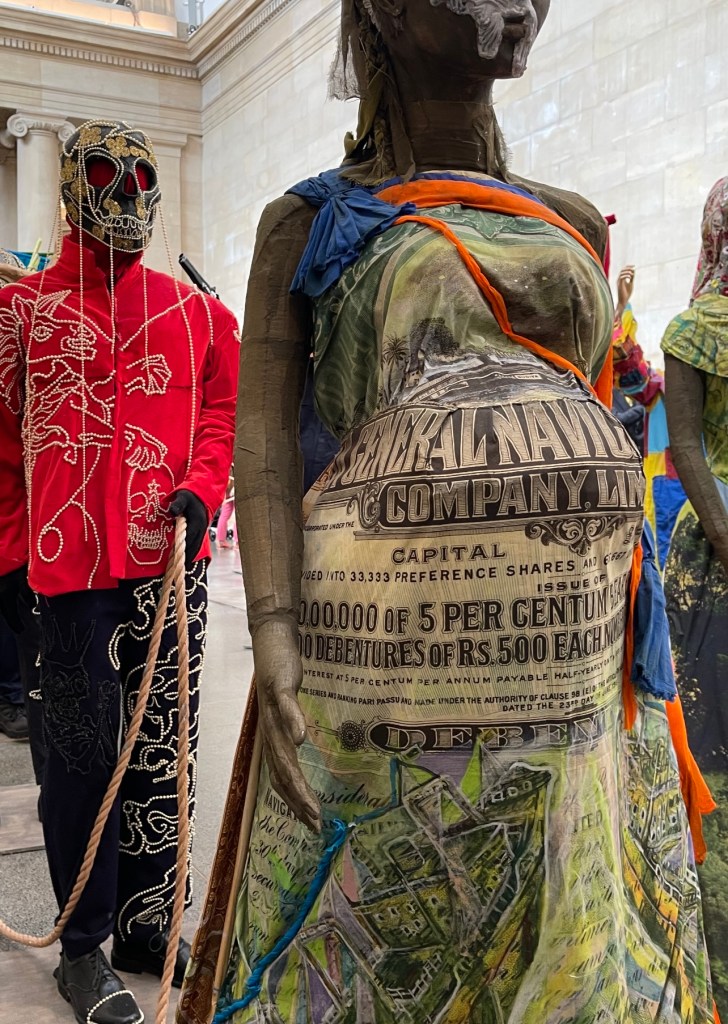
Inspired by Hew Lock and his 2022 Commission for The Tate Britain, ‘Procession’ . I was drawn to the work which embraced so many important topics such as trade, slavery, environmental disasters, monuments to empire, carnival culture and textile printing in this ebb and flow of history. This ‘extended poem’ ( Lock 2022) produced an overwhelming awareness of these topics in an animated, life sized and seemingly never ending sculpture. The printed textiles were a prominent and strong narrative. The stark and bold juxtaposition of these documents, dollar bills and bonds enveloping and shrouding the figures the depicted the people who lives were so very affected by them. Wearing these printed images seemed to bring a greater connectivity and understanding of the direct actions and narrative of their being.
‘what I try to do in my work is mix ideas of attraction and ideas of discomfort – colourful and attractive, but strangely scarily surreal at the same time’ Hew Locke 2022.
Tracy Emin’s “Everyone I have ever slept with ‘ 1993 -1995 was a seminal artwork that leapt away from a hard canvas orientated work to more tactile and engaging personal work by the artist. The pure materiality of the piece creating a softer and relatable object in a cocoon like environment inside the seemingly very private and beautifully decorated interior. Again I was drawn to the enveloping and immersive aspect of this work, more powerful as it would some how surround and overtake you if you stepped inside.
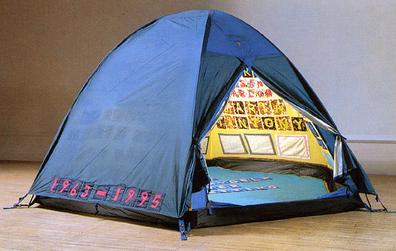
Tracy Emin. ‘Everyone I have ever slept with ‘ (1993 -1995 )
My final piece here is less dramatic in narrative to Locke or Emin but I do take from these works a sense of the fabric as a key and specific source of engagement and recognise its potential for its narrative of intimate materiality. Closeness to the skin, it surrounding you wearing you brings a deeper contact and relatability as opposed to just viewing it on a wall.
I like to have my studio work and its objects contained within close to hand – plus a sense of privacy and the personal. The synchronicity of objects and materials is more apparent and the opportunity for chance relationship and ideas are more likely to arise.
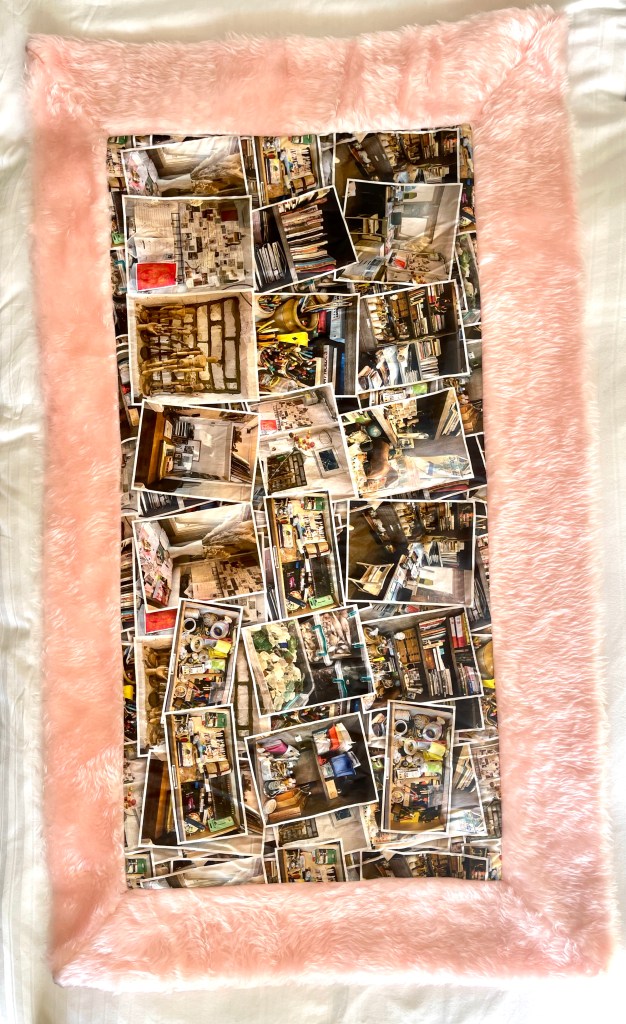
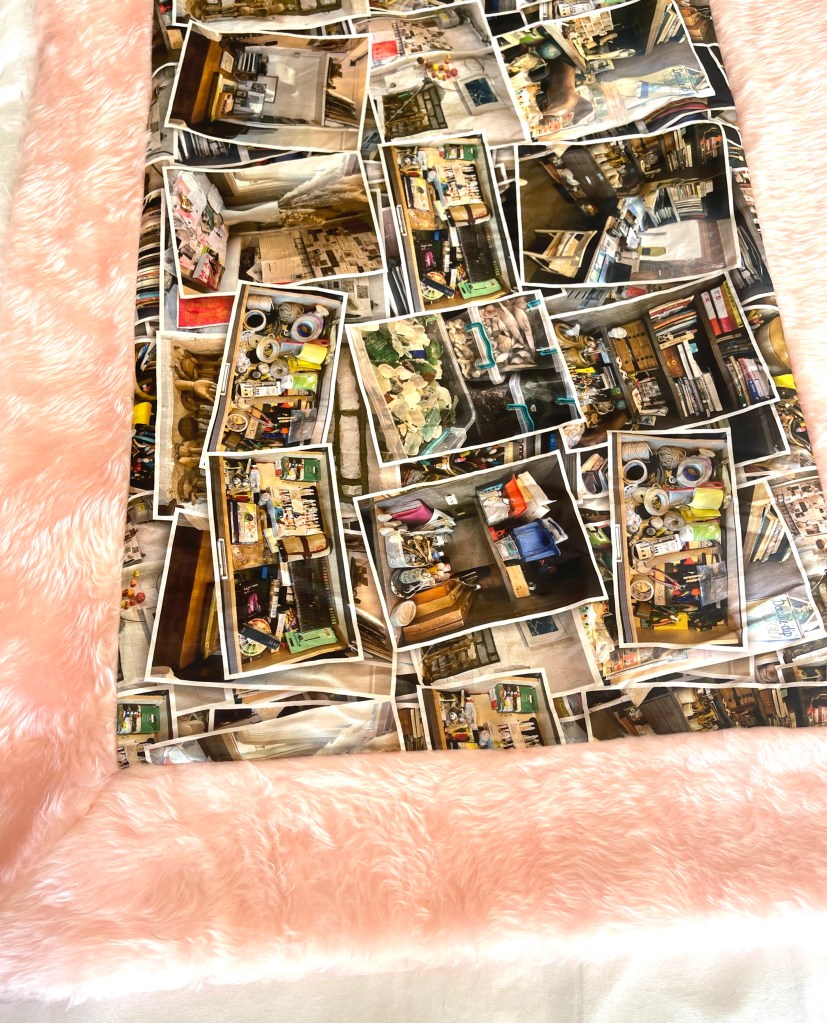
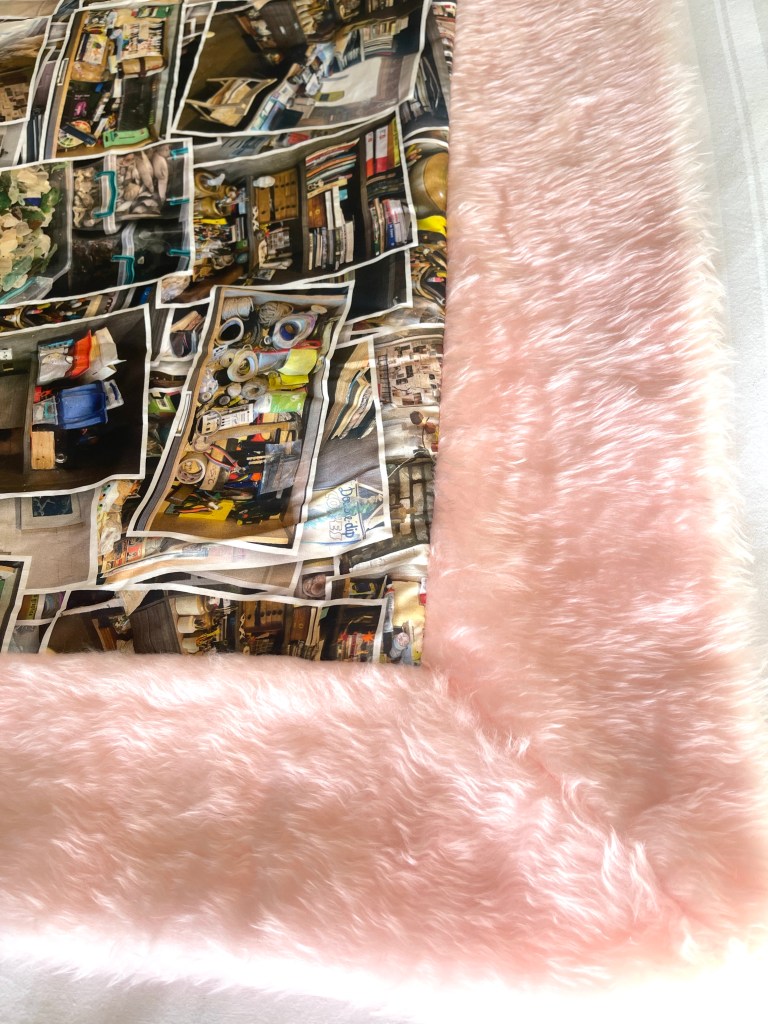
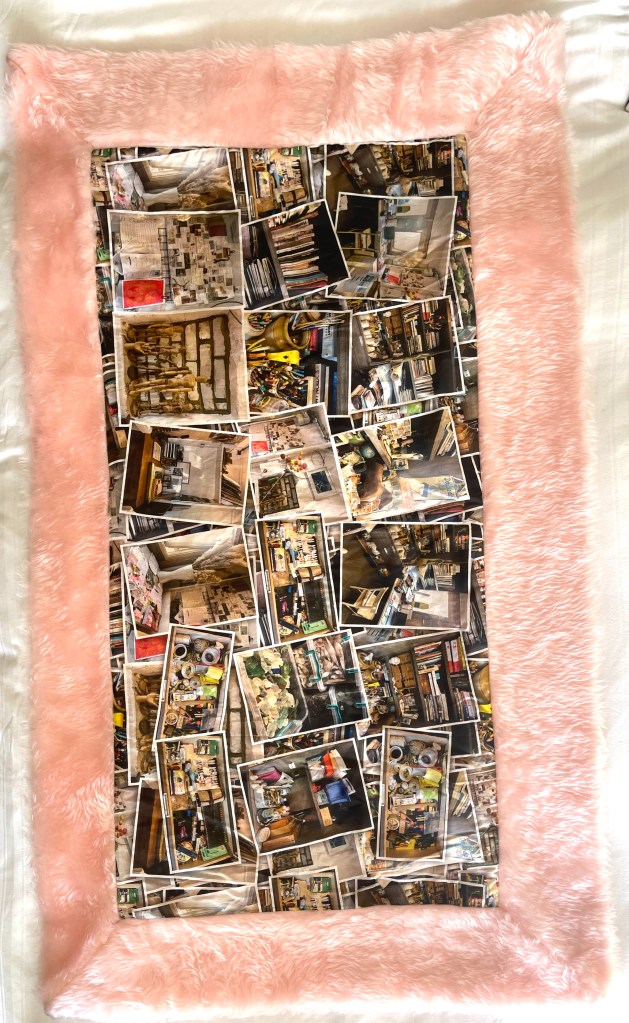
‘Creative Hug’
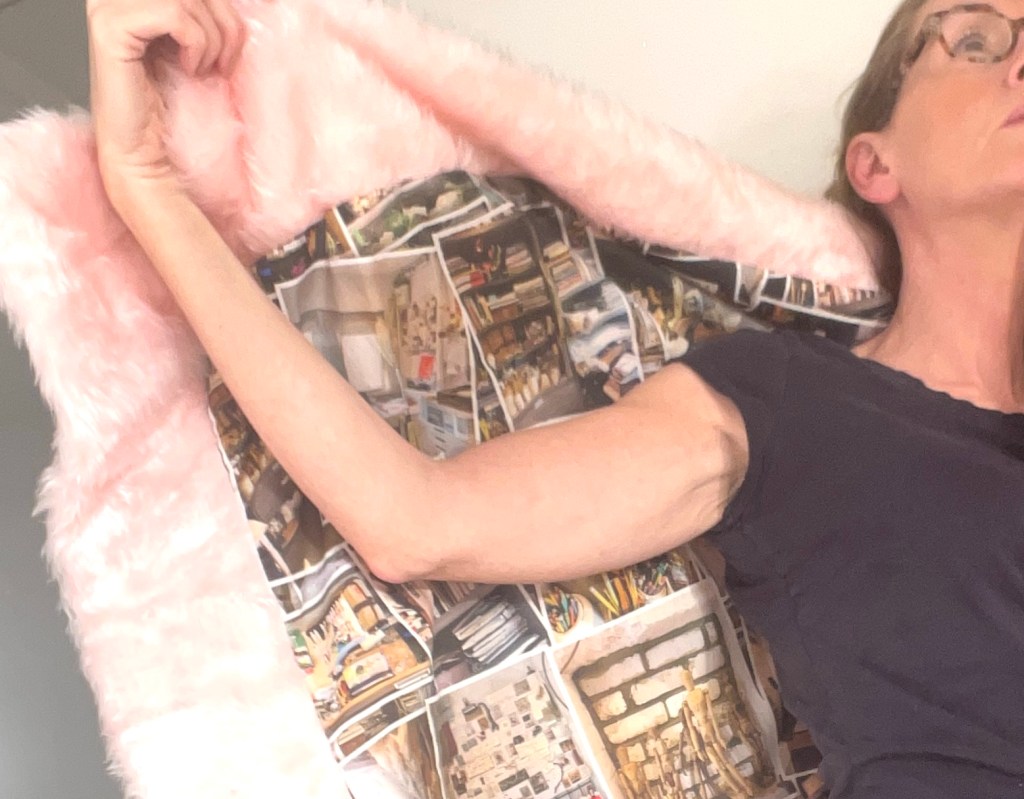
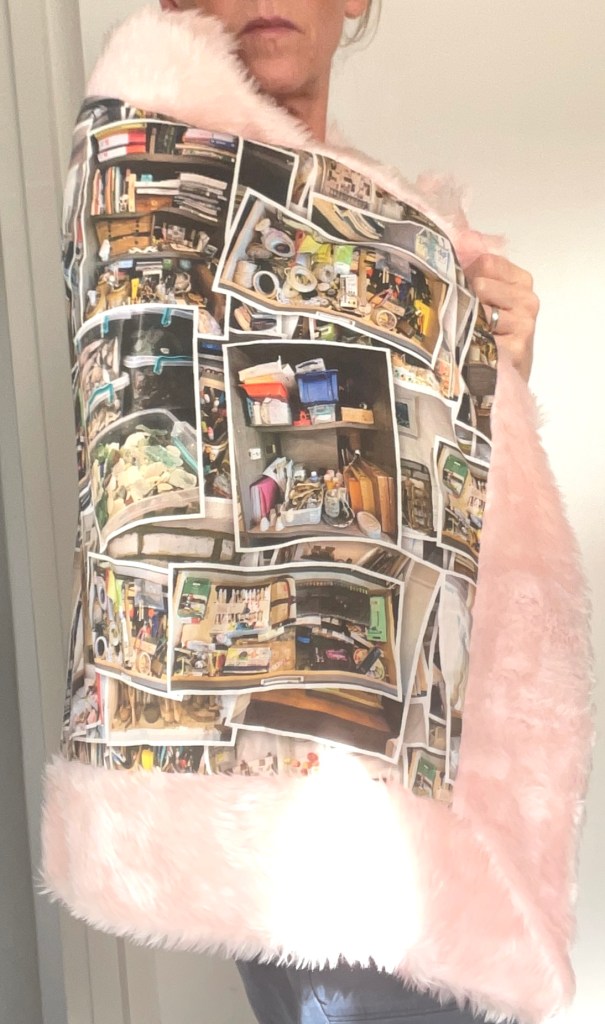
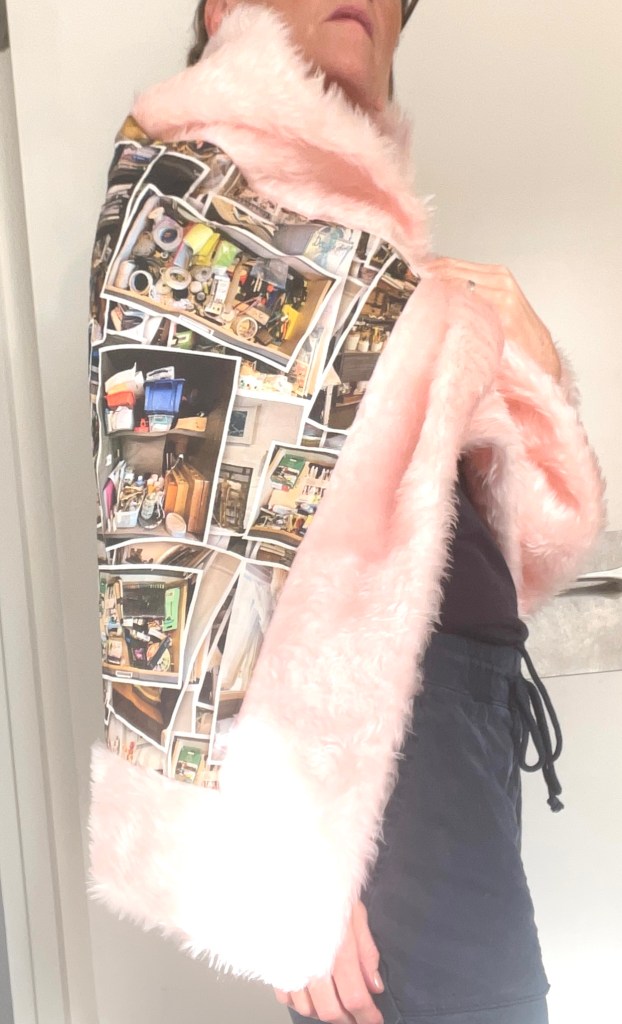
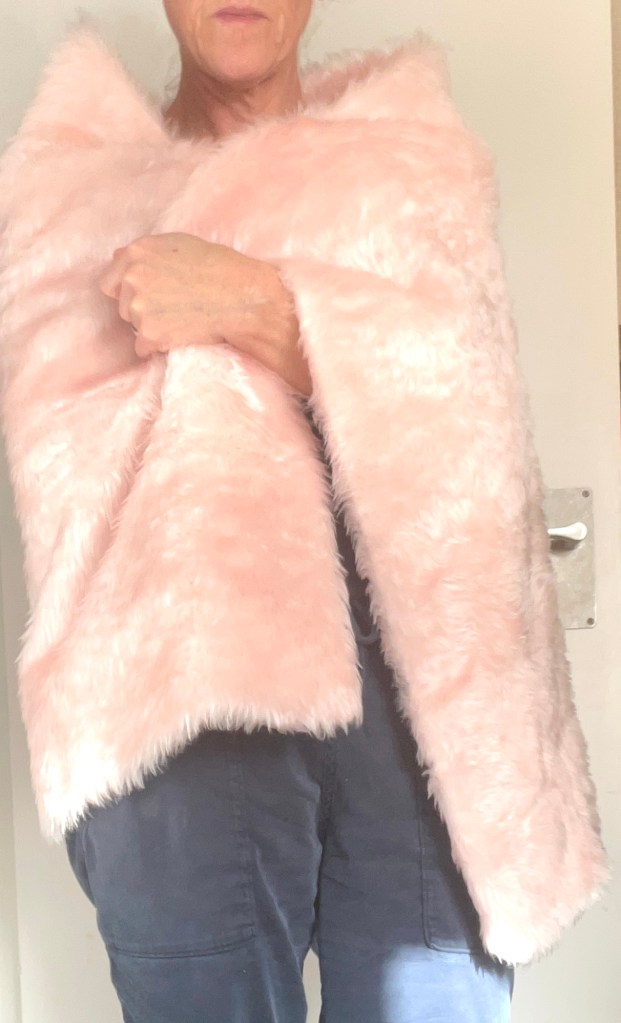
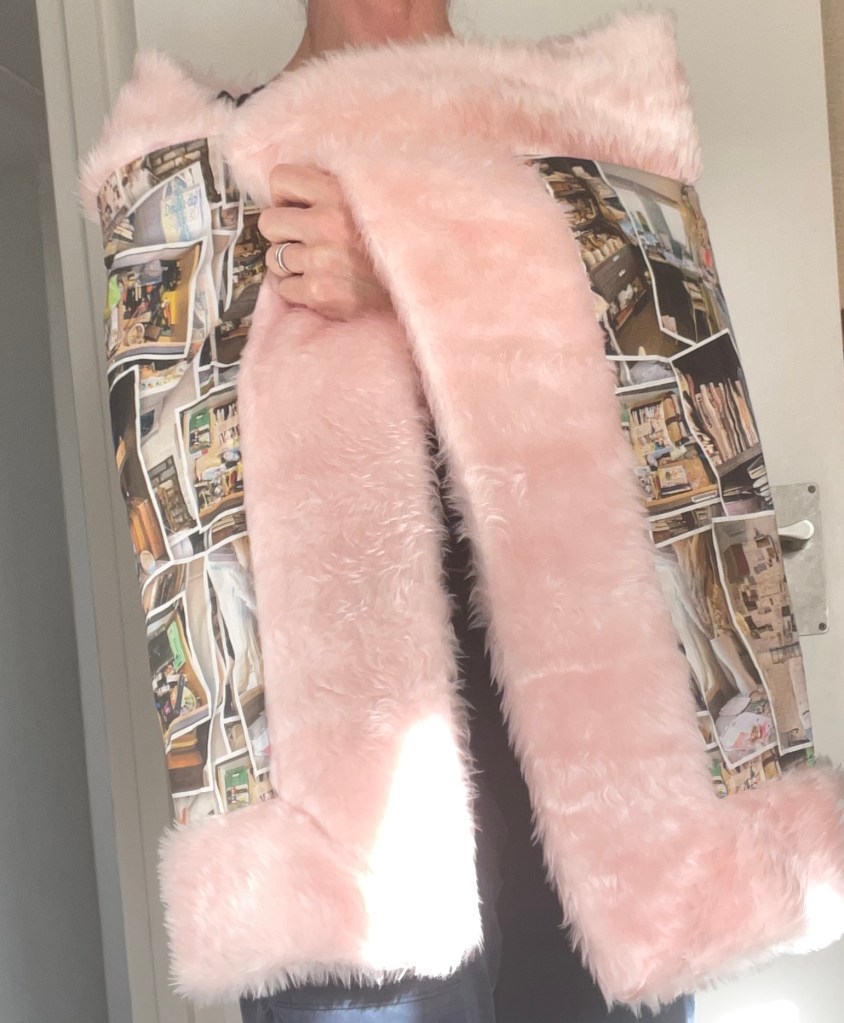
Wearing this work I hope a person would feel a sense of warmth, comfort and some joy, (maybe smiling at wearing a fluffy pink fur stole !) I would like the wearer to have a glimpse into some of the emotions I might feel when working in my studio. Visually they could also explore the intimate space and the cramped conditions of my creative environment viewing the collection of pictures on the inside of the piece. It is an interactive piece that I will leave in my chilly studio for visitors to wear should they wish.
Ex 1.4:
Reading Point:
‘Leftovers come to stand not for what once has been but what will be.‘ – this quote by Briony Fer ( The Scatter: Sculpture as Leftover//2005op. cit., 75-6.) did resonate strongly with me as seek out the discarded and lost objects as a starting point for narratives of the past and human interaction and society. I have always been intrigued by human debris and our throw away society a a key part to establishing our psyche. and Anthropocene.
Orozco’s work was familiar to me and much admired, allowing objects and their relationships to each other to become apparent over time. A chance encounter that becomes the beginning of a new work, with stark juxtaposition or harmonious joining physically or spatially. It is for this reason I chose to work in a studio full of ‘ things’ to allow for unexpected inspiration and narrative.
It is in long periods of inaction or lack of inspiration that the studio should resonate with a hum of creativity, albeit low level, in a way a stark and empty space will be too quiet and still. Naumans video diary of his studio at night illustrates his integral need to keep working and producing using the very essence of his studio to create a disorientated quiet and sensitive narrative. In conversation with curator Michael Auping below:
‘I guess it’s late work. I hope it’s not too late. Maybe in the sense that there’s ten years of stuff around the studio and I’m using the leftovers, but I’ve always tended to do that anyway. Pieces that don’t work out generally get made into something else. This is just another instance of using what’s already there.’ .
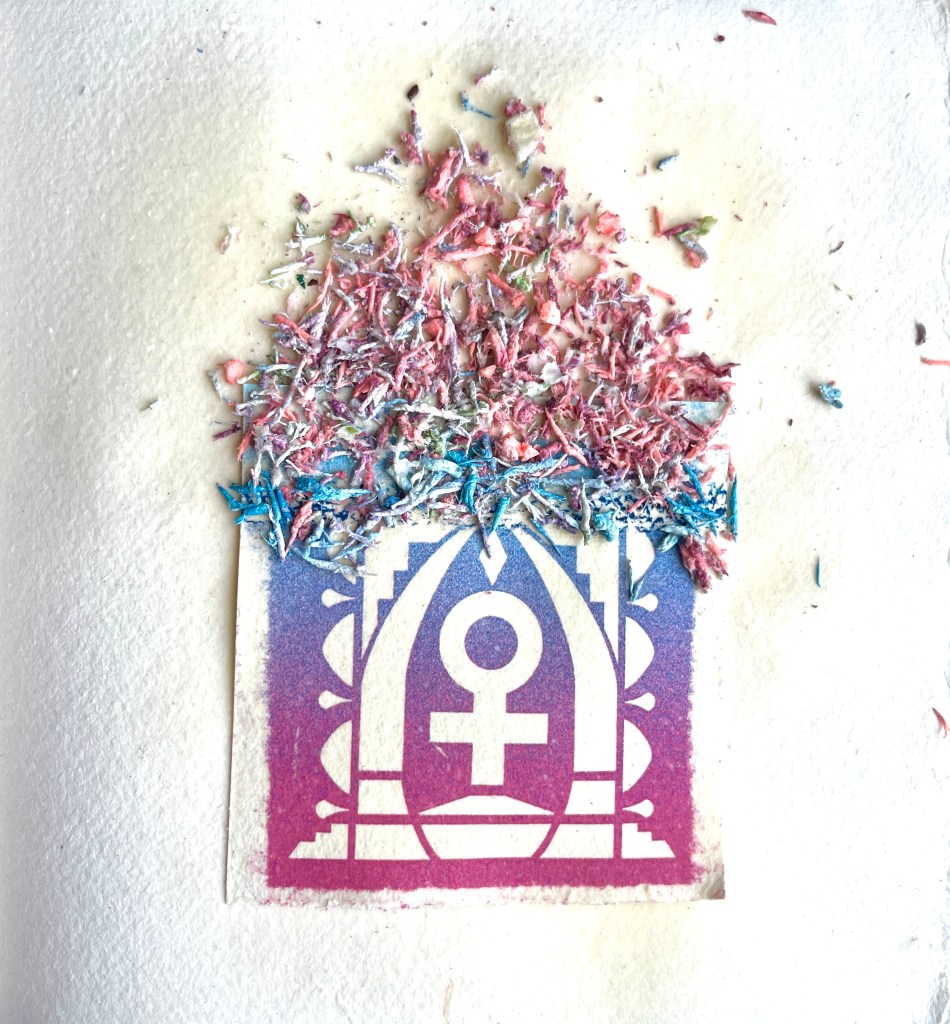
Using some of my studio waste material I begin to explore ways this may be part of my current work.
Using the debris from the studio:
Picking out a piece of paper from the rubbish I remembered I had wrapped up a mass of erasure pieces, the remnants produced from some active rubbing-out. I took these colourful pieces and arranged them over the top of my work on ‘Shrine to Female’ This image now appears on the one hand to be morphing, disconnecting and breaking down. Looked at another way it can be seen as the process of the creation of the image. Like a mass of pixels coming together to form the image below them. The narrative has expanded from a semiotic image to one of open question and origin…..
Research Point :
Rachel Whiteread: Drawing
Whiteread’s process of drawing is integral to her thinking and creation process and are a way of working through her initial ideas to a more comprehensive conclusion.
They have been become like a diary entry for her, documenting her concerns and process. Whiteread also expresses that it is an enjoyable way to think and pass time.
Apart from the physical act of drawing Whiteread also counts her collected items and found objects as drawing.
…’ They’re as much drawings, for me, as the drawings themselves, and they’re related to casting and they’re sometimes related to domesticity – they’re a little bit of everything.’
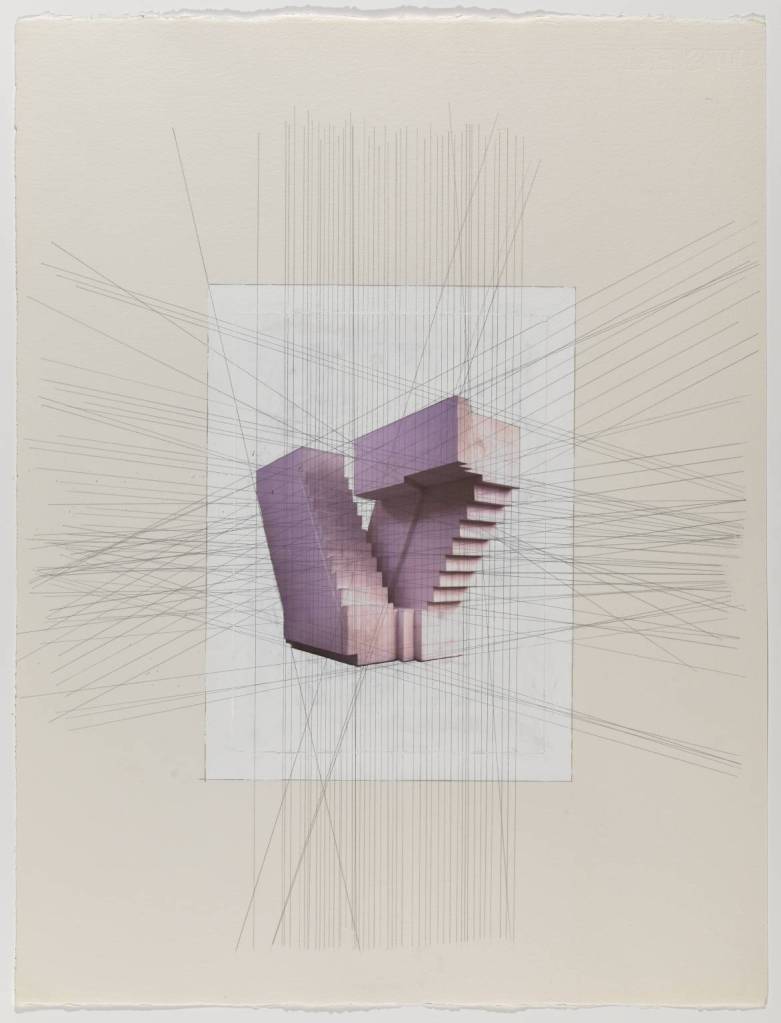
Like Whiteread, I find my collection of objects in some way encompass an idea or even an unidentifiable concern that might resonates with a project or process that I will go onto explore in the future. They are both inspiration and documentation at the same time. I am always happy to receive or find these objects personally, they all have the potential to open doors to a wider concern or idea albeit widely different.
Pure drawing ( pen/pencil on paper ) has no found narrative, the process of the ‘thinking through’ an idea and its proceeding exploration comes from within, where as an object offers inspiration and an existing narrative and history. Using both methods to define, consider and ultimately find a conclusion or resolution would seem to hold the most potential.
Damien Hirst’s has multiple collections, skulls, tropical birds and enthomological cabinet created in 2013 that is methodically lined with insects.
“I think of a collection as being like a map of a person’s life,” He says.
This I must agree with. Although not everyone collects, which in itself is fascinating as I would personally find it incredibly difficult not to acquire a range of inspiring, wonderous and intriguing objects, often at little or no cost. Personally it seems inherent, culturally and perhaps ethically important to do so. The mind of the non collector would seem lacking and empty to me.
Hirst goes onto explain
“Like the flotsam and jetsam washed up on the beach of somebody’s existence.’
A collection can be a deeply personal expose of inner thoughts, feelings and interests and some are hidden away for good reason. While others are exposed and immediately visible. The person behind the collection has curated their own intimate art work, a life time of collecting is a biography of that persons life, a casual archive of their existence over the years perhaps.
Hirst has created numerous works using the theme of curation and collection: from the late 1980’s and 1990’s he produced a series of cabinet pieces where collection of objects were paced in museum like vitrines.
He has said: ‘I like ideas of trying to understand the world by taking things out of the world. You kill things to look at them.’ (Quoted in Morgan, p.24.)
The collections although not his own personal belongings are a comment on visual, aesthetic and scientific dilemmas. Removing items from their naturel environment, ending the life for artistic or scientific,purpose in the case of his ‘Forms Without Life’ 1991, ‘Life without you’ 1991 and Isolated Elements Swimming in the Same Direction for the Purpose of Understanding 1991.
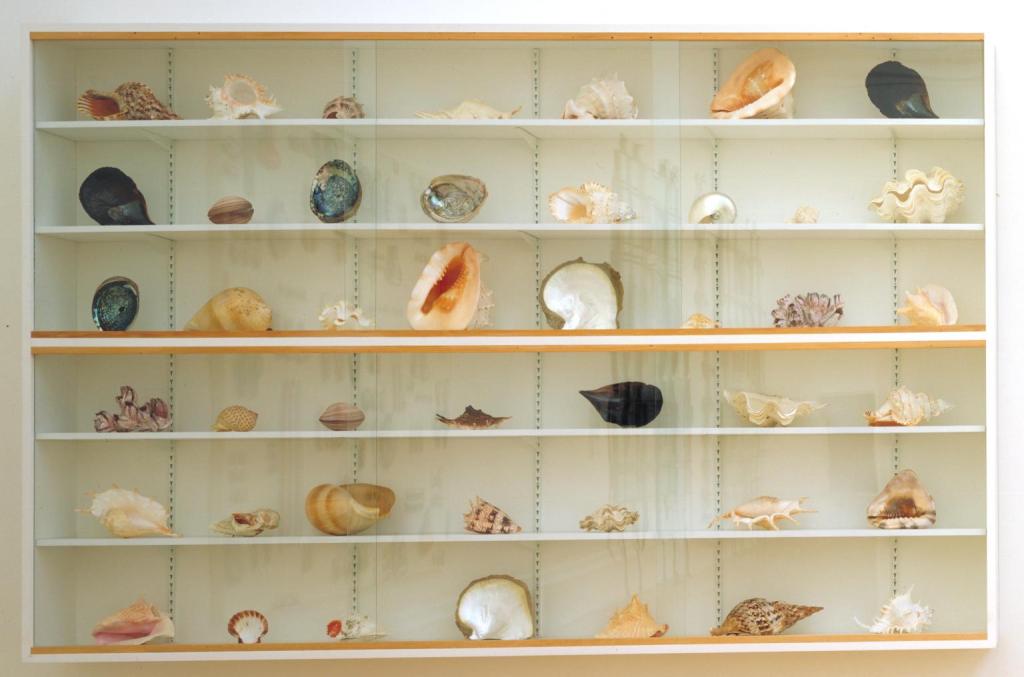
Further work such as Pharmacy 1992, ‘Dead Ends Dried Out, Examined’ 1993 refer;
‘self-reflexively to the processes of visual investigation central to scientific and museological display’. ( Elizabeth Manchester May 2009. Tate)
Perhaps the controlled formalised vitrine offers a feeling of order and sense to complex emotions and dilemma. The museum like narrative and provenance proffers a higher authority of answers and status quo. Hirst seems to have been heavily influenced by the concept of collection and display throughout his career. My own personal museum visits as a child to the Natural History Museum in London and The Science Museum do resonate strongly with me. The excitement and curiosity of the closed vitrine offering up a glimpse of its secrets behind glass were inspiring and magical and perhaps why I have collected small curiosities from a young age wanting to recreate those fascinating cases of intrigue .
Hirst was no doubt influenced by Joseph Cornel and Kurt Schwitters. These early adopters and the found object curated and assembled their objects onto canvas as part of a found narrative.
The beauty and intrigue of assemblage art and found objects was highlighted personally when visiting Joseph Cornell’s (1903-1972) ‘ Wanderlust Exhibition at the Royal Academy in 2015.
His boxed images of found objects hold a magical and museum like presence, offering the objects within them a second life, bringing the unnoticed or discarded into the forefront. He has a unique quality of creating beauty from the banal where their elevated presence is questioned. Cornell, a silent pioneer of his time has informed much of my enthusiasm and approach to this art medium.
Unlike Ducham’s found objects, Cornell’s speak of previous discarded lives and abandonment as their meaning and usefulness has passed Cornell offers them a spiritual resting place and afterlife full of enquiry, narrative and history. There is a strong element of protection and safeguarding regarding their beautifully boxed and enclosed surroundings. This was an integral part of Cornell’s enquiry such was the strength of their visually protected enclosure, offering a treasured, secure environment for these objects, highlighting their change of context from the pedestrian to the artistic, from the mundane to the absorbing.
‘Interestingly, the found object – deployed by Cornell as a talisman of the past and transfigured so successfully that a dime store trinket can seem antique – has evolved to become, in contemporary art, an extension of our round-the-clock consumerist present and a critique of the global economy.’ (Deborah Solomon. Wanderlust Exhibition. Royal Academy 2015)
Solomon’s quote hints that Cornell may have been one the first artists to comment on a consumerist society with his assemblages of ‘junks’ elevated status to their inquisitive vitrine encasement. The preservation concerns in Cornell’s work echoes with my own ideas of capturing physical elements from the past where the discarded and found objects open up a narrative concerning conservation and safe -guarding the future environment. The ‘boxed’ assemblages adding a comforting dimension to the narrative.
Fig 4 Joseph Cornell. Planet Set, 1950
Fig 5 Joseph Cornell’s “Homage to Juan Gris,” 1953–54
Robert Rauschenberg ( 1925 -2008) became well known for his ‘combines’ where his artistic production mixed found objects and painting, embracing the anti-aesthetic art movement. Influenced by his friend Joseph Cornell, Rauschenberg is quoted as saying “The only difference between me and Cornell is that he put his work behind glass, and mine is out in the world.” ( Rauschenberg 1953)
Rauschenberg’s raw and trail blazing work is littered with the ‘found object’ with its fingerprints and narrative from a past existence and history. His work from the early 1950’s is reminiscent to Cornell’s with his series of ‘Personnel boxes’ These encloses or boxes of assemblages and collages are divided into ‘Scatole personali’( Personal boxes) and ‘Feticci Personali’ ( Personal Fetishes ) They involve a found boxed element or enclosure to be emptied, filled, opened or shut but ultimately discovered and investigated. Rauschenberg wrote of their richness of the past or their vivid, abstract reality; he also mentions their ‘false history’, a suggestion that the past is not clearly there or fully documented. The work resonates with the intimacy of a collector of the found object and of a documenter of a chequered history.
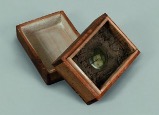
FIG 5.1 Rauchenberg 1952 Untitled .( Scatole personali)
Rauschenberg’s later large, indexical and dynamic images of extremes and juxtaposition pushed the boundaries of assemblage art and found objects onto the ‘big canvas’ in unapologetic 3D format. Dynamically curated at The Tate Modern Exhibition( 2016 -2017) I was captivated by their bolder, more shocking presence taking assemblage art to a new level. They brought great significance and awareness to the importance and acceptance of found objects placed in ‘Abstract Expressionism’ .
Claus Oldenberg ( 1929- 2022) Moving further up to date with Claus Oldenburg’s 2013 “Museum” is an exhibition space shaped in Mickey Mouse’s head.
Inside, it is an illuminated vitrine that is painstakingly filled with souvenirs, gadgets, and studies for future sculptures . There is a mass of fake junk food or street food expertly placed to insite notions of indulgence, poor nutrition, pop culture and absurdity. Visual puns some smutty and tasteless others offering a deeper complex narrative. There is a purposeful and complex mix of the sense and senseless, the informed and the bonkers. Such familiar objects taken for granted over time seems to re-awaken alongside more outlandish items. Offering a new narrative or concern. It is a pace full of life and bouncing stories and connections. Oldenberg continually plays on this in his other large scale works. Looking at scale and colour and form in quirky unexpected ways. Challenging our perceptions and relationships to the very day object. There is a sense of revolt and animation to the work that brings the very small to the very large.
‘ I have combined my unworldly fantasy in a shock wedding to banal aspects of everyday existence.’ ( Oldenberg)
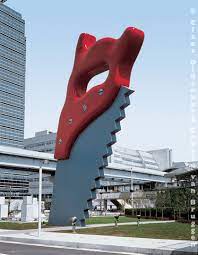
The sculpture Saw, Sawing, 1996, by Claes Oldenburg and Coosje Van Bruggen in Tokyo, at the exhibition complex used as the Olympic press centre in 2021. Photograph: Leon Neal/Getty Images
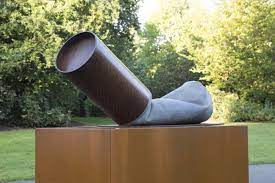
Claes Oldenburg’s Fagend Study, 1975, at the Frieze sculpture park, Regent’s Park, London, 2016. Photograph: Guy Bell/Shutterstoc
‘That’s how I do my work. It grows out of the surroundings. My focus was not on abstraction ( that) had dominated the scene. I became more interested in objects. I found them more versatile than figures, because you can change an object with out making it look strange.’ ( Oldenberg)
I agree with Oldenberg that objects have more diversity in application and usage, their narrative is open to exploration and manipulation as is their form.
Looking closer at my own work I find my methods of archive would perhaps be best served in a traditional chronological date format. The learning process had encouraged so much exploration of media and styles that it is only now I can perhaps see a patten of work emerging. I am explorative and do use a large amount of mixed media and found objects but still feel experimental with much of my work and rarely repeat a process or imagery for very long. I feel there would be more to offer chronologically, by way of artistic journey and progression than otherwise. Themes have come and gone and the work created under them has also varied but perhaps this would be a consideration of classification as a second choice further down the line of creative output. The working process would better undertaken by way of diversity and confidence of materials used over time, feeling increasing bolder with them as I have progressed. Always looking for new source material, collecting remnants from old buildings, charity shops etc to create and increase levels of narrative and artistic intrigue.
 The Sharpe Gallery