Exercise 1.1
Format Options;
Contextual Study – Comfortable with this format and writing.
- Develop an argument, references, analysis and conclusion.
Essay – Motive and purpose. ORIGINAL IDEA! After a period of research, contemplation an original idea becomes the focus of the writing.
The process of either of the two above formats with push me to explore more fully ideas and concepts I will be examining. The journey of process will expand and my concepts and final conclusions. I see it as a creative and explorative work. The research covering all manner of media, text, artists, exhibitions and interview.
Linking Creative and written work .
I am considering adding some text to push narrative in final pieces. Title of artwork will also be visible. Corresponding text and creative work will be directly linked to either my contextual study or essay. Looking directly at the topics that I am currently exploring, mental health semiotics, female empowerment, inclusion. These are not exhaustive and may shift slightly but will be part of the full body of work written and creative. I expect both to develop together within the exploration of the subject maters in more depth.
Ex 1.2:
Making Connections:
Research into the female asylums in t e 1900 in the UK and in Paris were topics used for previous exercises at HE2. The exploration of this topic expanded my potential narrative for further work:
1 – The state of female mental health today: its perceptions, its societal pressures, its hidden symptoms, its acceptances and prejudices.
2 – The patriarchy – Looking at how this has kept female issues, development, acceptance and its old traditions firmly within society.
Looking at body image, the ageless woman, the multi tasker the many roles we play in society.
My research processes have come from a variety of sources:
Essentially, female Artists – their first hand essays, interviews, text etc. On line, and other media. Their voice, their past voice and their critics voice are rich sources of research and inspiration.
Numerous Art books – representing an overview of the art world, with relevant information and other possible directions and options to further explore. Looking at art books by women for women.
Exhibitions ( Most recent – Marina Abramovich R.A 2023) – The current voice of the matriarchic artist.
- Emin, Lucas, Bartusova
Looking at female as an inclusive being, – non ethical, cultural, racial, classless. A bringing together – steer away from divides and focus on the common conditions, pressures and standing.
Theoretical position outlines a set of thinking on a particular area.
Methodology is applying your thinking to the world.
Semiotics – ( foot in both camps)
Ex.3.1
Introducing Research Methods : the following resonate with my perceivd work at the current time.
- Anthropology – comparative study of human societies, culture and their development.
- Reflective Practice – exploring and applying theories, academic or my own to test assumptions and find solutions to problems)
- Semiotics – originating in linguistics, the study of signs or symbols, their use and interpretation. How we communicate attaching meaning to words or images?
1 .Reflective Practice –
Reflection: the foundation of purposeful learning Reflection is an active process of witnessing one’s own experience in order to take a closer look at it, sometimes to direct attention to it briefly, but often to explore it in greater depth. This can be done in the midst of an activity or as an activity in itself. The key to reflection is learning how to take perspective on one’s own actions and experience—in other words, to examine that experience rather than just living it. By developing the ability to explore and be curious about our own experience and actions, we suddenly open up the possibilities of purposeful learning—derived not from books or experts, but from our work and our lives. This is the purpose of reflection: to allow the possibility of learning through experience, whether that is the experience of a meeting, a project, a disaster, a success, a relationship, or any other internal or external event, before, during or after it has occurred.
‘Recognizing the necessary role of reflection in excavating learning from experience and becoming familiar with the basic elements of a reflective practice will allow practitioners to begin to act on the notion that knowledge is embedded in the experience of their work, and to realize the importance of this knowledge in furthering their practice’
( What is Reflective Practice? Joy Amulya Center for Reflective Community Practice Massachusetts Institute of Technology)
Accessd Nov 2023 AT: https://www.careinnovations.org/wp-content/uploads/what-is-reflective-practice65.pdf
Importance !
Literacy in the Arts- Retheorising Learning and Teaching
‘In creative disciplines, reflective practice is an integral and cumulative form of learning. Reflective learning generates knowledge that is specific to oneself and is a form of evidence upon which to analyse and change one’s practice. Critical reflection requires a deep knowledge of the discipline and an awareness of one’s positioning within that discipline and in relation to one’s creative performance. Meaning making through performative expression allows for personal transformation through acute awareness of and reflection on one’s own beliefs, knowledges and values through the process of creating artistic work. Self-awareness and identity are significant both in the study of the arts and in becoming an artist, as aesthetic inquiry and performance are constituted by subjective self-expression in relation to objective conditions. Reflection can be expressed using symbols or semiotic systems other than language. Depending on the disciplinary context, particular modes or forms of expression will be privileged, including material forms of practice, still and moving images, music and sound, live action and digital code.
Ryan, M.E. (2014). Reflective Practice in the Arts. In: Barton, G. (eds) Literacy in the Arts. Springer, Cham. https://doi.org/10.1007/978-3-319-04846-8_5
(https://link.springer.com/chapter/10.1007/978-3-319-04846-8_5
Chris Argyris (the person who coined the term ‘double-loop learning’ to explain the idea that reflection allows you to step outside the ‘single loop’ of ‘Experience, Reflect, Conceptualise, Apply’ into a second loop to recognise a new paradigm and re-frame your ideas in order to change what you do).
Neil Thompson, – People Skills, six steps to apply reflective practice:
- Read – around the topics you are learning about or want to learn about and develop
- Ask – others about the way they do things and why
- Watch – what is going on around you
- Feel – pay attention to your emotions, what prompts them, and how you deal with negative ones
- Talk – share your views and experiences with others in your organisation
- Think – learn to value time spent thinking about your worK
Challenge and analyse results !
Learn from experience – avoid past mistakes
Be aware of the potential to be bias or discriminative
Look at different perspectives
2. Anthropology -human biology, archaeology, cultural anthropology, and linguistics are understood to be the pillars on which the whole discipline rests.
Where does this research methos come from?
How has it been applied?
What methods were used to gather data?
–
The Four Subfields of Anthropology
Anthropology -human biology, archaeology, cultural anthropology, and linguistics are understood to be the pillars on which the whole discipline rests.
4 main category’s :
Socio-cultural Anthropology is the study of the social and political dimensions of living peoples. ( participant observations, )
Archaeologists A focus heavily on the materiality of social life. ( in relation to social) Document and interpret the material remains of human activities. Historiacal records and oral histories)
Biological Anthropologists study the biological and biocultural evolution of humans. They compare populations of nonhuman primates, extinct human ancestors, and modern humans. Focussing on human culture, communication, society, and genetic determinist theories.
Linguistic Anthropologists study one of the most fundamental aspects of human society: communication. Some linguist anthropologists use techniques associated with socio-cultural approaches, like participant observation, to explore forms of communication. ( semiotics)
- Look at Urban anthropology
- Social sociolinguist – looking at brain development, social relationships, interaction.
- Overall complexities of human culture and human development
(What is an example of reflexivity?
Emotional reflexivity examines whether your own beliefs or biases are influencing your work. For example, you may experience strong emotions such as empathy, compassion, or anger as you listen to the participants’ stories. It is important to acknowledge these emotions and consider how they may affect your study.24 Feb 2022)
American Philosopher – John Dewey – over riding belief in democracy, liberalism,. Art communicates moral purpose and education. Dewey believes moral purpose is justifiable, art conveying messages that stimulate reflection on purposeful lives. Dewey is a pragmatist whose attraction to art postulates it as a means to an end because he envisions the end as just and fair: democracy.
3. SEMIOTICS – strong link to linguistics:
- Signs: Elements that stand for something else. They can be words, images, sounds, or gestures.
- Symbols: Special types of signs that have a conventional or agreed-upon meaning within a particular culture.
- Signifier and Signified:
- Signifier: The physical form of the sign (e.g., a word, an image).
- Signified: The concept or meaning associated with the sign.
- Semiotic Systems:
- Language: One of the most common and studied semiotic systems. It includes words, grammar, and syntax.
- Non-verbal Communication: Gestures, facial expressions, body language, etc.
- Syntagmatic and Paradigmatic Relations:
- Syntagmatic Relations: The linear combination of signs in a sequence (e.g., words in a sentence).
- Paradigmatic Relations: The selection of one sign over another within a particular category (e.g., choosing a specific word from a set of synonyms).
- Semiotic Analysis:
- The process of breaking down and examining signs and symbols to understand their individual components and how they contribute to meaning.
- Denotation and Connotation:
- Denotation: The literal, primary meaning of a sign.
- Connotation: The secondary or associative meanings and cultural implications of a sign.
- Icon, Index, and Symbol (Peircean Semiotics):
- Icon: A sign that resembles the object it represents in some way.
- Index: A sign that has a direct connection or correlation with its referent.
- Symbol: A sign with an arbitrary or conventional connection to its meaning.
- Cultural Semiotics:
- Examining how signs and symbols are culturally constructed and how meaning is shaped by social and historical contexts.
Semiotics, interdisciplinary and is applied in various fields such as linguistics, literature, anthropology, communication studies, media studies, and more. A framework for understanding how meaning is created, communicated, and interpreted in different cultural and social contexts.
Pierce’s theory of Signs..
https://plato.stanford.edu/entries/peirce-semiotics/
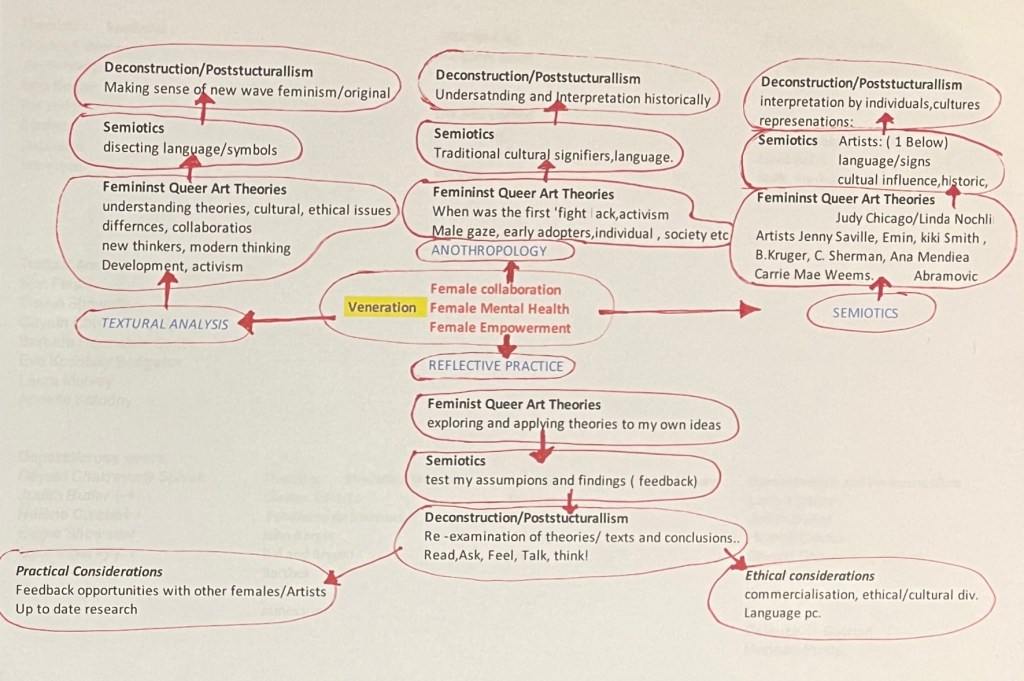
At this stage I would look to employ a multi-method approach My methods of research Combining, Anthropology, Semiotis and Reflective practice, ( Textural Analysis possible feedback from artists in a response narrative – regarding Shrine Postcards). The theories I feel most resonate with my project are : Semiotics/structuralism, Feminist and Queer theory. Deconstruction/Poststucturallism
Secondary consideration : Posthumanism
1.4 Theoretical Perspectives
Diagram :
Theorists Lists:
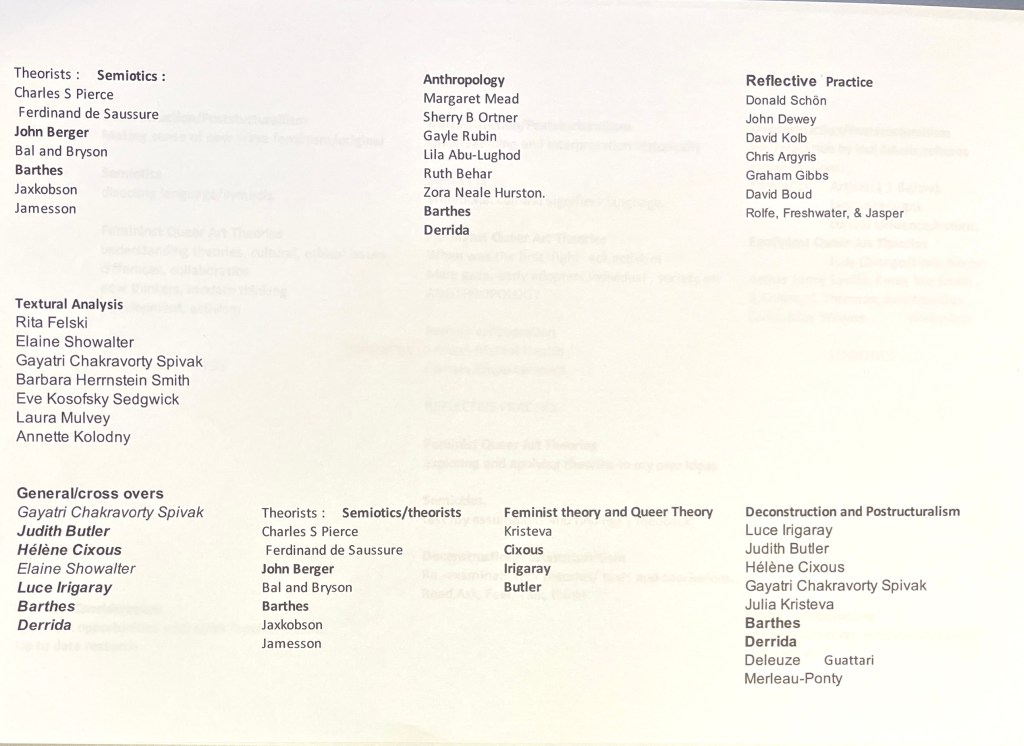
Download version of diagrams below:
PROJECT 2
Focussing your Research.
Exercise 2.1 Refine your ideas for Research
Content Gathered. Summary of Findings. Key ideas and/points and questions raised by material.
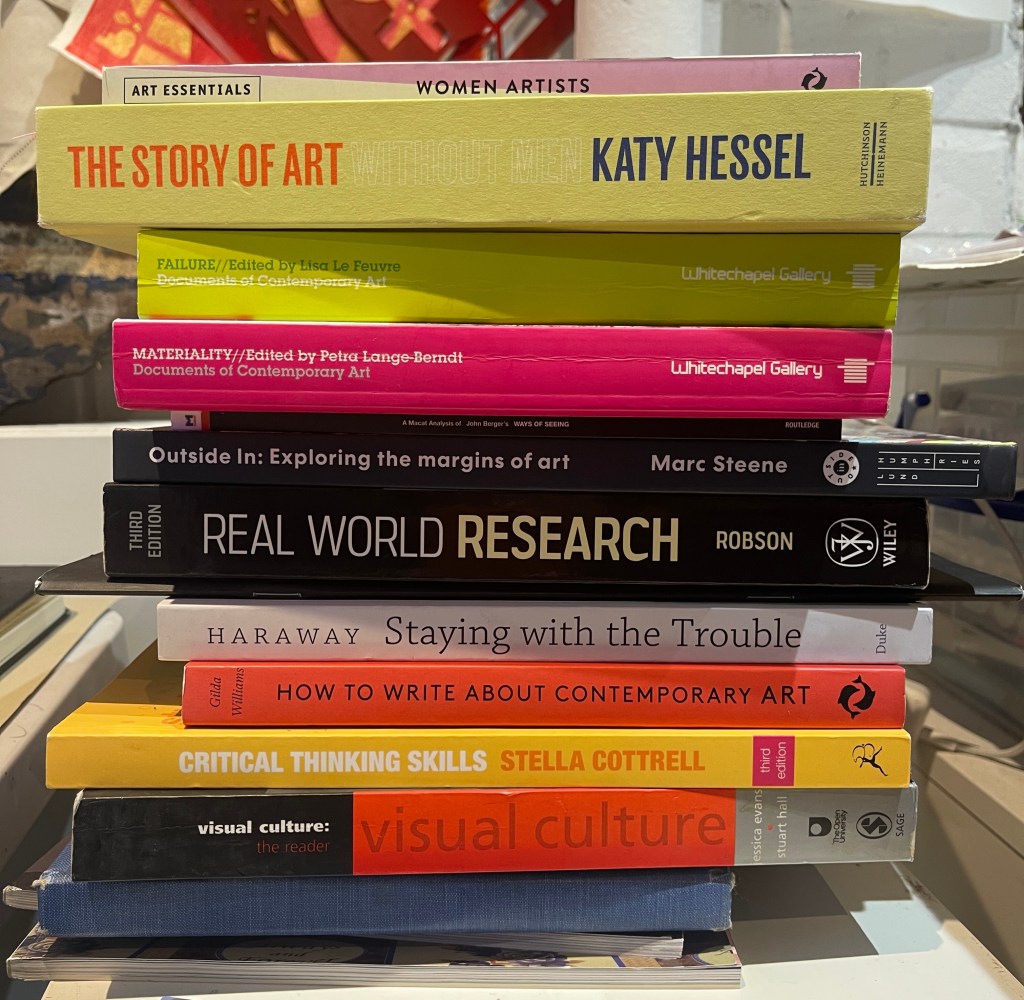
Books as a material resource:
Writing skills:
Critical Thinking Skills – Stella Cottrell
How to write about Contemporary Art – Gilda Williams
Visual Culture: The Reader – Open University Jessica Evans/Stuart Hall
Real World Research – Colin Robson
Theories :
Staying with the Trouble – Haraway
Ways of Seeing – John Berger
A MACAT Analysis – John Berger’s Ways of Seeing
The Outside In – Exploring the Margins of Art – Marc Steene
Materiality – Whitechapel Gallery
Failure – Whitechapel Gallery
Misc:
Beneath The Water Tower – Graylingwell Asylum
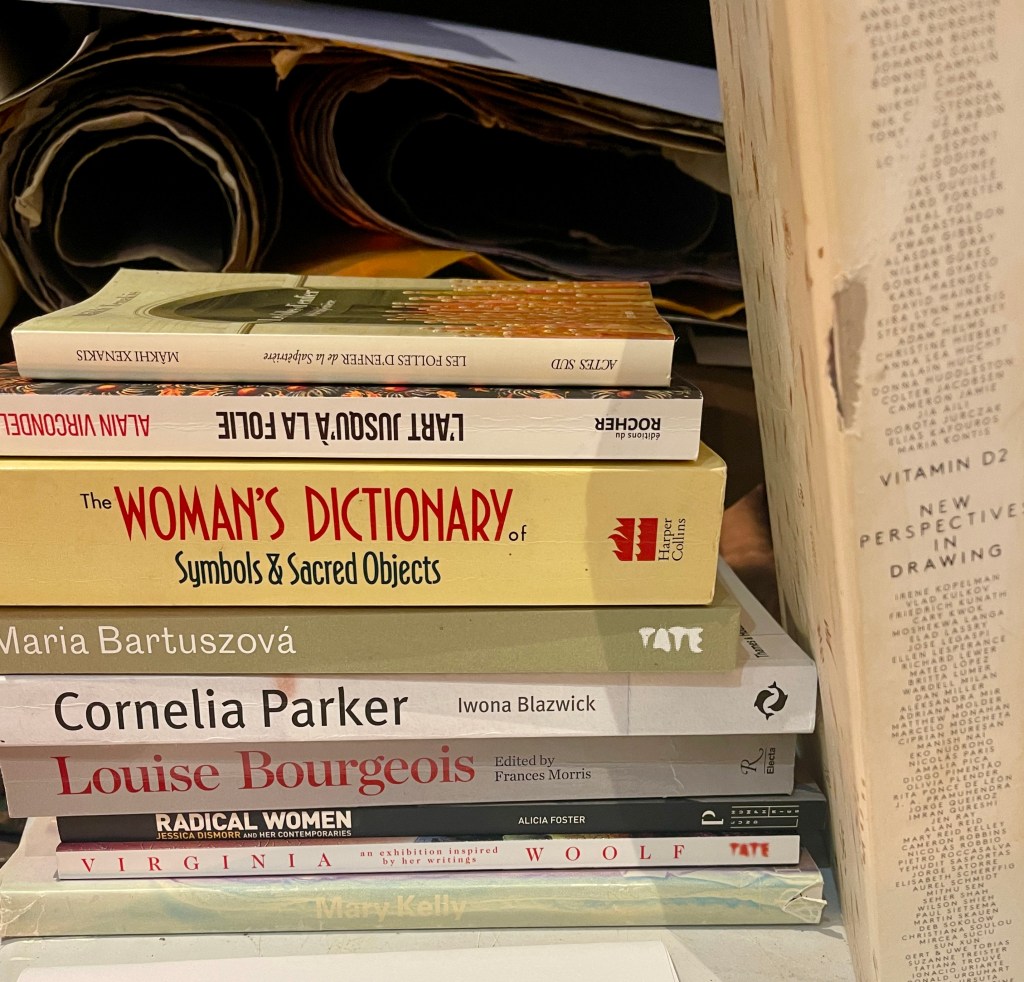
The Woman’s Dictionary – Symbols and Sacred Objects
Women Artists: – Art Essentials
The Story of Art – Katy Hessel
Helmut Newton – World Without Men
Artists:
Louise Bourgeois – Frances Morris
Paula Rego – Tate Publication
Cornelia Parker – Iwona Blazwick
Radical Women – Alicia Foster
Virginia Wolf – Tate ( exhibition inspired by her writings)
Mary Kelly – Phaidon
La Salpetriere – ( Aloise Corbaz , Seraphine de Sertis, Caille Claudel)
On Line Text/ research to include:
Guerilla Girls . ( com) – Instagram/ website
PLUS: Tracy Emin/ Judy Chicago, M Abramovic, Linda Nochlin, Griselda Pollock, jenny Sackville, Kiki Smith, Barbara Kruger, Cindy Sherman, Ana Mendiea, Carrie Mae Weems. Etc
Key Points Raised .
1 -Securing an original ideas on current thinking and concepts – At this stage I wish to look at a coming together , collaborative, union, a togetherness of ‘femaleness’ cross culture, background and ethnicity. What in fact do we all have in common, what traits, issues ‘one voice’ do we share?
2 – Overwhelming amount of material in regards to feminism/feminist theories – can I find a pathway through to a new idea or addition? Do I have enough ?
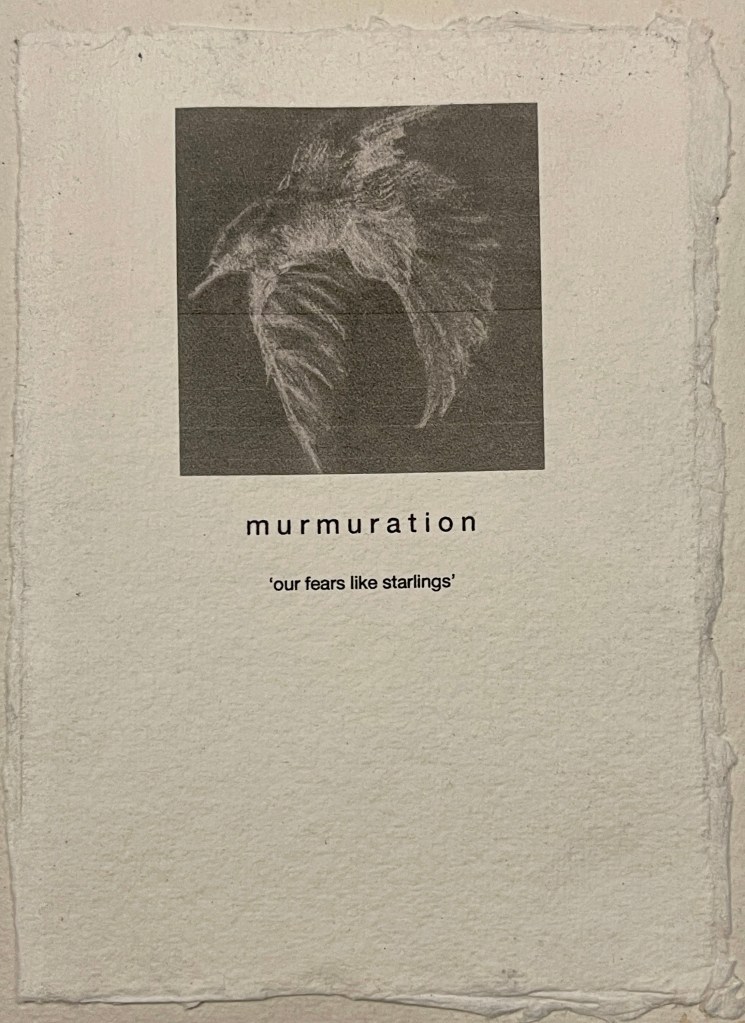
3. I am interested in the the sculptural and the semiotic. Possible performance piece with a ‘prop’ that would be considered an ‘object referral’ item – denoting a negative emotion. It would serve as an interactive piece of art – possible photographs in situ? – (Focussed on Murmuration and its link to fear, anxiety , depression etc…)
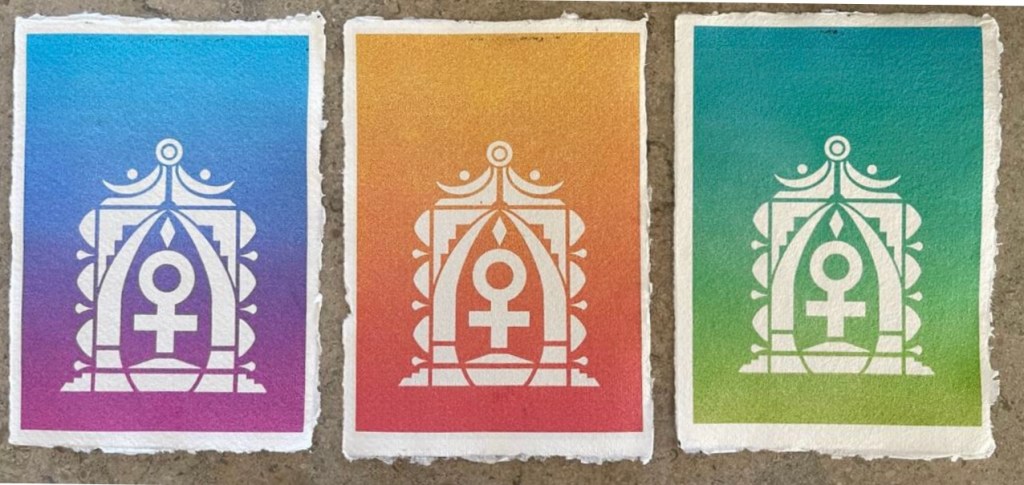
4 – Creating a physical 3D Shrine to the ‘female’ following on from the ‘postcard’ semiotic.
Point 1 – Feedback / collaborative response to ‘Shrine’ – inviting other female artists to create a small work that resonated with them under the theme “venerate’ to the female /femaleness. Sending out 2 postcards to each artist – one for them and another to expand the process/project.
Not performative but collaborative and the results would be shown in a space allowing for all responders to be seen..( the ideal) .. a process that would take a number of months to complete.
Point 2 – a large scale work with ‘alter piece’ connotations for ‘Shrine’ or ‘Veneration’ (Title not fully established.) Using hard material, to construct / create a base to embellish with symbols/marking denoting ‘all’ ( or a many) global cultural references to the female as possible. Again here I woul dbe interested in recording a response ot this work
Research Point – Learning equals Research !
Research is an active process
We construct meaning from information
Not a passive process
Engagement needed
The more we research the more we can actively and specifically research
Language we use and the way we decipher is crucial as it is full of social constructs
Research is finding connections with our peers, family, teachers friends etc
Conversation and discussion is essential for expanded and diverse knowledge reference and interpretations.
Research resolution takes time to come to arrive at.
It is hard to place a dividing line between the two concepts of learning and research, especially as immersive new learning involves active research . Learning by rote does not often involve much, if any of the individuals own voice. Perhaps this method is more suited to the much younger chid. As we grow older, more curious, suspicious even we begin to follow up the learning process with ‘back – up’ information. An essential skill in the world of fake and heavily manipulated news etc. Taking research for granted from a singe source is not advised, learning with out context or background similarly. Reflective practice will be an essential tool for a rounded, non biased perspective and a more comprehensive outcome or conclusion.
Exercise 2.2
I feel I have a plethora of potential resources to push my chosen project pathway forward. In the age of social media I can obtain up to date thinking and concepts as they happen and record data accordingly. This will be a valuable addition to the collected books and text.
I need to engage fully with diverse cultural and ethical concerns and practices regarding female mental health and female empowerment. These differ from culture to culture and one size does not fit all. Again through above mentioned resources , museums and libraries plus theorists looking at post colonial feminism, cultural sensitivity, taboos and stigmas, (Gayatri Chakravorty Spivak:Chandra Talpade MohantyI will hope to navigate this complex global field. In this instance this will be in regards to semiotic imagery, relationship to the visual and narrative.
Researching work of diverse and ethnic artists will be a consideration in this discourse.
- Faith Ringgold
- Carrie Mae Weems
- Kara Walker
- Shirin Neshat
- Wangechi Mutu
- Yayoi Kusama
- Ana Mendieta
- Njideka Akunyili Crosby.
- Ensuring I send my Shrine postcard to a diverse group of women will be useful in obtaining a narrative and a perspective on certain topics.
- Looking at haptic elements for inclusivity – feel and touch for individuals with limited or no sight , other disabilities ( Haptic Perception – Maria Bartuszova 1976/1983 )
Autonoetic Consciousness: The ability to mentally place oneself in the past, present, and future, contributing to a sense of personal identity and emotional well-being.
Bodily Autonomy: The right of individuals to have control over their own bodies, particularly in matters of reproductive choices and personal health.
Cultural Hegemony: The dominance or control of a particular cultural group over others, influencing societal norms and values, often related to the empowerment or disempowerment of certain groups.
Embodied Agency: The recognition and utilisation of the body as a source of power and expression, emphasizing the connection between physicality and empowerment.
Gynocentrism: A focus on women or a female-centric perspective, often used to critique societal structures that disproportionately prioritise the needs and experiences of men.
Heteronormativity: The societal expectation that heterosexuality is the norm, marginalising and stigmatising non-heteronormative expressions of sexuality
Intersectional Feminist Economics: An economic perspective that considers the overlapping impact of various social categories (such as gender, race, and class) on financial well-being and advocates for policies addressing these intersections.
Neurofeminism: An interdisciplinary approach that explores the intersection of neuroscience, gender, and feminism to understand how brain structures and functions may be influenced by social and cultural factors.
Psychoemotional Resilience: The capacity to adapt and bounce back from adversity in the realms of psychological and emotional well-being.
Postcolonial Feminism: An approach that explores the intersectionality of gender, race, and colonialism, examining how these factors interact to shape women’s experiences.
Transfeminism: A movement that advocates for the rights of transgender individuals within the framework of feminist principles, recognizing the intersectionality of gender identities.
Visual Cultrue:
Deconstruction A philosophical and critical approach that seeks to understand the relationship between text and meaning by breaking down textual elements and exposing their underlying assumptions.
Diaspora -Definition: The dispersion or spread of people from their original homeland, often used in the context of cultural or ethnic groups.
Gender Politics – the debate about the roles and relations of men and women
Fetishism: The attribution of magical or supernatural qualities to inanimate objects, often related to the concept of commodity fetishism in the context of consumer culture
Hegemony – The dominance or control of one group or state over others, often achieved through cultural or ideological means.
High Culture – a set of cultural products of aesthetic value in the arts held by the highest esteem by the elite
Objectification – the demotion or degrading of a person or class of people ( especially women ) to the status of mere objects .
Paradigm ; Definition: A pattern or model of something, often in the context of cultural or visual representation.
Semiology:Definition: The study of signs and symbols, including their structure and function in communication.
Simulacrum: An image or representation of something that has no true or original existence but is created to simulate reality.
Social Realism – art movement dedicated to the every day conditions and of the working class and the poor
Transgression – Definition: The act of violating or going beyond established boundaries or norms, often explored in the context of art challenging societal norms
etc
Ex 2.3
Henry Moore Institute – https://henry-moore.org/henry-moore-institute/
The Drawing Room – https://drawingroom.org.uk/about-us/
Judy Chicago – New exhibition Non 2023 – reviewed at https://ocula.com/magazine/conversations/judy-chicago-comes-out-swinging/?utm_medium=email&utm_campaign=Judy%20Chicago%20Comes%20Out%20Swinging%20%20Must%20See%20The%20Many%20Faces%20of%20Marisol&utm_content=Judy%20Chicago%20Comes%20Out%20Swinging%20%20Must%20See%20The%20Many%20Faces%20of%20Marisol+CID_c44eb3b5db19051216191cc337dd4b67&utm_source=Email&utm_term=Read%20More
Dont forget OCA Library/ Google Scholar
2.4 Glossary Page ( created )
Other sources: key word search : Art /contemporary terminology: ( see Glossary)
- Innovative – Introducing new ideas, methods, or concepts.
- Conceptual – Emphasising ideas and concepts over traditional aesthetic considerations.
- Avant-garde – Pushing the boundaries of what is accepted as the norm or the status quo.
- Provocative – Eliciting strong reactions, challenging assumptions or norms.
- Multimedia – Involving the use of multiple forms of media or artistic expression.
- Interactive – Allowing or requiring the viewer’s active participation.
- Experimental – Involving a spirit of exploration and risk-taking in artistic methods.
- Cutting-edge – Incorporating the latest and most advanced techniques or ideas.
- Boundary-pushing – Going beyond established limits or norms.
- Thought-provoking – Stimulating contemplation, reflection, or deep consideration.
- Visually striking – Arresting and memorable in its visual impact.
- Bold – Exhibiting courage and a willingness to take risks.
- Narrative – Involving a story or a sequence of events, either implicit or explicit.
- Symbolic – Using symbols or metaphors to convey meaning.
- Ambiguous – Open to interpretation, having more than one possible meaning.
- Ephemeral – Transient, fleeting, or impermanent in nature.
- Surreal – Displaying dreamlike or fantastical qualities.
- Expressive – Conveying strong emotions or feelings.
- Diverse – Embracing a wide range of styles, themes, or influences.
- Cultural commentary – Providing commentary or critique on societal or cultural issues.
- Challenging – Posing difficulties or demanding intellectual effort from the viewer.
- Controversial – Stirring disagreement or debate, often due to sensitive topics.
- Socially engaged – Addressing and involving social issues or concerns.
- Critical – Analyzing or questioning established norms, conventions, or systems.
- Introspective – Reflecting on one’s own thoughts, feelings, or experiences.
- Political – Pertaining to government, power, or societal structures.
- Identity exploration – Investigating or questioning aspects of personal or collective identity.
- Eclectic – Deriving inspiration from a diverse range of sources or styles.
- Postmodern – Characterized by a rejection of grand narratives and traditional conventions.
- Meta – Referential to its own form, structure, or artistic process.
- Technologically-driven – Utilizing or influenced by advancements in technology.
- Eco-conscious – Addressing environmental issues or concerns.
- Global perspective – Incorporating a viewpoint that transcends local or regional boundaries.
- Aesthetic exploration – Investigating and experimenting with visual or sensory qualities.
- Fragmented – Composed of disconnected or disjointed elements.
- Ambitious – Demonstrating a challenging or lofty artistic vision.
- Emotionally charged – Evoking strong emotional responses from the viewer.
- Site-specific – Created to exist in a particular location, responding to its context.
- Installation – A three-dimensional artwork created for a specific space.
- Performance-based – Involving live actions or events as part of the artistic expression.
- Transgressive – Violating or challenging societal norms and taboos.
- Futuristic – Reflective of or inspired by the future and technological advancements.
- Abstract – Non-representational or distorting recognizable forms.
- Minimalist – Emphasizing simplicity and a reduction of elements.
- Maximalist – Embracing excess and abundance of visual elements.
- Reinterpretation – Presenting a new understanding or version of something.
- Cinematic – Resembling or evoking qualities of film or cinematic experiences.
- Craftsmanship – Demonstrating skill and meticulous attention to detail.
- Narrative ambiguity – The intentional inclusion of unclear or multiple storylines.
- Curation – The careful selection and arrangement of artworks for a specific exhibition or collection.
Further concepts :
- Philosophical – Engaging with fundamental questions and principles, often exploring the nature of existence, knowledge, and values.
- Intellectual – Emphasizing the mental and conceptual aspects of the artwork, appealing to the viewer’s intellect rather than emotions.
- Symbolism – Using symbols to represent ideas, concepts, or qualities beyond their literal meaning, adding layers of meaning to the artwork.
- Semiotic – Involving the study of signs and symbols, exploring how meaning is created and communicated through visual language.
- Metaphorical – Using metaphor, a figure of speech, to convey abstract ideas or emotions indirectly through concrete forms.
- Allegorical – Conveying a broader, often moral or political, meaning through a narrative or symbolic representation.
- Existential – Addressing themes related to individual existence, freedom, and choice, often with an emphasis on personal responsibility.
- Cerebral – Appealing to intellectual and rational faculties, often requiring thoughtful contemplation.
- Cognitive – Involving mental processes such as perception, memory, and reasoning in the creation and interpretation of the artwork.
- Ideological – Expressing or reflecting a particular set of ideas, beliefs, or values within the context of the artwork.
- Cultural critique – Examining and evaluating cultural practices, beliefs, or societal norms through artistic expression.
- Social commentary – Offering observations or critiques on social issues, often with the intention of sparking discussion or change.
- Identity politics – Engaging with and commenting on issues related to personal or group identity, often in relation to power dynamics.
- Psychological exploration – Investigating the complexities of the human mind, emotions, and behavior through artistic means.
- Spiritual – Addressing or evoking themes related to the transcendent, sacred, or divine.
- Ethical – Exploring questions of morality, right and wrong, and ethical considerations within the context of the artwork.
- Human experience – Reflecting on the breadth and depth of human life, emotions, and relationships.
- Memory – Exploring the role of memory, nostalgia, or historical recollection in shaping individual or collective consciousness.
- Timelessness – Conveying a sense of enduring relevance or significance beyond the specific historical or cultural moment.
- Reflective – Encouraging contemplation and introspection, often prompting viewers to reflect on their own experiences and perspectives.
- Recontextualisation – Placing familiar elements into new contexts, challenging preconceived notions or associations.
- Subversive – Undermining or challenging established norms, conventions, or power structures.
- Dialectical – Involving a dialogue or tension between opposing forces or ideas.
- Dialogical – Creating a space for dialogue or conversation, often within the artwork itself or between the artwork and the viewer.
- Synthesis – Combining disparate elements or ideas to create a cohesive whole.
- Deconstruction – Analyzing and breaking down traditional assumptions or structures, often revealing hidden meanings.
- Reinterpretation – Presenting a new or alternative interpretation of existing ideas, narratives, or artistic forms.
- Intertextuality – Referencing or incorporating elements from other texts, artworks, or cultural contexts within the artwork.
- Archetypal – Involving universal symbols, themes, or characters that resonate across different cultures and times.
- Mythical – Drawing on or reimagining mythic or legendary narratives and themes.
- Postcolonial – Addressing the legacy and impact of colonialism on culture, identity, and power dynamics.
- Poststructuralist – Engaging with ideas that challenge fixed meanings and question the stability of language and structures.
- Intersectionality – Exploring the interconnected nature of various social categories (such as race, gender, and class) and their impact on individual experiences.
- Fragmentation – Breaking down or fragmenting the visual or conceptual elements of the artwork, often for symbolic effect.
- Temporal – Relating to or exploring the dimension of time, often in terms of past, present, and future.
- Spirit of the age – Capturing the prevailing attitudes, values, and cultural characteristics of a specific historical period.
- Epochal – Reflecting a significant and defining period or event in history.
- Autobiographical – Drawing on the artist’s personal experiences, memories, and perspectives.
- Collective memory – Examining shared memories, narratives, or historical events that shape the identity of a community or society.
- Social justice – Advocating for fairness, equality, and the rectification of social inequalities through artistic expression.
- Environmental consciousness – Addressing ecological issues and advocating for environmental awareness and sustainability.
- Global interconnectedness – Exploring the interconnected relationships between different cultures, societies, and individuals on a global scale.
- Narrative complexity – Incorporating intricate or layered storytelling structures, often with multiple perspectives or timelines.
- Ephemeral nature of existence – Reflecting on the transient and fleeting aspects of life, often emphasizing impermanence.
- Temporal juxtaposition – Placing elements from different time periods side by side, creating contrasts or connections between past and present.
- Cultural hybridity – Celebrating or examining the blending and mixing of different cultural influences and identities.
- Rethinking tradition – Challenging or reinterpreting established artistic, cultural, or societal traditions.
- Dialogues with the past – Engaging in conversation or reflection with historical or artistic precedents.
- Interdisciplinary – Involving the integration of multiple artistic or academic disciplines in the creation or interpretation of the artwork.
- Transcendence – Going beyond ordinary limits or boundaries, often aiming for a heightened or transcendent experience for the viewer.
Project 3 Gathering DATA !
Potentail collection methods:
- Visits – female artists. Local full time artists exhibiting currently and previously.
- Possibly contact head curator at Pallant House Gallery for an interview regarding femaleness/ feminism/ in relation to current and future curration/exhibitions. Look at the mural collaboration:
- https://www.independent.co.uk/arts-entertainment/art/reviews/jann-haworth-review-work-in-progress-pallant-house-gallery-chichester-exhibitions-radical-women-a9184571.htmlJann Haworth: Close Up and Radical Women: Jessica Dismorr and her Contemporaries, review – Two exhibitions shine a light on women’s work
- interviews – with female artists ( I conduct) and textural research to gauge current thinking in the Anthropocene. Such as ‘Susan Cutts ‘Paper Sculptor.
- reflective practice – regarding research – Current exhibitions of Judy Chicago/ M. ABROMOVIC.
- To do :Look for current exhibition in 3rd world economy regarding female issues etc
- textural analysis – theoretical text and collated information and relate to above artists work ( historical , social political)
- Artists response ( to postcard ‘Shrine’) – insight into a range of emotions, ideas, ideals, politics of female/feminism/femalness/
- TO do : List of artists to send to:
I expect this to be a Qualitative data research project.
Project 4.
Literature Review :
Guidelines – sites below:
https://www.ed.ac.uk/institute-academic-development/study-hub/learning-resources/literature-review
EX. 4.1
Recent visit to M.Abramoic at the R.A
Marina Abramović – The R.A October 2023:
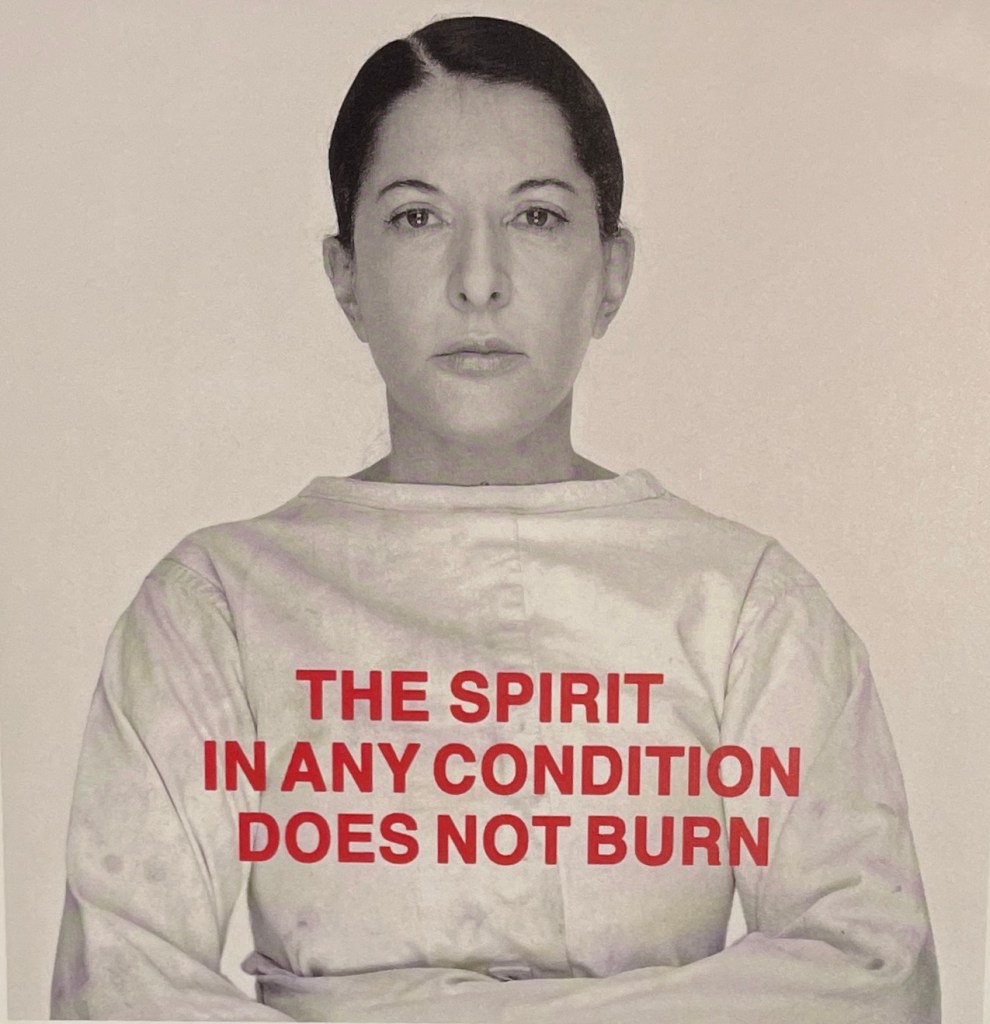
Above : Postcard of the show .
Abramovic at the RA is the first retrospective to be given to a female artist in the institutions history. This was quite a surprise and had a bearing on the exhibition, not least because of the words from Abramovic herself :
“ I have to make work that’s so good that it opens the road for all the young and incredibly talented female artists coming after me. If my show is not good then it will reflect badly on everybody else, so I have to be incredible.”
She remains a trailblazer in that respect, the ‘ Grandmother of Performance Art’ as is often quoted by critics and admirers.
The retrospective is a combination of her life’s work to date spanning over 50 years. It is imposing in scale and space and is quite the spectacle. It documents using video footage, photographs and surrogate performers tributing Abramovic’s seminal works. Disappointingly the performance artist herself is not physically present among the exhibition at any point but there is curated care taken to feel a deep sense of her in every room.
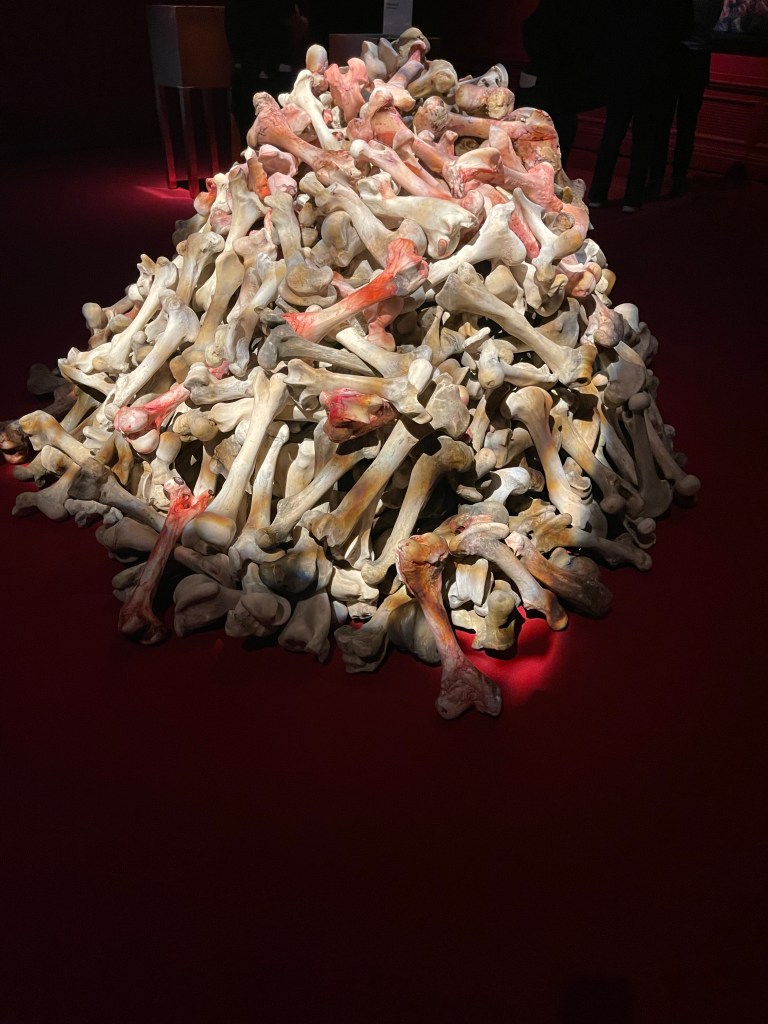
This is partly to do with the scale and boldness of the exhibition. It is immense and at times overwhelming, with scene setting getting a theatrical lift. No more pertinent than in the blood red painted walls of the Balkan Baroque Gallery’ . Taking ownership of the history of the Balkans War – Abmramovic is originally photographed sitting in a white dress on top a pile of fresh bloodied cow bones as she attempts to scrub them clean in an act of absolution and cleanliness. The reconstructed cow bones now in the middle of the gallery space resemble more of Halloween prop in their plastic state and lack the impact and narrative of the original performance. This is true of so many of the other performance pieces, albeit carried out by talented performance artists from Abramovic’s gruelling training camps. Perhaps it is the lack of Abramovic’s actual presence that lessens these spectacle and in some way homogenises the performances.
The brave, extreme, Boudica like work of Abramovic testing the limits of her life, her health and her sanity in the name of performance art are impressive. They blur the lines between art and something else that I am not altogether sure of? Spirituality perhaps or empowerment of the female? While she does not consider herself a feminist she embodies a strength of being and possibilities of the female that while extreme and powerful are in some way challenging and stirring.
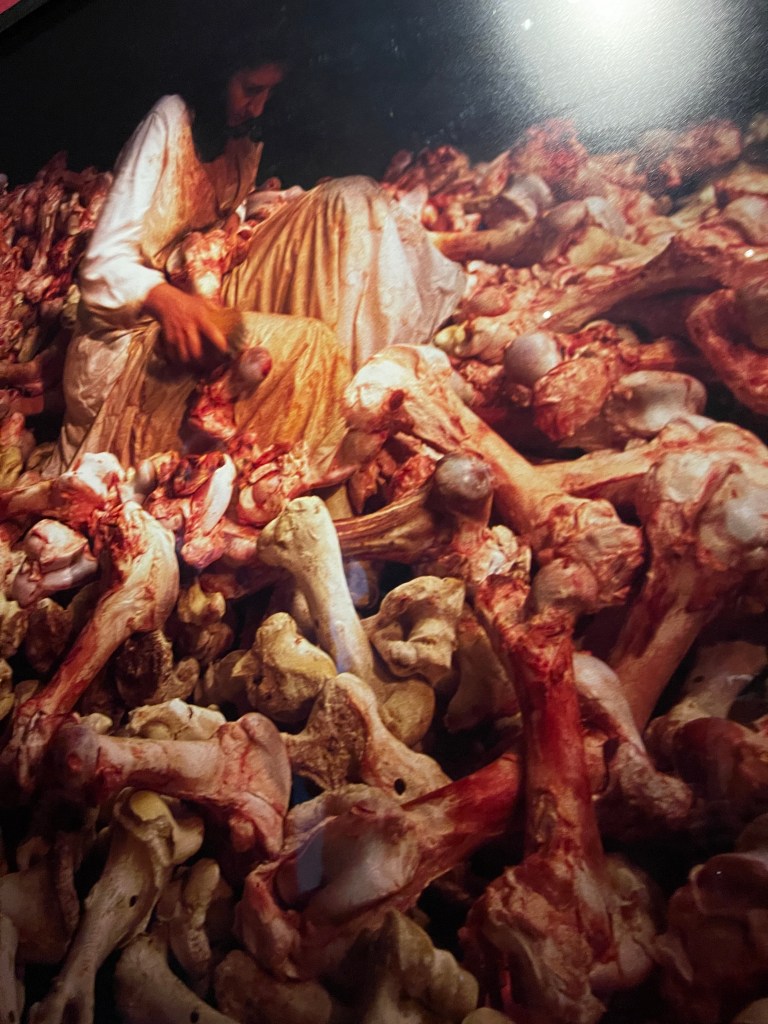
Above left; Bloodied and visceral, a photograph of Abramovic scrubbing bones in Balkan Baroque 1997
Above right : The sterile plastic bone mound as displayed in the R.A Exhibition does not carry the same visceral response or narrative.
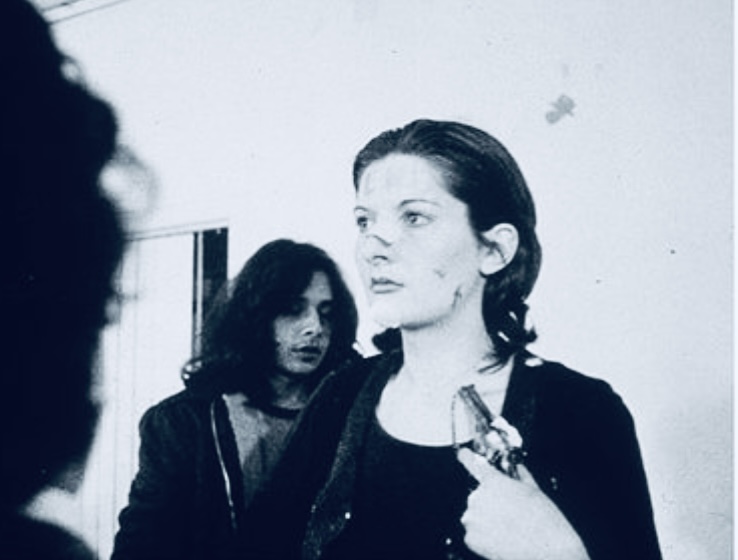
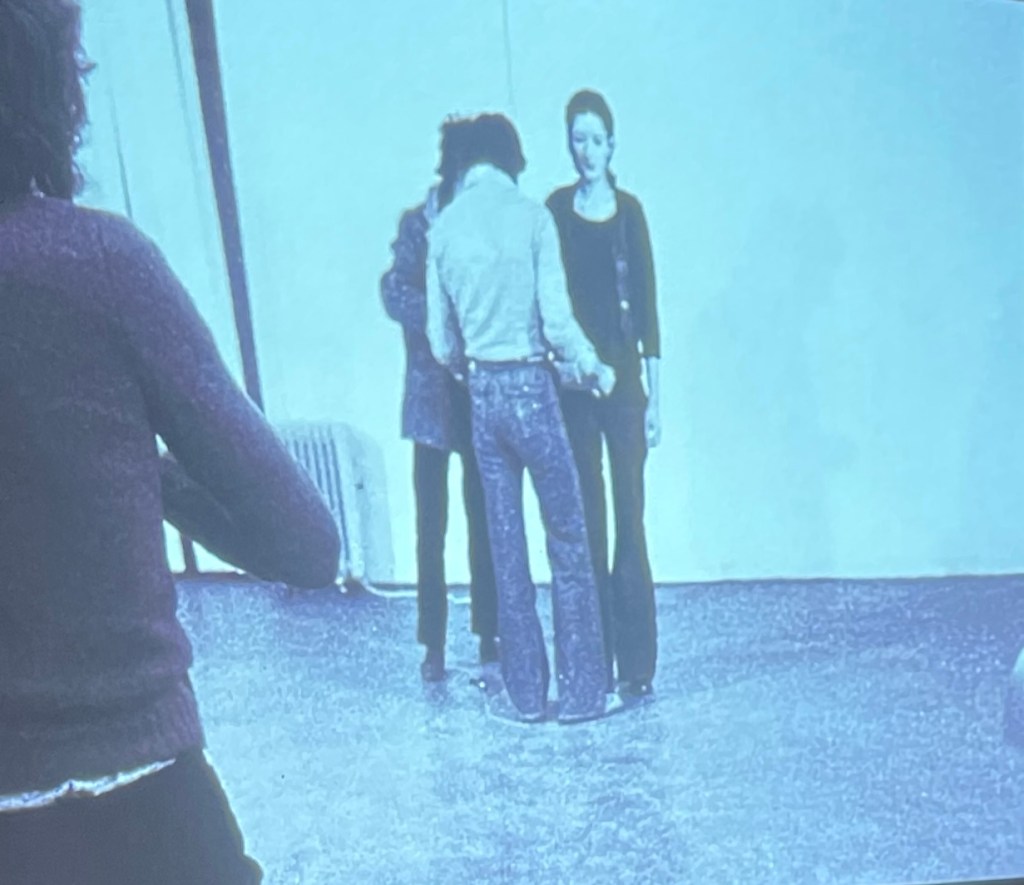
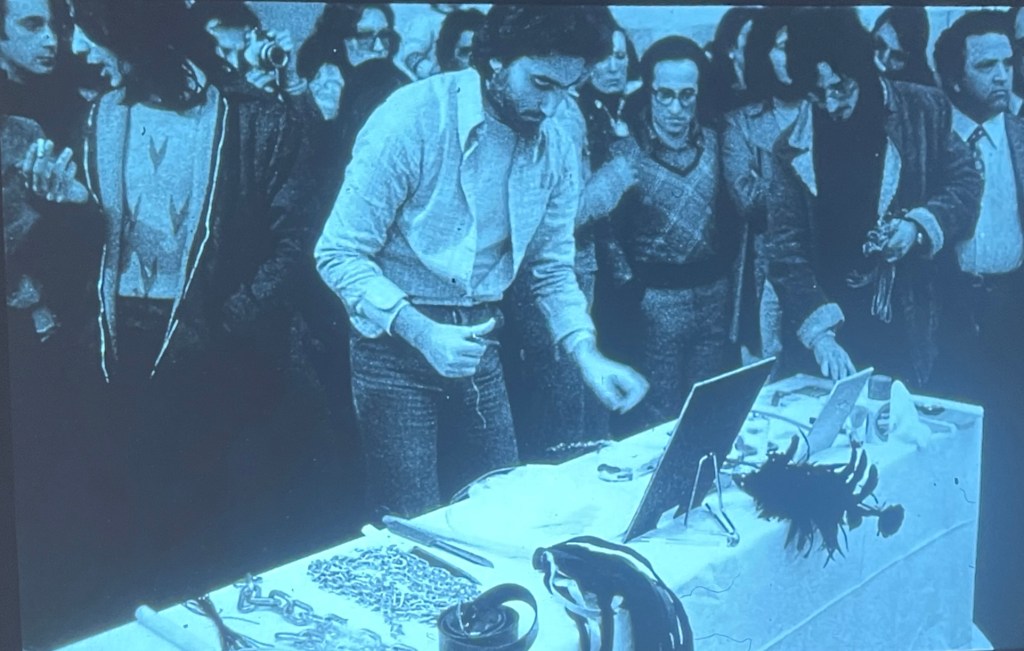
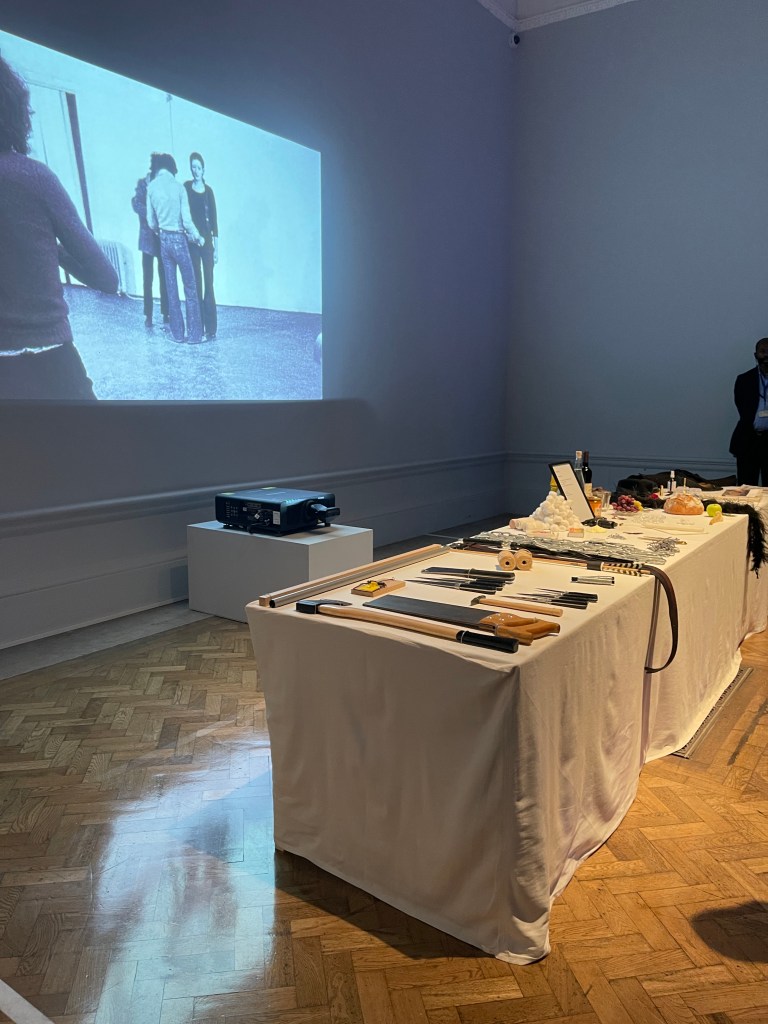
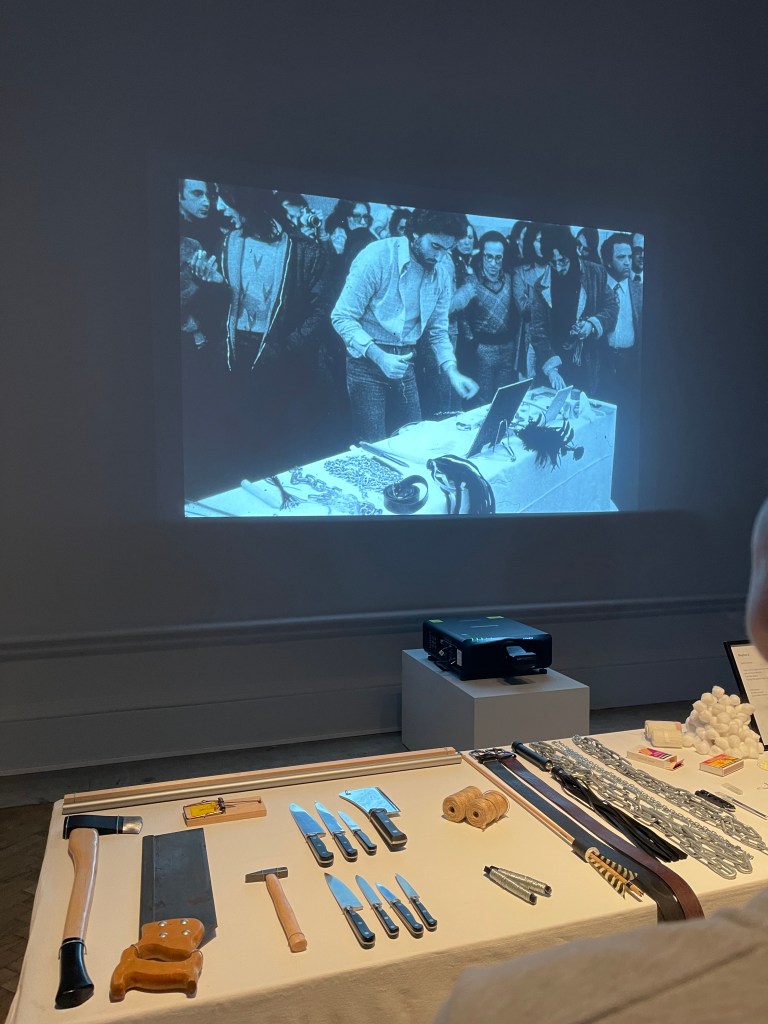
Above: Public Participation: Rhythm O. 1974
The sterile starkness of the exhibition juxtaposed to the traumatic experience the artist endured that turned a section of the artists hair white.
Eve Arnold – ‘ To Know About Women ‘ – Newlands House Gallery – Petworth
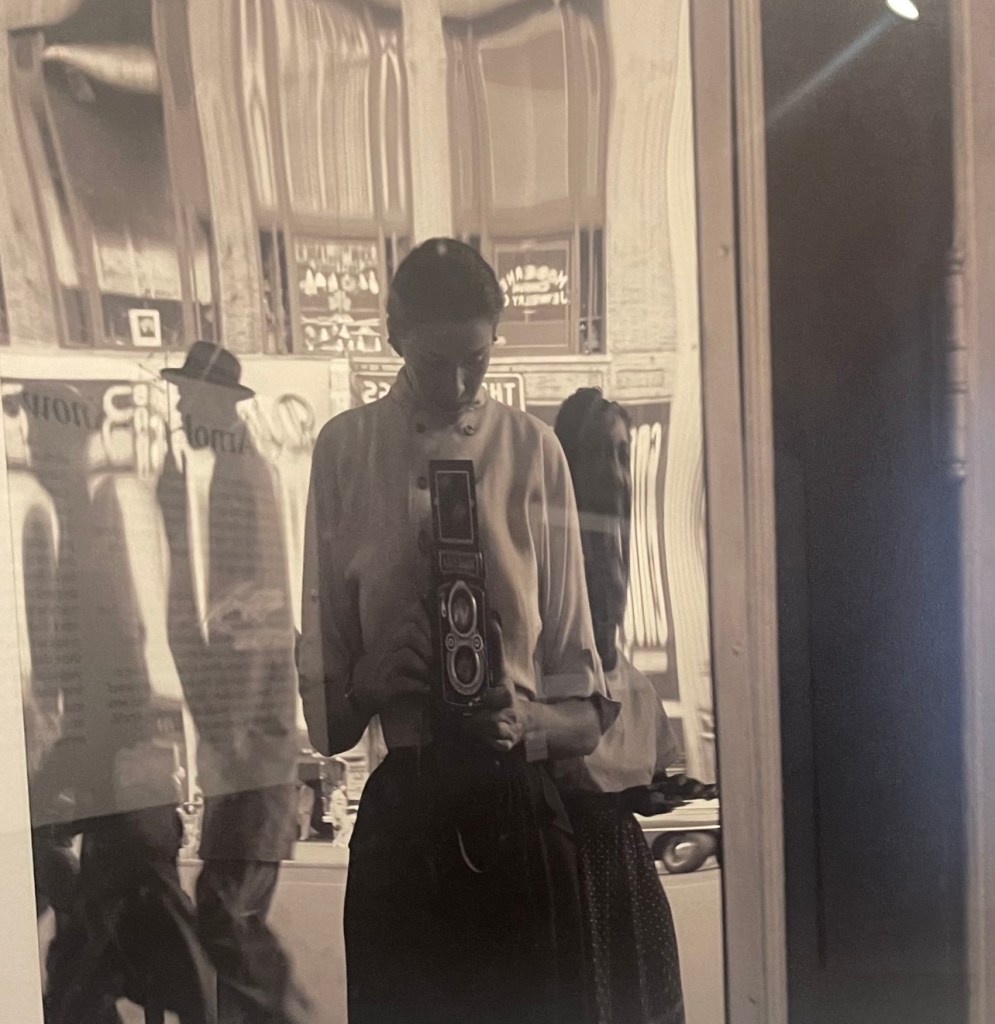
Above – Self Portrait in a distorting mirror. 42nd Street New York USA. 1950
Eve Arnold ( 1912 – 2012) was a pioneering female photographer famous for her ‘warts and all’ celebrity photographs of the 20th century but was in fact a world class photojournalist. This exhibition was an enlightening and intellectual look at her work beyond her most famous pictures. The images are of varying size, some b/w some full colour and were hung in the beautiful 18th Century townhouse gallery in Petworth, West Sussex.
The work is exhibited chronologically through out the rambling rooms and engage if a wide range of social and political issues. Above all Arnold was interested in representing marginalised people and cultures, she was not afraid to document taboo and hidden subject matter. Her subjects trusted her and hence the images show a private and quiet reality that was understated yet powerful. Her subject matter is predominantly female where she brings a confidence and power to the work despite its rawness.
“I have been poor and I wanted to document poverty; I had lost a child and I was obsessed with birth; I was interested in politics and I wanted to know how it affected our lives; I am a woman and I wanted to know about women.” (Arnold)
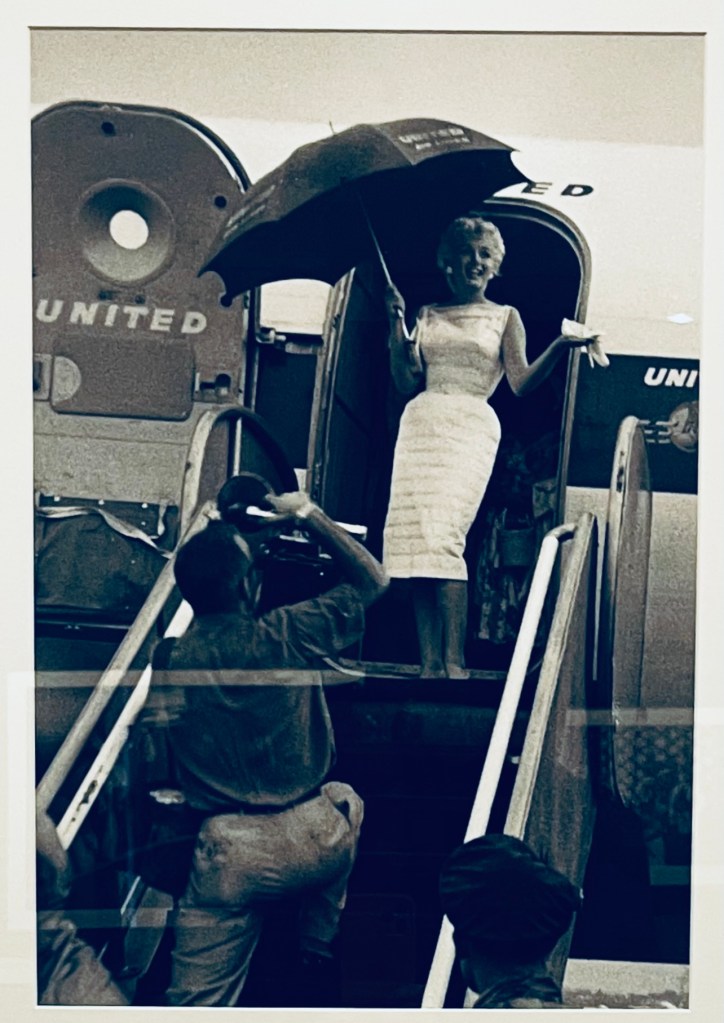
Arnold was the first woman to be admitted to the Magnum photographic agency a testament to her powerful and trail blazing work. Her ‘on and off’ images of Marilyn Monroe are perhaps her most iconic and it is touching to see such vulnerability in them. These are in stark contrast to the much disturbing images of white fascists in the crowds at a Malcolm X rally in 1962. Arnold continued to shine a light on marginalised communities like the civil rights movement but also same sex marriage , child labour and veiled women living in Afghanistan and the UAE. These all continue to have such relevance and freshness, the issues she highlighted are still here today. I was reminded of Shirin Neshat’s imagery when viewing the women in ‘Behind the Veil’, subtly highlighting the womens repression and subservience. Arnold work behind the scenes at the black fashion show during a period of black and white segregation were joyous and beautiful and remain perhaps a rare glimpse into this world.
I admit to knowing little about Eve Arnold prior to the exhibition but left in awe of her. In the final room we see a video interview of the late photographer who was eloquent, passionate and brave even in her much later years. Inspiring and quietly influential her work was making a difference opening up the eyes of the world to view her complex subject matter.
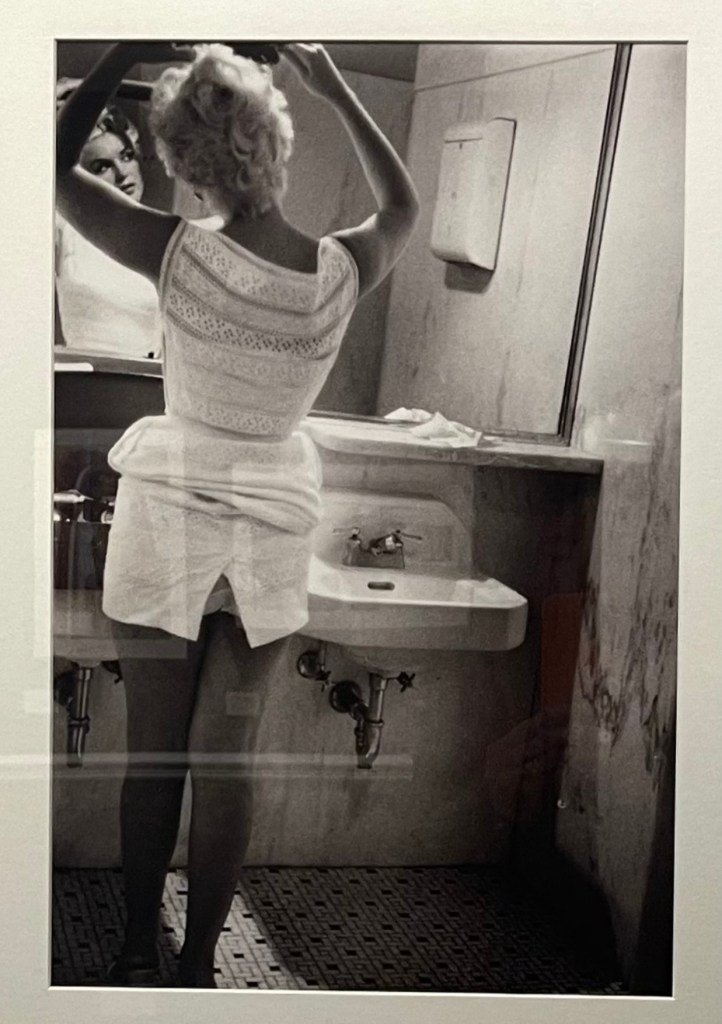
Above left – a washroom in Chicago airport 1955 – Marilyn dress hitched up adjusting her hair.
Above right – Marilyn Monroe upon arrival in Illinois 1955 – her more familiar iconic status.
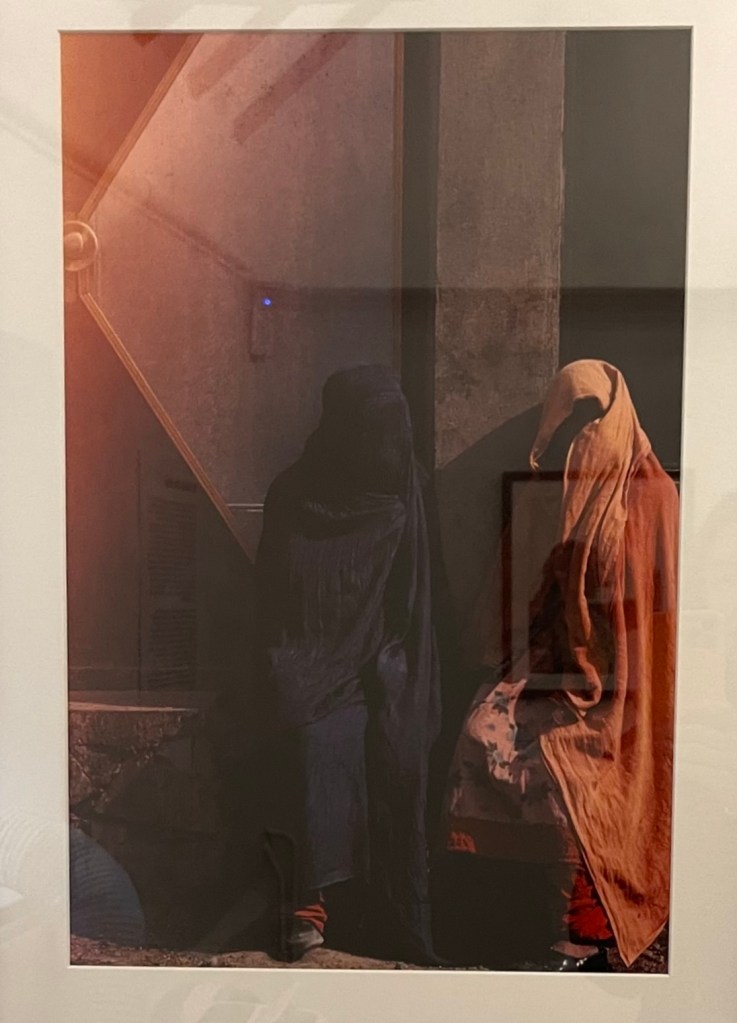
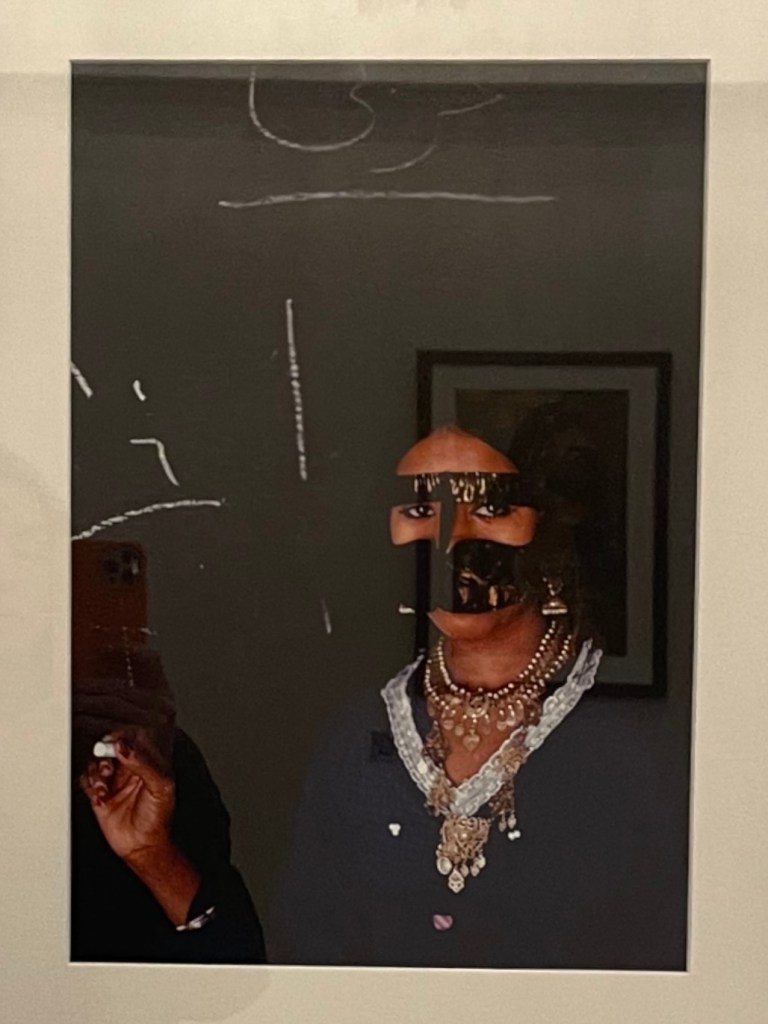
Above ( left and right) – ‘Behind the Veil’ 1970.
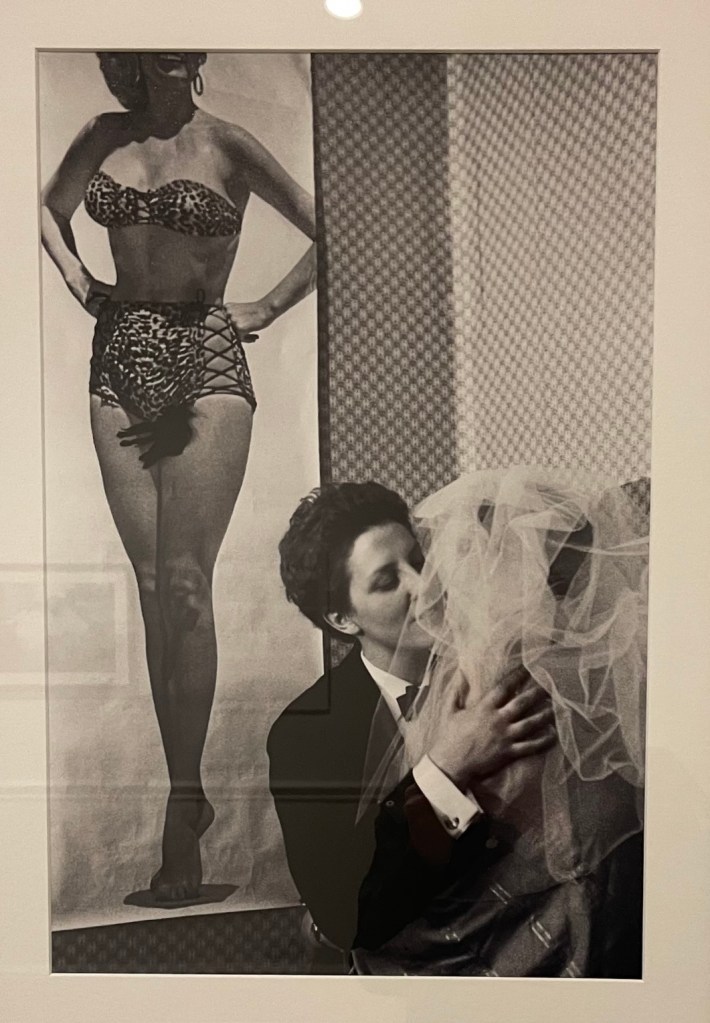
Above right – Lesbian Wedding celebration London 1965
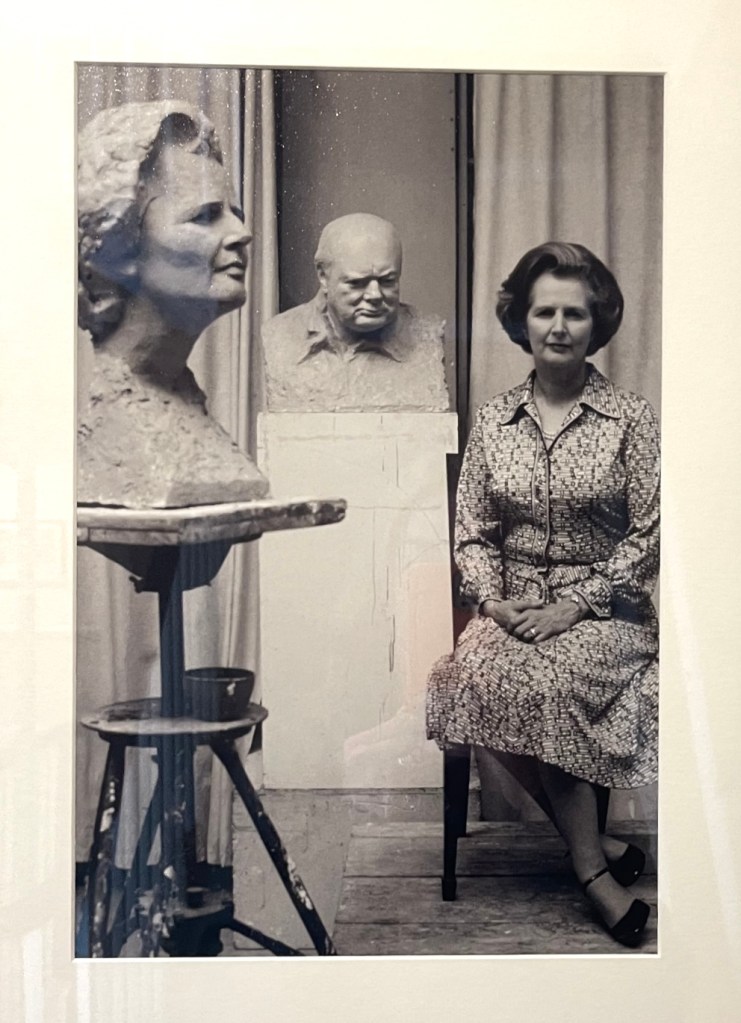
Above right – Margaret Thatcher. London 1977
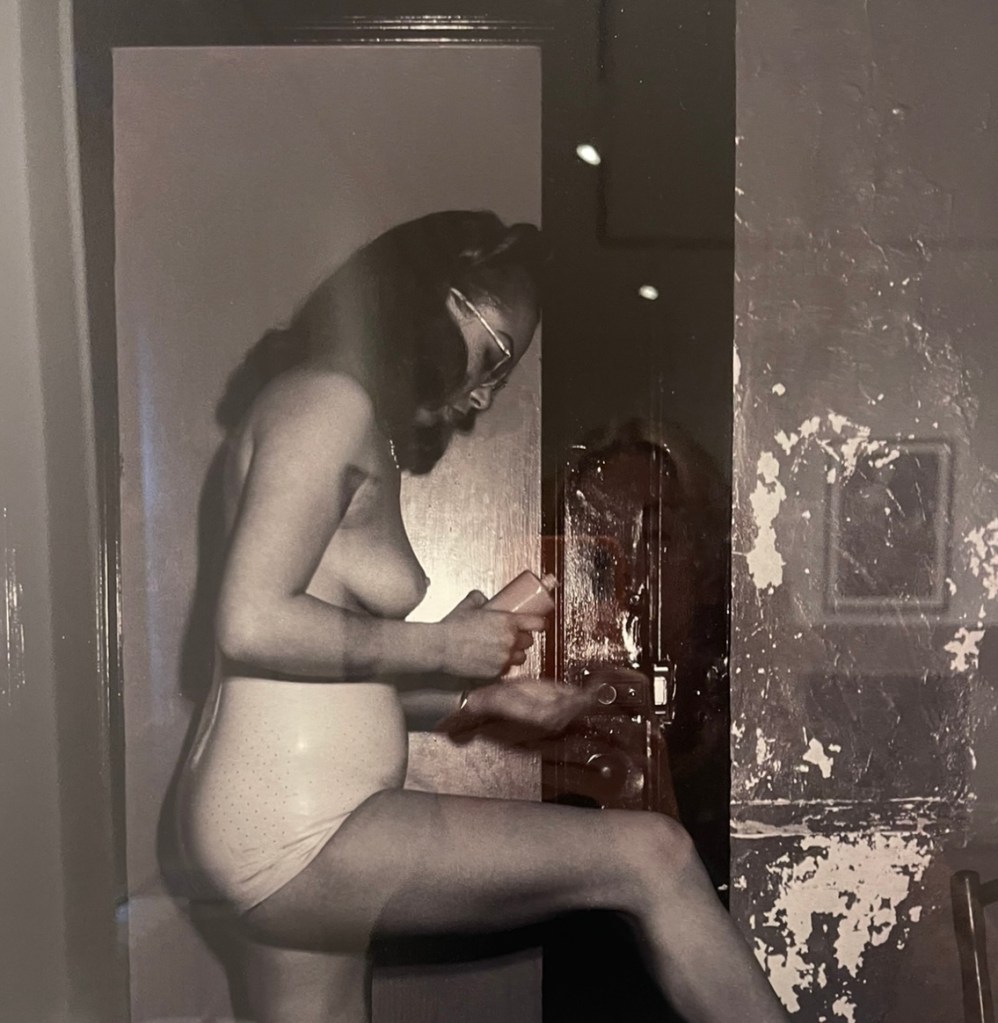
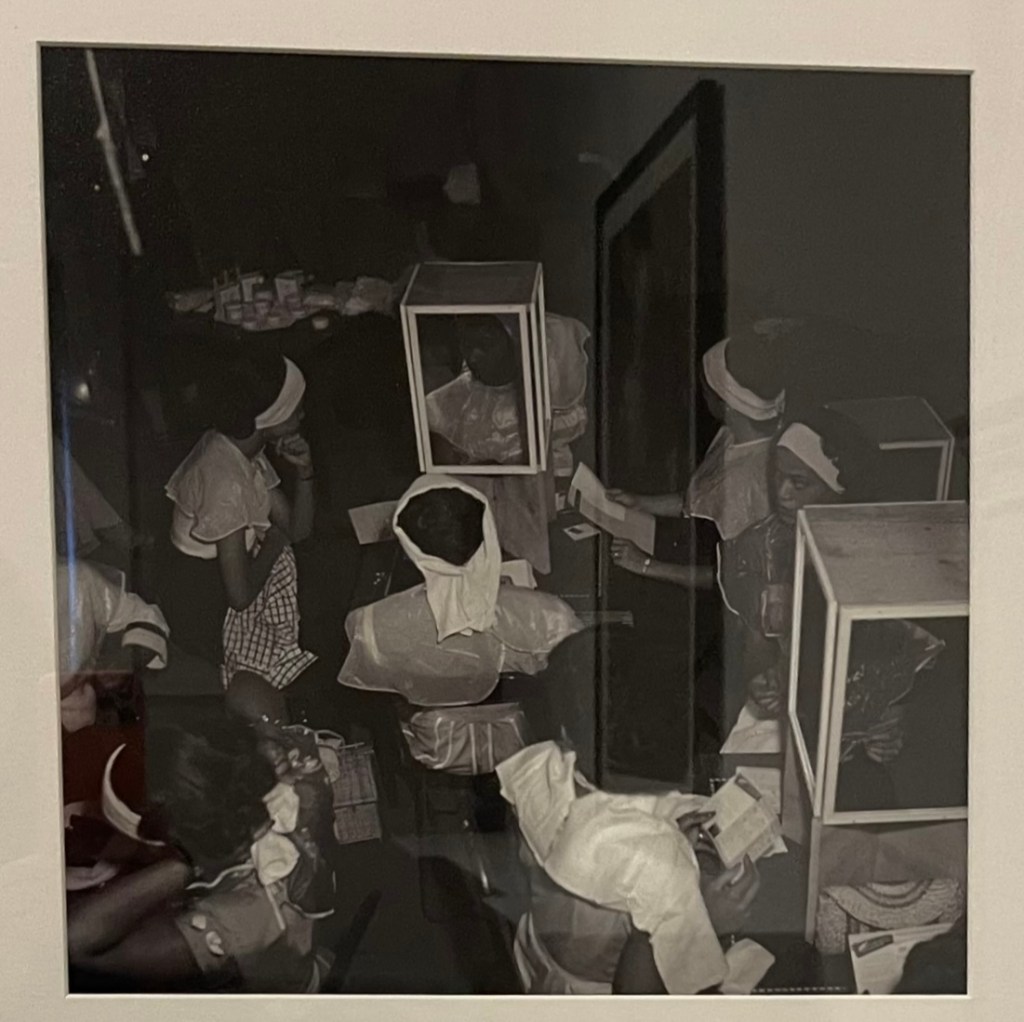
Above right The Harlem Images – These images caused a sensation due to their shocking difference to the ‘norm’.
Above Left – Hair and beauty class for young black women.
Below : Bar Girl in a brothel in the red light district. Cuba 1954
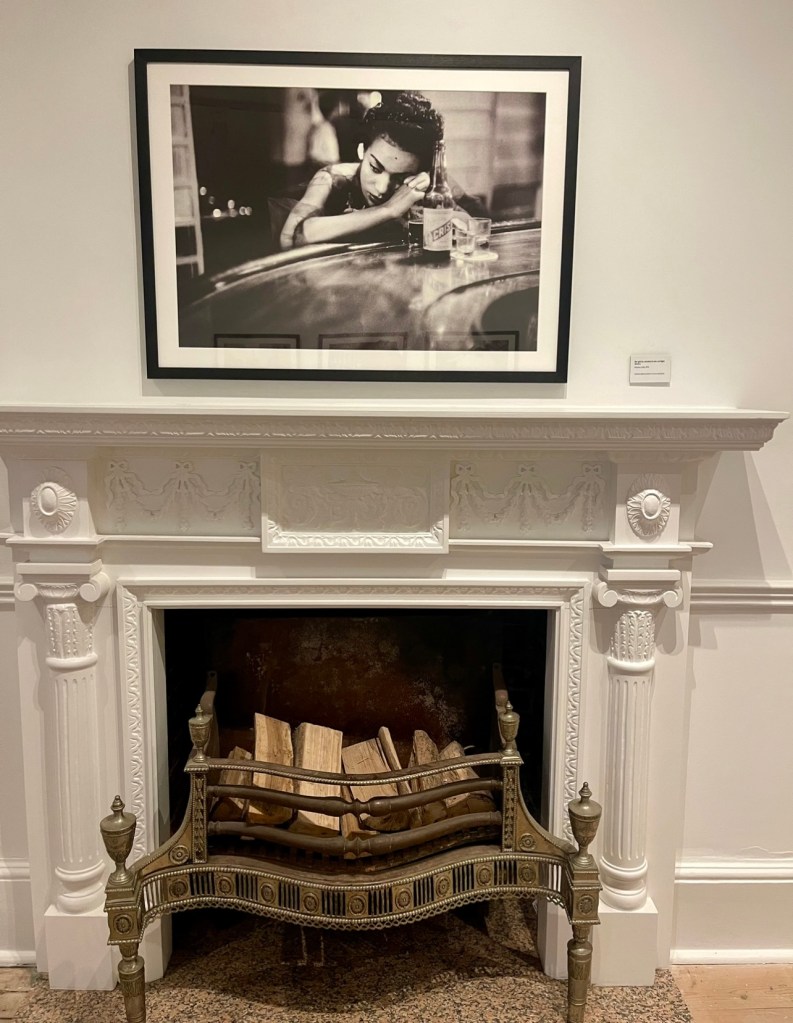
(Pictures taken whilst n gallery walls are imperfect due to reflections and angles needed to photograph .)
Conclusion
Abromovic and Arnold provided a plethora of thought provoking and diverse artistic narrative between them. They both document political events with visceral reactions, however the photographic process is crucial to both in preserving and capturing the action. Arnold is less concerned with self where as Abramovic is quite self indulgent and theatrical. They both embody and celebrate female empowerment highlighting a strength of possibilities and a pioneering spirit. I have been challenged by and informed by both of these great women.
Project 5.1
Compare and Contrast
Judy Chicago: The Dinner Party -: London 1985.
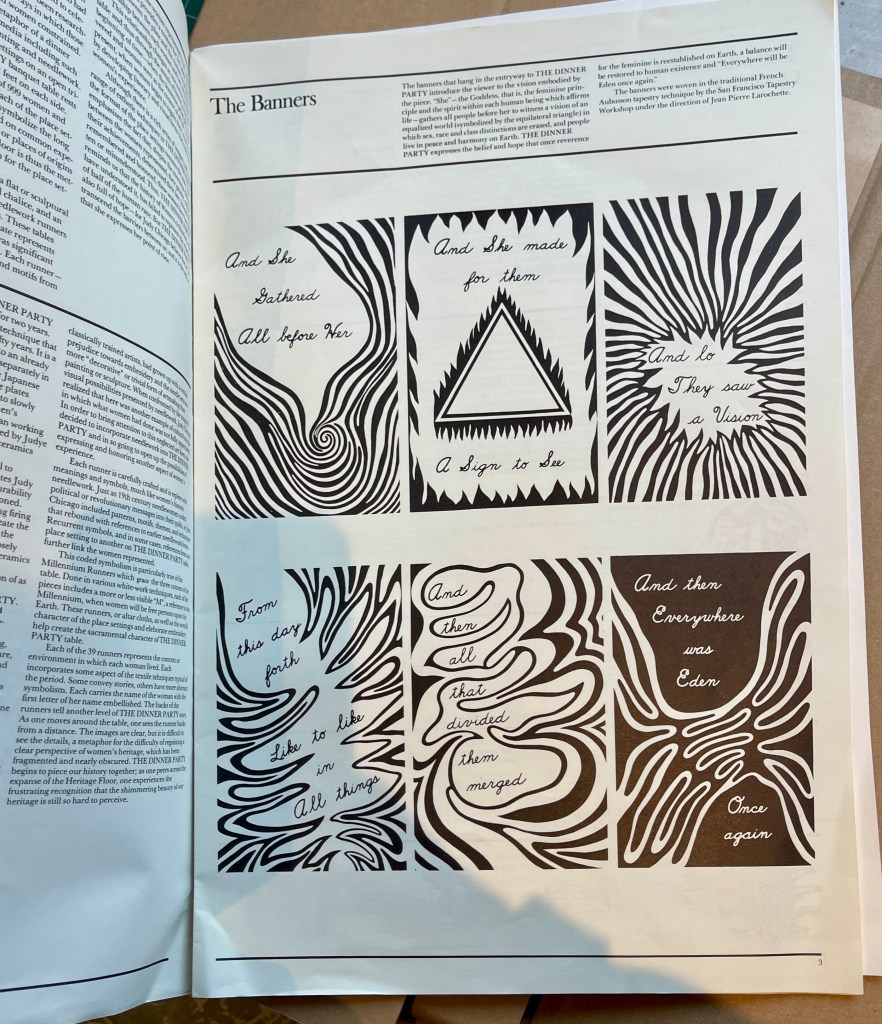
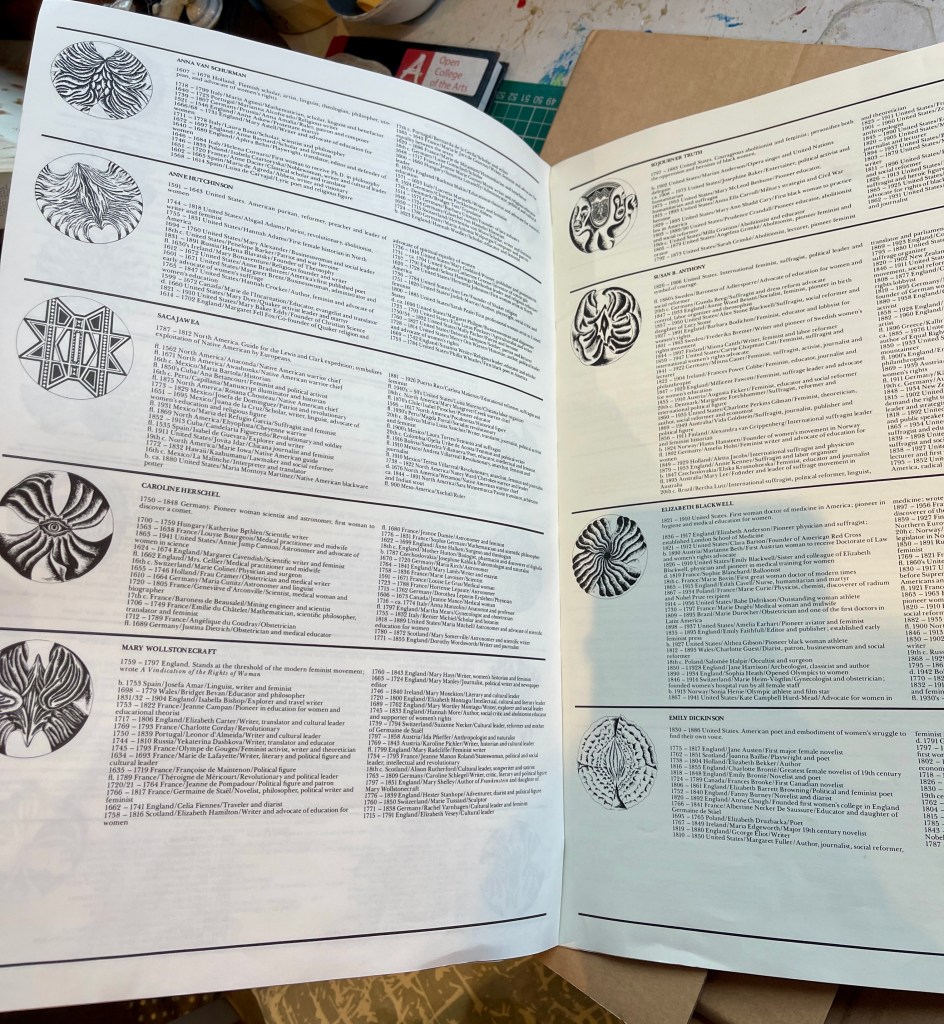
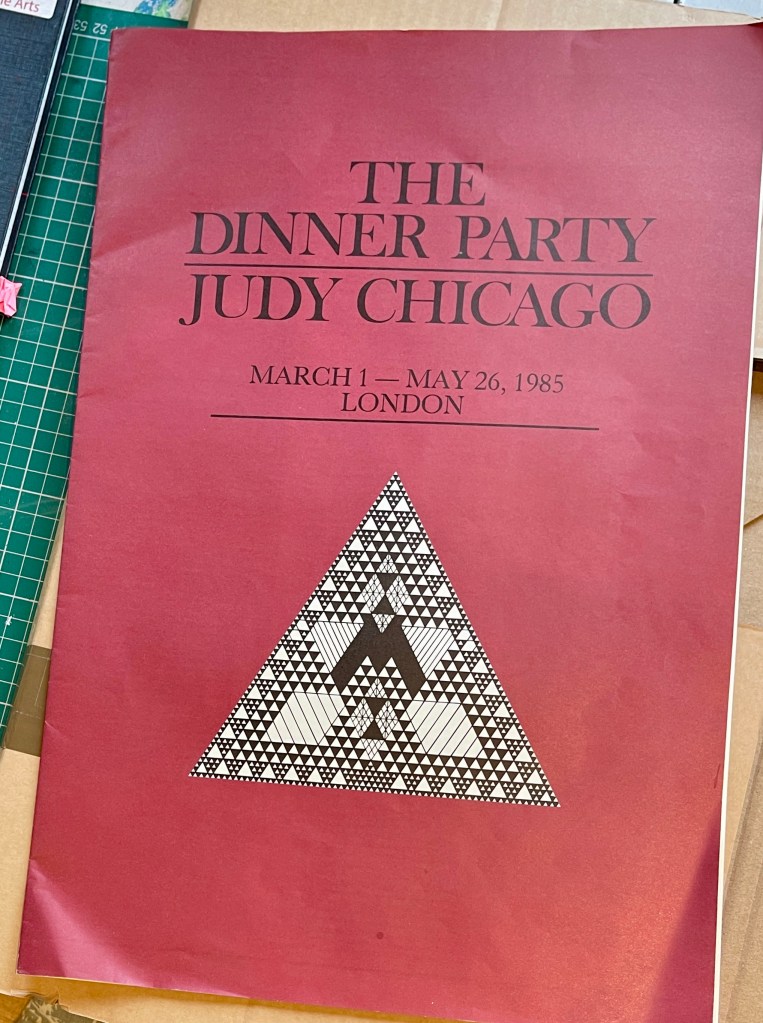
I was thrilled to purchase one of the original programmes from Oxfam online for this momentous event .
The Exhibition Catalogue: Welcome to the Dinner Party.
This text is written on the large double page folded catalogue and is divided into a few sub headings relalting to the concept and making of the project. It is written by Di Robinson head of Die hard Productions who produce the show.
The initial writing style of very specific and concerns the facts surrounding the collaboration and and fabrication of ‘The Dinner Party’. Robinson immediately points out that Judy Chicago was alone in conceiving the project but was executed by her in co-operation with working communities of men and women. Continuing to use “her and she’ by way of referencing Chicago, Robinson quite bombastically enthuses about the works context ‘ her intention was to create ‘a reinterpretation of the Last Supper from the point of view of those who had done the cooking throughout history’ . The descriptions are concise as Robson details the works statistics and specific placement. Robinson alludes only briefly to the deeper meaning behind the work when describing The Heritage Floor as ‘metaphoric as well as the literal foundation of the place setting on THE DINNER PARTY. ‘All previous and further mentions mentions of the work are set out in capitals through out the brochure, highlighting its title at a glance. The list of description continues with a brief mention as to the relationship between plate and runner and woman depicted. The description is objective at this stage and only later in the text do we see a more passionate language begin to emerge.
Robinson refers to bold statements concerning the work ‘gender rather than achievements, determined their fate’. and ‘these women have been forgotten or misunderstood’ There is a passion here likely driven by Judy Chicago herself as she continues with battle cry of ” the history of Western civilisation as we have understood it, has failed to represent the experiences of half the human race ‘ A powerful and though provoking statement offering a viscerl context to the works narrative.
Later prose is dedicated to greater detail of process and material, describing the crafts and and naming the individuals and teams that helped create the work. unlike other ‘factory based ‘ artists studios today of say Keff Koons or Damien Hurst there is an honesty and openness embracing of the other crafts people involved in the work. Robinson discusses the cultural myopia concerning needle crafts that Judy Chicago has encountered and her desire to celebrate and honour another aspect of women’s experience. There is a warmth and gentleness to the language words like crafted, skilled and art-making are peppered through out the array of collaborative practices.
Robinson text concludes with general descriptions of the symbolism and stories offering context to work but in little specific detail. She mention how one might view the artwork , moving around it, looking at it from behind but mentions the difficulty in seeing the full detail of the work. Robinson then pointedly concedes that this might be a metaphor concerning the ‘difficulty of regaining a clear perspective of women’s heritage’. Her strong and pertinent language is juxtaposed in her final more gentle and feminine description when she states that ‘the shimmering beauty of our heritage is still so hard to perceive’..
The rest of the brochure/catalogue is full of beautiful black and white drawing of the banners and place settings that list the names of the women who have been offered prominence at the table. It is in itself a work of art. The banner text introducing the ‘viewer’ to the vision of the works they are about to encounter. This uses more explicit and emotive language perhaps seemingly old fashioned and ‘hippy’ by todays standards but apt for the time and context it was expressed in and the new wave of feminism that surrounded the works. “ THE DINNER PARTY expresses the belief and hope that once reverence for the feminine is reestablished on Earth, a balance will be restores to human existence and “Everywhere will be Eden once again”. I actually found this beautifully emotive and still relevant today, plus a necessary inclusion into the carefully constructed and generally practical, relatable catalogue with an unwavering passion to the cause .
Article : Ocula Magazine 2023. ‘Herstory ‘ ( Retrospective ) Exhibition
In conversation with Judy Chicago and Massimiliano Gioni ( Artistic Director of the New Museum)
The exhibition adopts a curatorial framework to present Chicago’s pioneering contributions to feminist art history, positioning her six-decade practice amid the rise of second-wave feminism and highlighting her conviction for preserving women’s histories.
This text is an transcript of a conversation between Judy Chicagi ( JC) and Massimiliano Gioni ( MG). MG is interviewing JC in light of her retrospective ‘Herstory’ (Nov 2023.) There is a brief introduction outlining the purpose of the exhibition that was aimed at understanding the practice of JC well beyond her well documented THE DINNER PARTY . There is a short description of what work the exhibition consists of and on what floor it can be fond on. It then covers the materials and media JC used over her career. It states that the museum only lightly touches upon some of JC better career pieces in order to examine a fuller breadth of practice and lesser known works. After some further basic descriptions of large scale works, noting their past inclusion in shows dominated by male artists at the time. This is expanded upon in a factual manner reflecting on JC as a minority female artist on the scene at the time in the early to late 1970s – 80’s. The article references the exhibition as JC envisioning a woman-led world.
MG asks JC opens questions concerning what and who is an artist? This open and broad question receives a melancholic reply from JC reminiscing on her fathers musing and early college days, culminating in a discussion concerning The Dinner Party and its initial critcal savaging. JC is open and honest and uncomplicated in her answer albeit long. JC is comfortable and confident in explaining that her work was indeed quite seminal in pushing feminist views and art to the fore front. JC explains she has not been commercially aware during her only career and only sought to make art with a voice. None of JC statements or historic perspectives are questioned by MG, who allows JC to wallow and indulge in a lengthy and quite self congratulatory reply. In fact quite the opposite as MG goes onto to further question in a shocked manner why the early art establishment did not recognise the greatness in JC .
The conversations dilutes in to further disbelief about women artists marginalised role and the patriarchy’s dismissal of them and other gender spectrums through out art history. JC’s strong views on how she wants artwork to be viewed and curated is outlined in no uncertain terms. Her views are left unpicked and the following questions are directed towards language in JC’s art. The article is full of agreement and concurrence, MG not willing to push any buttons that might contradict JC’s views and opinions. His language and questioning is not controversial or particularly enquiring. This seems to be an open and non threatening platform for JC to discuss her historic career unhindered there is no partiality from the interviewer. JC does allow for some context to her work to come in to the conversation but continues to discuss her struggles to be taken seriously in the marginalised environment. JC is firmly put on a pedestal throughout the piece, rightly or wrongly. It is an interesting discourse into her career and the early obstacles she overcame and the more famous male artists she met along the way. A question from MG concerning ‘ is art a gender?” was perhaps the most interesting and pertinent, JC reply was curt;
Of course, I understood that gender was a construct. There just wasn’t that kind of theoretical language that there is now.
JC then went on to discuss the construct of masculinity, queer theory, and gender as prior to her this was not easily or readily accessible. This historic disclosure was insightful and allowed the reader to recognise more fully the era and culture so prominent during her early days. As MG goes onto call JC a role model and questions the burden of this I felt the conversation had reached celebrity self congratulatory status. Was it perhaps a little trite and unnecessary and would one ask this of a a male artist of the same calibre ? JC seems to be of a similar opinion.
JC is powerful and unrelenting in her manner and voice , a fighter, a feminist and above all seeks a fair playing field for all genders. The article was not particularly enlightening or even disclosed otherwise hidden depths to JC it was informative and served to firmly stamp JC’s unbridled opinions onto the art world and to a slightly intimidated interviewer.
Article by Melena Ryzik New York Times – Culture Reporter. Pulitzer Prize winner.
Ryzik is reviewing the ‘Herstory’ exhibition.
The article begins with a description of the galleries first instalments “Trinity Hoods” .
‘They frame a set of three wall-mounted “Hoods” (1964–65/2011), eye-popping compositions of vulvar, phallic, and geometric shapes spray-painted on car hoods.’ (Ryzik)
We learn that JC did in fact attend an auto-body school to lean spray painting – she was the only woman out of 250 men. A meaningful fact to be made aware of and adds to the irony of the artwork described by Ryzik who is amused at the imagery and and double entendre of it. The reader is immediately engaged in the personal opinion of the journalist and her relatability to the work. We are told JC founded the first college level feminist art programme in the US and released coloured flares and smoke into the landscapes liberating colour along with herself. I was impressed by this description and imagery that seemed to immediately convey the nature and context of the art work.
After much dissecting and research ( through out the industry ) there is finally some negativity from Ryzik regarding JC in regards to her work with Miriam Schapiro who made feminist collages.
‘I’ve long been hesitant about that imagery, wondering about the exclusions suggested by its literalness. It seems, like a pussy hat, to premise womanhood on organs alone.‘
A relatable and questioning point that further engages the reader to re consider JC as a modern day feminist the icon. Latter reviews of JC paintings are described as transcendent, luminous and spiritual by Ryzik in a flurry of what seems like genuine admiration and gushing. Ryzik is in agreement with the establishment when it comes to The Dinner Party, citing its mass collaborations, reclaiming ancient practices and traditional craft denigrated as women’s work. She is equally positive about the “Birth Project’ using superlative and positive language to describe its materiality and imagery.
Ryzik is less supportive of JC ‘s later work, citing its more literal content as too weighty, with ‘anguished imagery’ unclear in its purpose. Its a bold view and I am in agreement having viewed them. She further critiques the over simplistic imagery that some how serves to reduce complex dichotomies and subjects. I perceived there was a strained tone to these works that Ryzik was trying to understand and convey to the reader.
Ryzik’s analysis continues with the conclusion that the banners crafted for Christian Dior in 2020 – ‘queries on the inane’ expressing that the project felt painfully outdated. As a reader I wondered, reading between the lines, if there wasn’t some constricting parameters placed on JC by Dior that wasn’t comfortable to rock the boat too much with the postings of feminist outrage. Ryzik plants this seed of doubt. Concluding that JC need to move on from her gender stereotypes of whiteness and the middle class experience where the emphasis is purely on gender as this has served to be a heavy handed narrative of old wave feminism.
‘Not all of women’s work is about womanhood. Chicago — who spent so much of her career pigeonholed — should know.‘ ( Ryzik)
This article was refreshing and concise allowing the reader to see beyond the iconic works of Judy Chicago to the new. Questioning her narrative as still relevant and on point when perhaps certain aspects have moved on in society. The tone was critical in places but not in its entirety. The language was objective, this was an open review not in the hands of a commissioning gallery or curator. It offered a more rounded and alternative view to the overwhelmingly gushing views of the art establishment.
Ryzik. Judy Chicago. New Museum . AT; http.://www.nytimes.com/2023/10/12/arts/design/judy-chicago-new-museum-art-feminism.html ( Acessed Nov 2023)
Ocula Magazine . Judy Chicago comes out Swinging ; At https://ocula.com/magazine/conversations/judy-chicago-comes-out-swinging/ (Accessed Nov 2023)
Project 6.1
Draft Research Question :
At this point I am still wavering between a number of options – Mostly on a similar path regarding ‘femaleness’ but with the added potential question concerning female mental health representation in art. Fine tuning the question with the overwhelming amount of material associated with feminism and the female has been difficult to navigate. Female mental health representations seems a less documented topic with more clarity of question and research parameters.
Possible titles :
1 Femaleness. Exploring this collaborative inclusive concept aimed at venerating the notion of what it means to be female in society today. How does it fit into the second wave of feminism and what are its current artistic representations?
or
2.What is the definition of ‘Femaleness’ in art culture today. Can it be seen as a collaborative and inclusive concept/viewpoint across a global society?
3. “How does semiotics in art contribute to the understanding and deconstruction of gender stereotypes in visual media through a feminist lens?”
or
4.“In what ways can semiotic analysis be employed to examine the portrayal of women in art, and how does this analysis intersect with feminist perspectives on representation and empowerment?”
Explore work from the past for and the veneration of the female example, ancient Artemis Temple, The Guanyin of the South Sea of Sanya ( Shrines)
Later collaborative work from , Judy Chicago, The Sister Chapel, looking into more recent work by The Reformers, The Women’s Table at Yale Uni. Guerilla Girls, others ?
Individual Artists working in the context of feminism/femaleness etc
Celebrating the female – Hashtag METOO movement as a conclusive new agenda LGBTQ+ and corresponding art work
Key feminist art theorists today : Linda Nolan, Griselda Pollock, Simone De Beauvoir, Judith Butler, Helelne Cixous, Luce Irigaray
Barthes, Berger Semiotics.
Visual Cultrue…
Art and Mental Health –
“How does the semiotic analysis of fine art contribute to our understanding of the representation of women’s mental health, and in what ways can artistic symbolism and visual language be employed to challenge or perpetuate societal perceptions and stigmas surrounding mental well-being in women?”
How has female mental health been traditionally represented in art. Who are the artists addressing these concerns to effect positive changes in attitudes and expectations that will impact on female mental health …?
or
How has art traditionally depicted the mental health of women? Which artists are actively addressing these concerns to foster positive changes in attitudes and expectations, ultimately influencing the mental health of women?
Looking into early representations/ depictions of women in weakened states of health, physical and mental under the make gaze.
Artists ( female ) changing the narrative and portrayal today.
Images of strength, empowerment of the female
feminist theories – male gaze etc
Assignment 2
Proposed Research ethics and methodology and theoretical frameworks:
Literature Review : My research will come from a collection of books and text that I have identified as suitable resource material: These include work by individual artists I will research plus academic works regarding art theories and visual culture and research consultations. I will conduct a reflective ( practice ) review of this information and data.
Participant work / Collaborative work – potentially looking at artist response feedback to Veneration Project – art work produced by fellow artists in response to sending out my post card sized art work. This will be confidential and anonymous if required by the participant.
I will aim to be aware of my own biases and assumptions. My context and influences that may affect / influence research and interpretations.
I will look at a cross section of culture and ethnicity in my research. Artists and theorists from a cross section of society and culture and more. ( LGBTQ+ individuals )
My analysing of works and or interpretations will be fair and rounded with out stereotype and pre conceived notions . I will state/outline what constitutes the notion of ‘ poor or weak mental health; as defined accredited medical profession.
I will state what is accepted and defined when using words such as “feminism’ ‘femaleness’ etc from approved academic sources.
I will look to offer conclusions that promote awareness, positive change and understanding of the sensitive topics raised.
500 word research summary
My research material is informed by my Advanced Practice and my exploration into Female depictions of Mental Health in art and also the separate but corresponding concerns regarding “femaleness’ as a collaborative inclusive theory and practice. Both aspects of my work include looking at female depictions in visual culture via the male gaze or the patriarchy.
At a crossroads of exploration I can assert that these two concerns will have mutual overlays in regards to feminism, empowerment and subverted female achievements and depictions of the past. My research is aiming to explore areas of feminism that relate directly to artistic visual culture. Looking for evidence of semiotics that embrace ‘femaleness’ as opposed to the feminine exclusively in order to establish what is the essence of ‘femaleness’ and what it means today. Can it be seen as a collaborative, positive sate with inclusive traits that will in turn bring togetherness in societies and cultures torn apart by segregation, bias and discrimination? Feminist theorists including ; Judith Butler, Lynda Nochill, Luce Irigaray will be reviewed along side artists such as Maria Abramovic, Tracy Emin, Jenny Saville Shirin Neshat, Carrie Mae Weems to find symbiotic references most relevant to my concerns . I will explore artists over the last century cross culturally that have sought to to bring about change. I am aiming to receive some artistic responses to my work on ‘Veneration’ ( Shrine) from fellow female artists. This will be an additional avenue of thought and process to explore based on feedback and interpretation.
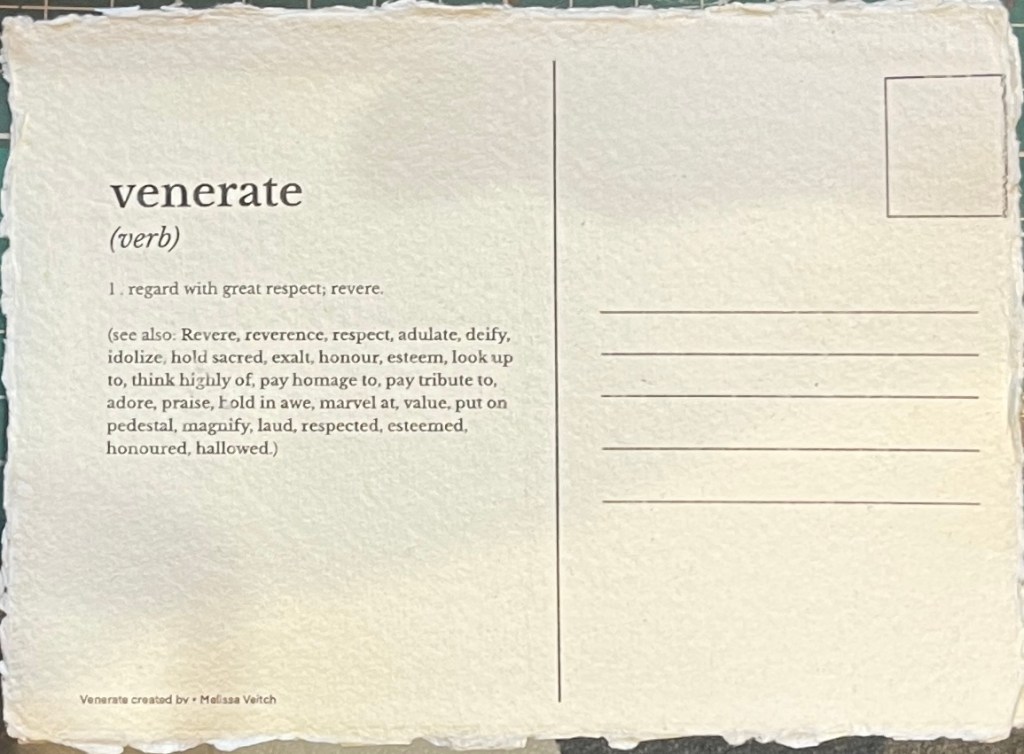
Semiotic of ‘Veneration’ ( Shrine)
Back of Post card below:
Alternative research focussing on female mental health will be explored via a range of publications concerning the historic descriptions asylums of the 18th/19th century and their powerful negative depictions in art and the time through to the Surrealist art movement in the 1920’s and beyond. Looking at embodied semiotics and commonly used representations of mental health. It will include an exploration of artists pushing boundaries of representation in this field and theorists such as Donna Haraway and Laura Mulvey.
Murmuration – ‘ Our fear like Starlings ‘
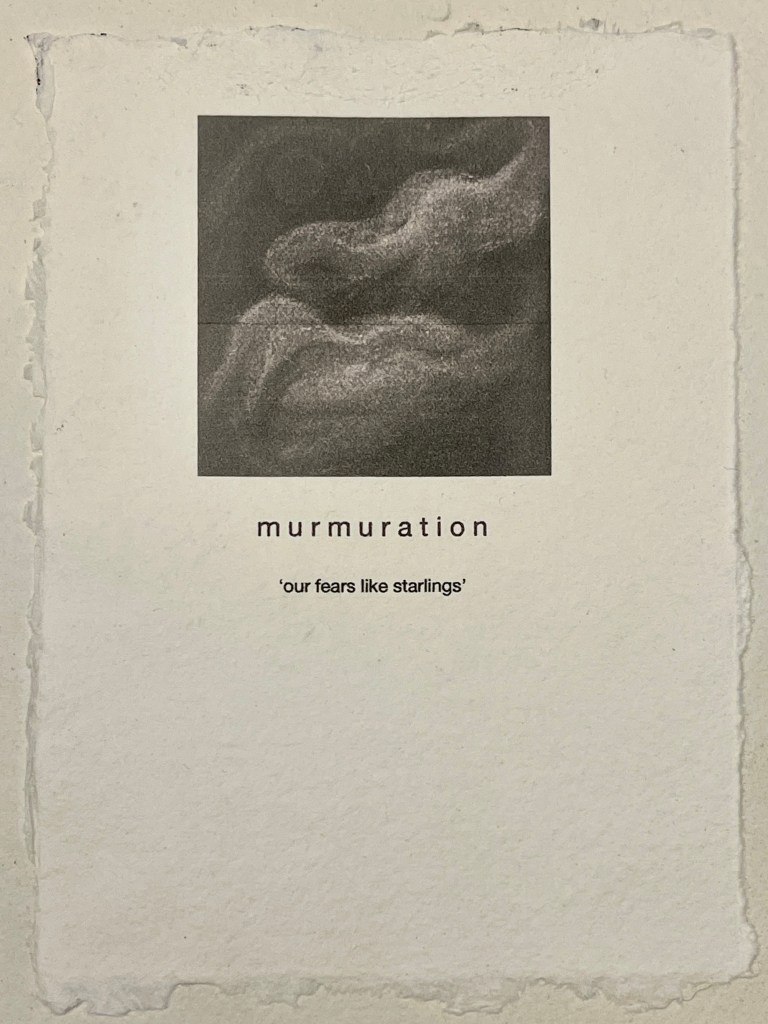
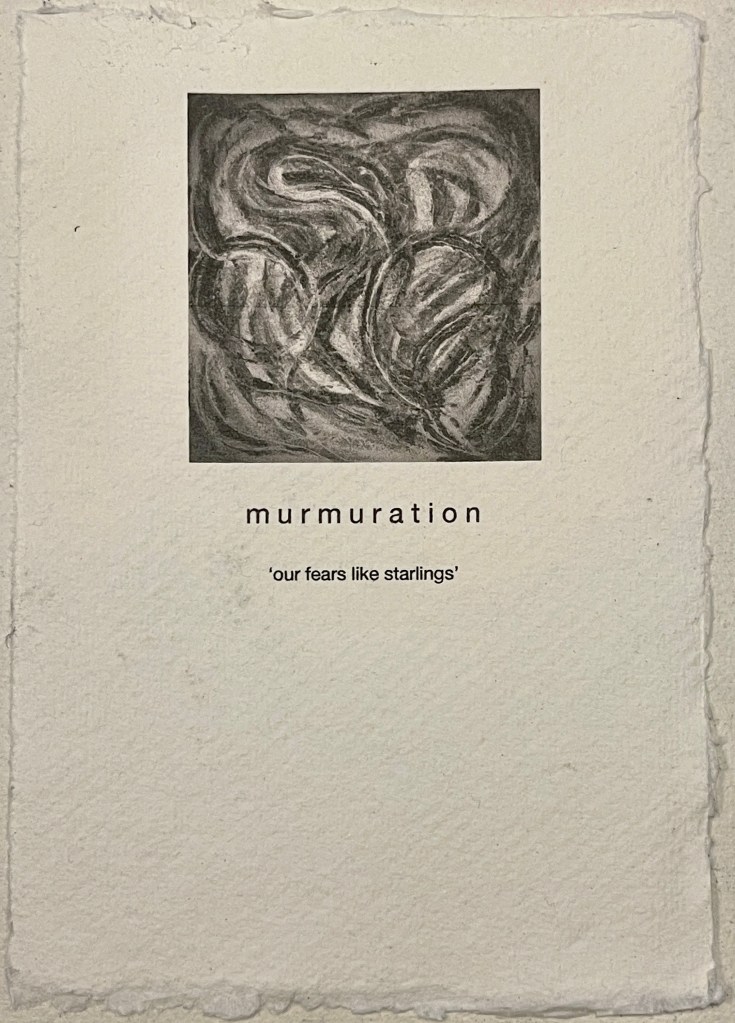
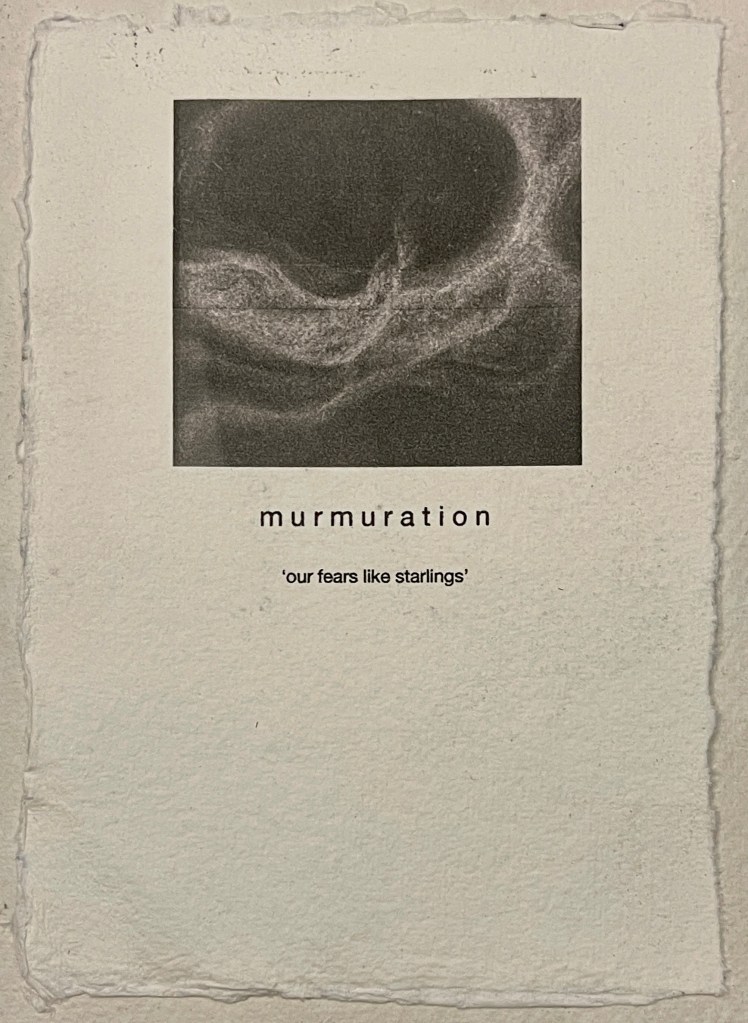
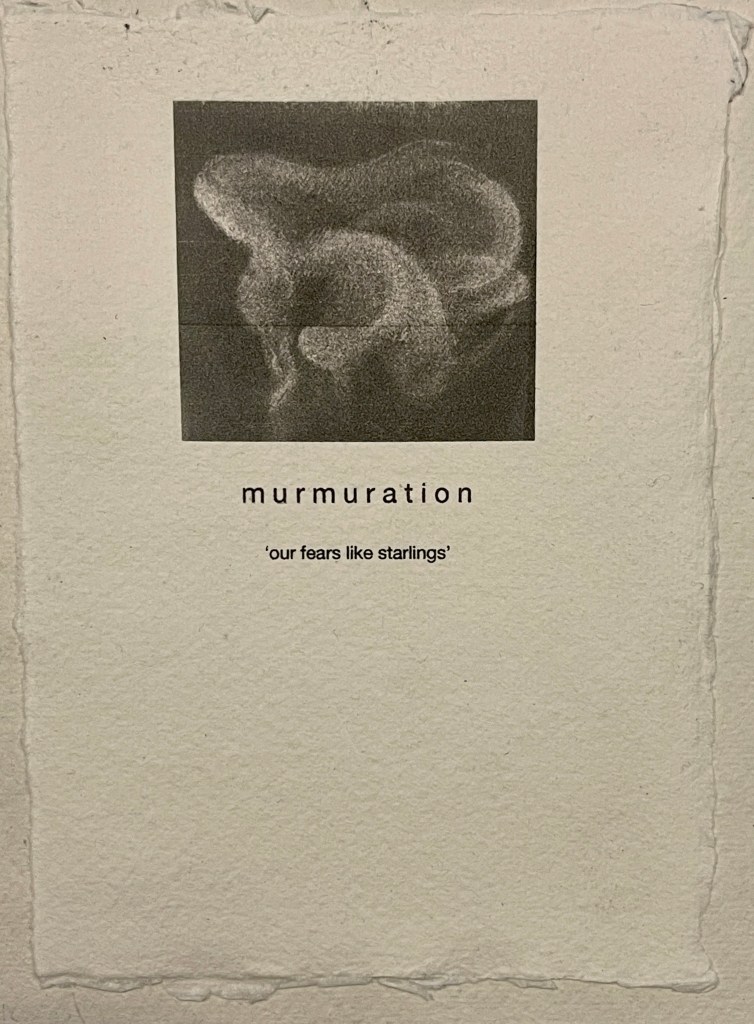
In both topics of research I will look to explore the positive impact of artwork and artists that have been trail blazers in addressing issues of female positivity, and equality cross culturally. In conclusion I will aim to to bring together positive and negative attributes of the research findings. Has visual cultures depictions and values moved sufficiently into the next phase of intent and identity concerning the female and all who identify with her.
 The Sharpe Gallery