Ex 1.1 The Everyday.
My current practice draws directly on my every day life and in one particular function of that every day life – perhaps the most boring and mundane of chores that is so often left to the ‘house-wife’ or ‘home-maker’ ( ‘home-manager’ ) role … a role usually taken on by the female …and that is the family washing. This endless task with its routine and rituals or gathering/ collecting, cleaning/drying and folding and redistributing has come with a material gift that I have become to get rather excited about. The waste fluff and debris that collects inside the tumble dryer. I have been collecting it for months now and have explored the various way I mightbe able to incorporate into my practice and enquiry. Taking int account such concerns as the ‘domestic tropes’, ‘women’s labour in the home’ ‘traditional home-maker’ the ‘discarded and the everyday’, ‘material detritus’, ‘machines of labour’ etc
My creative process or making patten generally comes after a period of machine collections. So it may be 5 -7 days between each creative session to allow the material to build up enough to allow for a work to begin. In between times I might be reviewing artists that work with unusual materials and exploring concepts around this. As I have a home studio base I find my work is fully integrated in to my daily life and chores as a mother, dog owner, home maker and freelance stylist. Im am not sure I would be able to work in a studio away from my home due to ease of access and the daily juggling of all other matters. For me this set up is ideal and I swap and change between my different ‘hats’. Not to mention that I have to pass the utility room (where the washing machine and dryer sit ) as I access my studio. I can even hear the ‘beep’ when the dryer finishes its cycle and I know I have a batch of new material to pick up !
Taking Stock: Appraisal and Evaluation:
size
scale
palette
form
materail
sound
temporality
subject matter
tactility
tone
quality
character
My own words would include:
Material narrative
Relatability
Originality
Connectedness
Viewer engagement
Textual narrative
Enquiring
Qualities of ‘femaleness’
the hidden
found object
The over – looked
Relating words to works:
Collage of words and work.
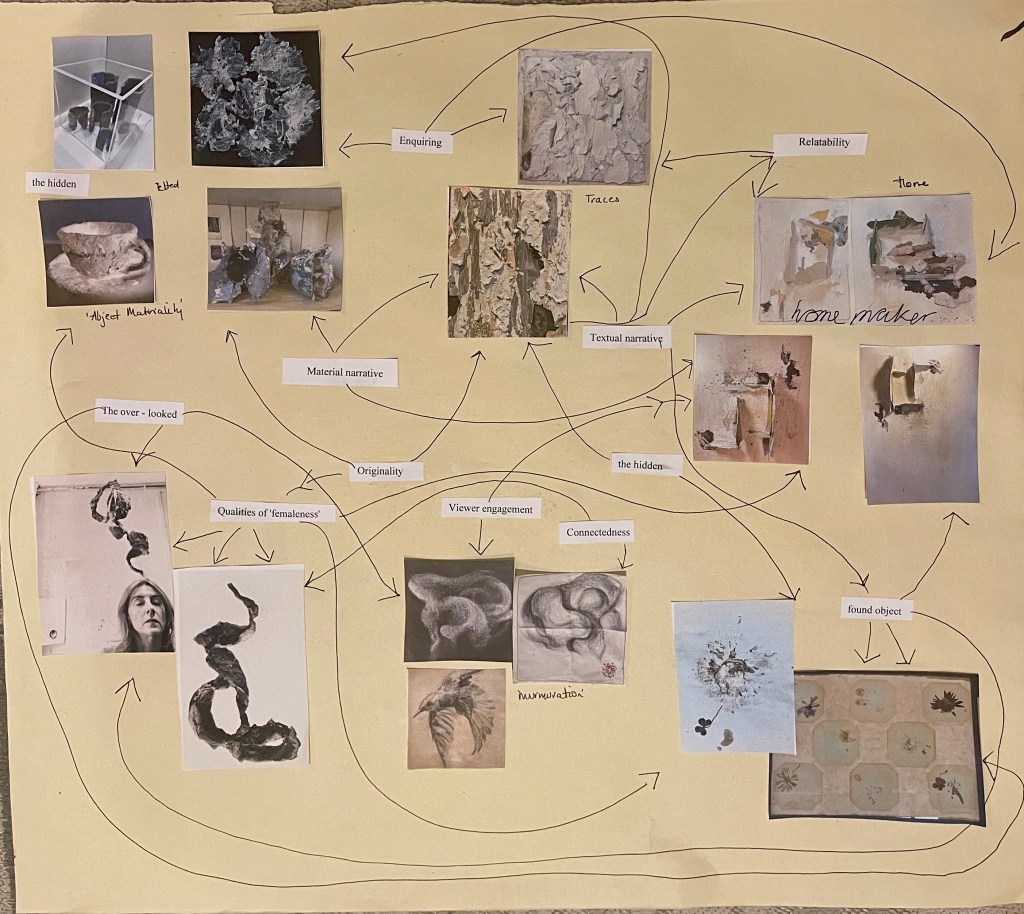
I took to using collage and a mind map to explore my work. I choose recent work to explore. What became apparent was my chosen key words did indeed relate to most of my recent work. This was a comforting confirmation of my practice and process. There were indeed strong connections and themes between the works.
‘Felted material’ – ‘Abject materiality’- this held the most diverse and inclusive narrative and cross referencing of relationships. It material narrative, textural, qualities of ‘femaleness’ found objects , enquiring, the hidden etc . Hence confirmation that this work would be the strongest for a final body of work.
‘Murmurations’- this contained most of the key prompt words but nothing specific to ‘femaleness’, the hidden, found objects or textural narrative. There was good relatability, viewer engagement. connectedness and was often overlooked as a metaphor.
‘Traces’ – was strong in textural narrative, enquiring, originality, found objects and the overlooked. It was weaker in ‘femaleness’ but strong in most other areas, so perhaps offering a more general and non gender specific presence.
Home – This connected to many of the key words – not specifically related to gender or femaleness, its negative concepts may not be widely considered by some whilst others will relate to its wider connotations of war, refugees, domestic abuse.
After taking part in the biggest exposure of my work to date in the Open Studios event I was able to see a strong link to my working practice themes by the repeated discussion topics. This was invaluable and cemented my concerns and on going interests.
Essentially ;
Female Mental Health and Societal pressures of now and the past. Metaphors of enquiry.
Found material and its hidden historic narrative – what we can gain from its future exposure and current enquiry.
The Home – its positive and negative connotations, its fragility and inherent importance to humans.
Exercise 1b. 10 Questions:
- Can you describe your artistic practice and the themes or concepts that inspire your work?
- How do you approach the creative process? Do you have any rituals or routines that help you get into a creative mindset?
- What materials and techniques do you typically use in your artwork, and why do you find them compelling?
- Can you talk to us through your process of developing a new piece from conception to completion? How do you generate ideas and refine them into a resolved artwork?
- How do you navigate challenges or obstacles during the creative process? Do you have any strategies for overcoming creative blocks?
- Many artists draw inspiration from personal experiences or external influences. Are there specific experiences or sources of inspiration that inform your work?
- Collaboration can play a significant role in artistic practice. Have you collaborated with other artists or professionals, and if so, how has collaboration influenced your work?
- Your artwork often explores [recurring theme or motif]. What draws you to this theme, and how do you approach its representation in your work?
- Your use of [specific material or technique] is particularly unusual. What led you to incorporate this element into your practice, and what effects do you hope to achieve with it?
- When you consider a piece resolved, what criteria do you use to evaluate its success? How do you know when a work is finished, and how do you decide to move on to the next project?
Research Point
Louise Bourgeois – changing styles.
Louise Bourgeois (1911 – 2010) is an artist that has shown a continued and developing style over the course of her practice. Despite her consistency in theme, trauma, memory and identity and human form her material and practice and form has changed dramatically.
Her early work was mainly abstract and geometric ( approx. 1940 -1950 ) and influenced by the art movement of the time Abstract Expressionism and Surrealism. Here we see her ‘Personage’ work. This was conveyed by tall thin wood sculptures that look totemic. They are isolated and seem vulnerable and perhaps echo her feeling at the time and her displacement from moving from France to the United States.
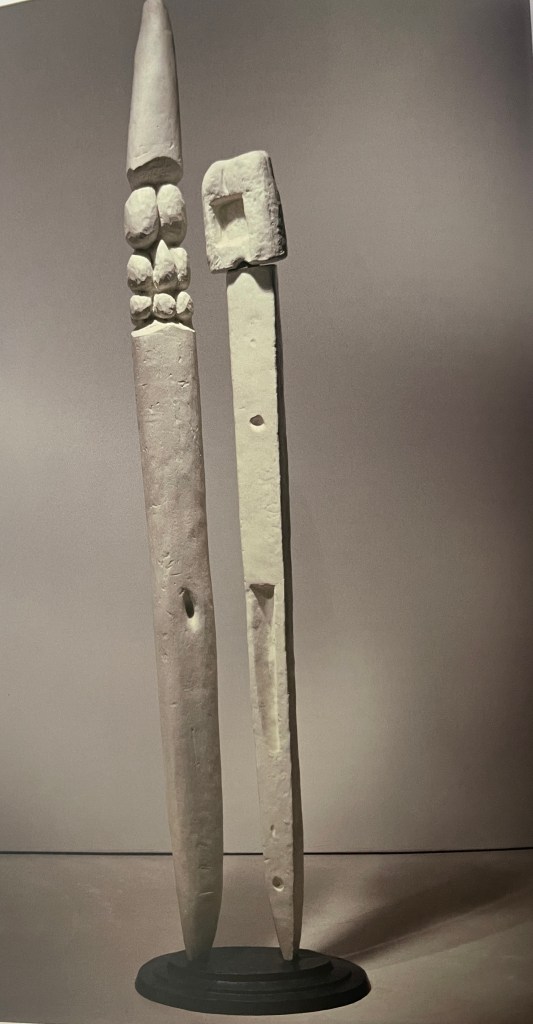
Bronze, painted white 203×50.8 x 30.5 cm
Her work moved on and around the 1960’s we can see her work more to wads a softer and more organic phase, working with biomorphic forms with creations such as ‘Femme Maison’ exploring the themes of identity and domesticity. Perhaps these softer forms are more reminiscent of the female and allowed for fluid and gentle form to be executed. This was the period we see an emergence into sexual imagery and the work of Sigmund Freud.
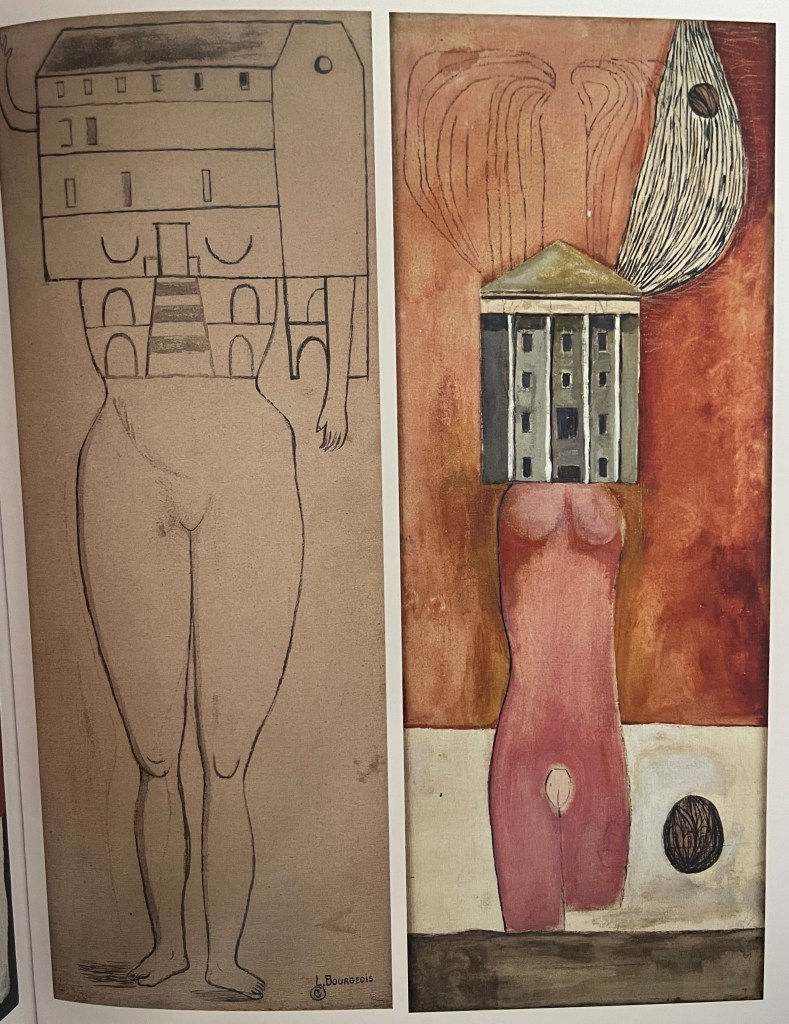
Ink on Linen
91.5 x 35.5 cm
Collection of
Ella M. Foshay
(right)1946-7
Ink on Linen
91.5 x 35.5 cm
Collection of
Ella M. Foshay
L BOURGEOIS:
Fig.130
Femme Maison 1946-7
Oil and ink on linen
91.5 x 35.5 cm
Private collection
By the 70s and 80s we see an upscaling in her work, monumental sculpture and installations as her confidence and providence as an artist grew. ‘Destruction of the Father’ ( 1974) representing a cathartic scene for Bourgeois. Her ‘Cells series also evoking deep trauma and memories from early childhood.
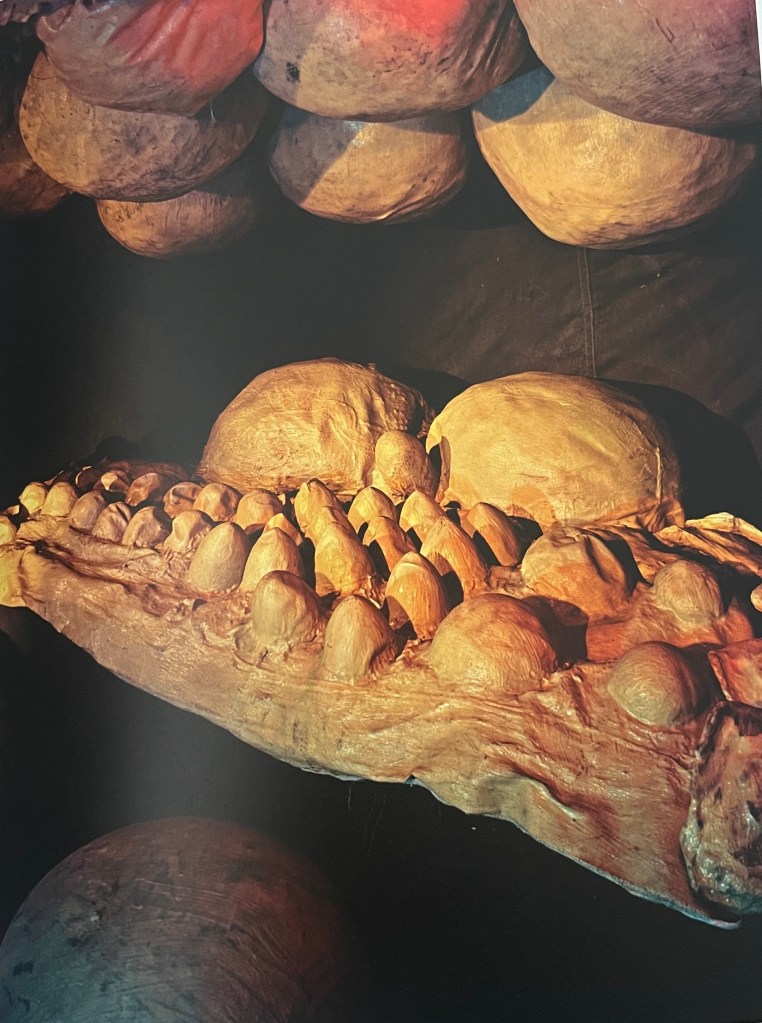
Father 1974
Plaster, latex, wood, fabric and red light 237.8 × 362.3 x 248.7 cm
In the1990’s to 2010 Bourgeois created her most famous work the large scale spider “Maman” was a powerful motif that symbolically showed the opposing protection and predation and was a tribute of kind to her mother, a weaver in her families tapestry restoration business. This was followed by deeper and darker work with ‘Cells’ that became more refined and complex and included many very personal items in these intimate and evocative spaces.
All of Bourgeois work is deeply personal and autobiographical. Her style was never static despite staying with intimate themes, always original and emotional. Reinventing and exploring process and style from small to large scale installations abstract and biomorphic.
Robert Storr wrote at length about Bourgeois changing style over her years as the circumstances of her inner life changed, meeting her husband, having a child, becoming a mother were crucial elements in her developing themes and practices. He curated a retrospective of the artist at MOMA in 1982 which was also pivotal in recognising her importance and role in contemporary art.
Her long time assistant Jerry Gorovoy has also provided a deep insight into her work confirming that emotional states and personal experiences transitioned into her creative process. Mignon Nixon an art historian examined Bourgeois work through a psychoanalysis lens focussing on the artists interest in Freud’s theories and her own psychoanalyst sessions which provide deep and complex narratives and material for her work.
Tracy Emin has often sighted Bourgeois as a strong and powerful influence on her own work , championing the woman who was fearless in her exploration of personal trauma and specific female experiences. Jenny Holzer has also praised Bourgeois work for sustaining and exploring it through her phycological journey
Journalist Roberta Smith stated admiration for Bourgeois ability to constantly reinvent herself and her unique ability to merge personal narrative with broader existential themes, each phase of her work building upon and transforming previous ones.
Exercise 2.1:
( letter to your self – Letter now on a previous laptop – need to down load to review at a later date )
Project 3 .Peer to Peer dialogue.
The Chichester Art Trail was an ideal platform for this experience as I spoke at length to a huge number of artists and the public about my work on display. It was fascinating to hear the responses and feedback to the work and this has certainly allowed clarity and focus in some area to develop. It was inspiring and informative in regards to future work projects and ideas plus begin working associations with other local artists.
Group Crit sessions have been informative and engaging, but the numbers are low in these sessions and not everyone will engage. However is is usually well informed and useful feedback.
I have struck up a friendship with an artist in her late 70’s who has exhibited all over the world and has a wealth of experience to impart. Commercially and academically her words and advice are on point.
Returning to previous galleries where I have sold some small pieces of work in the past. This will be useful in discussing current trends, themes and overall feedback to the work.
My ‘Veneration’ collaborative project allows me to reach out to other artists I come across about this project concerning ‘femaleness’. It has inspired debate and conversation about what the work could be and its wider narrative which will be a source of rich material and information.
Project 4.
Statement – First Draft.
Melissa Veitch is a maker at heart and a finder of hidden material and their lost narrative. Generally not engaging in sketchbook planning and long drawn out ideas before a work begins to emerge, instead, relying on a conversation with a found object or material to offer sparks of meaning and inspiration. Her work is engaging to the viewer as she seeks to find common ground and kinship with relatable mediums to a wide audience
Veitch’s subject matter is directly connected to her environment and day to experiences as a female artist, props and set stylist, wife and mother. She explores issues surrounding the domestic, the concept of home, mental health and ‘femaleness’. Much of her practice will involve material directly scavenged from abandoned building and homes, machine detritus, local charity shops, and antique markets reflecting her passion for the overlooked and yet to be discovered.
The bold and visceral works of Louise Bourgeois have influenced Veitch in both subject matter and material practice as has the ranging work of Cornelia Parker. These two seminal artists have sense of drama and metaphor within their work that evoke curiosity and enquiry within the every day object. It is the connection and fascination to the strong 3D narrative within these works and investigation into the overlooked and mundane that Veitch also seeks to enquire into.
Veitch’s art pokes an inquisitive finger into viewer an exploration of the intersection between the found object and personal narrative. Each piece she creates invites the viewer to look closer, to see the beauty in the discarded and the potential in the forgotten. Her work is a testament to the power of transformation and the stories that objects can speak of. Through her art, Veitch not only reclaims materials but also reclaims narratives, weaving them into new forms that challenge norms and create new conversations.
Reflective Commentary:
My final body of work seems likely to be centred around the felted and manipulated material qualities of machine detritus or “Abject Materiality’ as I have called in it a previous work. There is still some exploration to uncover, finding its physical boundaries and limitations and to what extent I can obtain the material to create the volume needed for much larger scale work. I have used magnets and stitching to create mass and connectivity and will follow this up with further large scale experimentation outdoors. The collection of the material has recently been made more accessible through another source – a local laundry.
I have purchased a large metal hoop, big enough to stand in that I am exploring as a means of displaying the large amorphous felted shapes with potential inclusion of some moulded ‘hollow objects’ also made from the same material. The large scale enquiry is important to bring this hidden material to the forefront and allow its stages of formation and narrative to be explored. Further to this I am looking to add the felted pieces into some clothing items, possibly cutting out large voids in an item and inserting a felted ‘pelt’. This will create a strange visual and also enquire into the narrative of washing our clothes away, literally, then replacing them with the reformed up-cycled felted ‘pelt’. ( A third concern less explored at this stage is the micro plastic fibres washed out of our homes via the washing machine and included the airborne fluff from the tumble dryer)
The stronger narrative for me concerns the domestic toil – past and present. The traditional trope of the female domestic and its machine rituals . The regurgitating detritus full of us, our hair our DNA a forensic diary and trace of where we have been and what we have done. Our clothes or outer shell of protection might be washed away and cleaned but our inner self remains. It’s a narrative rich medium and placing it within a number of constructs will evoke a diverse conversation. My recent experience and feedback at the Open Studios made me aware of the wide narrative this material can open up. The interest in the felted tea- cup which drew so much enquiry from the public ( as young as 3 years old) has also encouraged me to think of the humorous quality in art that can be so visually appealing. Including an aspect of this in my body of work might be a connective and inclusive way for engagement.
I plan to work on a number of pieces with the interconnectedness of narrative and material presented differently to evoke broad enquiry. I would like to include the haptic elements in the work and allow touch of the material. The potential size of the work to encourage walking around it and the possibility of wearing/draping the felted ‘pelts’.
Feedback :
Consider – Hair in relation to mythologies and fairy tales – do these narratives have any resonance with me ? ( Medusa , Rapunzel )
How and in what way s are you finding nurture, critical questions and avenues from the Research UNit that might foster and drive the AP.
Revisit statement – elements that are pertinent and reflective – how do they convey specific ideas and material?
Research Recommendations:
Catherine Bertola – This artist has been referenced and researched in this section 4 already and is part of my ongoing critical enquiry
Meret Oppenheimer – Also researched previously in section 4
Martha Rosler – The semiotics of the kitchen – research
The artist known as ‘Shoplifter’ – on Building a museum of a fantatical hair in Reykjavik.
Post Assessment :
Artist Statement – Take 2./3
Melissa Veitch is a maker at heart, unearthing hidden materials and their lost narratives. Generally passing traditional sketchbook planning and drawn out ideas, choosing instead to begin a conversation with found objects and materials. This approach allows her to draw sparks of meaning and inspiration from these items, fostering a dynamic and intuitive creative process. Her work resonates with the viewer as she seeks to establish common ground and kinship through relatable mediums.
Veitch’s subject matter is deeply intertwined with her environment and her daily experiences as a female artist, props and set stylist, wife, and mother. She delves into themes surrounding domesticity, the concept of home, mental health, and the essence of ‘femaleness.’ Much of her practice involves scavenging materials from abandoned buildings and homes, machine detritus, local charity shops, and antique markets. This reflects her passion for the overlooked and yet-to-be-discovered.
The bold and visceral works of Louise Bourgeois have significantly influenced Veitch, both in subject matter and material practice, as has the diverse work of Cornelia Parker. These two seminal artists imbue a sense of drama and metaphor in their work that evokes curiosity and inquiry within everyday objects. Veitch is drawn to the strong three-dimensional narratives in their works and shares their fascination with investigating the overlooked and mundane.
Veitch’s art pokes an inquisitive finger into the viewer urging them to reconsider and reflect on the unlikely but familiar materials present in her work and their own connections and interaction with these materials. Her creations reveal potential in the forgotten and discarded, encouraging conversations and debates surrounding the diverse stories these items can tell. Through her art, she invites viewers to explore the hidden narratives embedded in everyday objects, challenging them to be curious and open minded regarding the seemingly insignificant.
Artists Statement Take 3.
Melissa Veitch is a maker at heart, unearthing hidden materials and their
lost narratives. Generally passing traditional sketchbook planning and drawn-out
ideas, choosing instead to begin a dialogue with found objects and materials.
Veitch’s subject matter is deeply intertwined with her environment and her experiences
as a female artist, props and set stylist, wife, and mother. She delves into
themes surrounding domesticity, the concept of home, mental health, and the
essence of ‘femaleness.’ Her chosen materials reflect these rich narratives and
much of her practice involves scavenging materials from abandoned buildings and
homes, machine detritus, local charity shops, and antique markets. It is here amongst
the every day she finds the essential and imbedded histories of the female.
Veitch’s practice is concerned with drawing meaning and inspiration from
these items, fostering an intuitive creative process seeking to
establish common ground, viewer kinship and therapeutic undertones through relatable
mediums and subject matter.
The bold and visceral works of Louise Bourgeois have significantly
influenced Veitch, both in subject matter and material practice, as has the
diverse work of Cornelia Parker. These two seminal artists imbue a sense of
drama and metaphor in their work that evokes curiosity and inquiry within
everyday objects. Veitch is drawn to the strong three-dimensional narratives in
their works and shares their fascination with investigating the overlooked and
mundane.
Veitch’s art pokes an inquisitive finger into the viewer urging them to
reconsider and reflect on the unlikely but familiar materials present in her
work and their own connections and interaction with these exposed materials and
meaning. Her creations reveal potential significance in
the forgotten and discarded, encouraging conversations and debates surrounding
the diverse and sometimes uncomfortable stories they tell.
Artists Research
Kelly Cumberland – Expanded Drawing
https://kellycumberland.art/about ( accessed June 9th 2024)
…..installations and objects demonstrate how something seemingly delicate and insubstantial can overwhelm its environment, whilst dissected drawings represent the paradoxical fragility and strength of microbiological structures.
Continuous addition and removal, (re)production and reduction result in a coherent body of structural variations. Working in sequence, the components initially appear identical, however, the process ensures each work is unique, retaining the possibility for expansion and modification.
The works reveal how drawing is expanded through space, place, form, process, materials and meaning. The sequential work is often transposed from two-dimensional to three-dimensional forms, moving into expanded drawing.
Forms are translated through a variety of materials; paper, thread, celluloid, vinyl and ink. The materiality of her work and its relationship to place is important and she experiments with the documentation and representation of her drawings, expanding them into the print and publishing field.
Martha Rosler – Semiotics of the Kitchen. ( 1975)
https://americanart.si.edu/artwork/semiotics-kitchen-77211 ( accessed June 9th 20204)
In unsmiling deadpan, Martha Rosler parodies the role of the perfect TV housewife and cook. Running through an alphabet of kitchen utensils, she demonstrates each for the camera. Her gestures of hacking and stabbing are at times unnerving–thinly veiled expressions of frustration and rage. Rosler has said of this performance,
“As the woman speaks, she names her own oppression.” ( Rosler 1975)
A conceptual artist who has worked in many different mediums, including video, photography, and performance, Rosler made numerous pieces in the 1970s examining media representations of women’s roles.
I found this wonderfully narrative rich and at times amusing. Exploring the drudge of domesticity on the 1970’s – much of which has not gone away. She presents a disconnected, vacant exploration in A – Z format of the kitchen utensils. I was excited by the Apron use as a shroud of domesticity – an area I have been exploring for my own practice as the ‘uniform’ of the housewife/homemaker. Interesting to note thatthis was included in the performance and came first.
Hranfnhildur Arnardottir – Aka Shoplifter.
https://shoplifterart.com/ ( Accessed June 9th 2024)
Fabulous bold artist using fibres and furs to create large installations .
-
- site-specific installations explore themes of vanity, self-image, fashion, beauty and popular myth. For Shoplifter hair is the ultimate thread that grows from our body. Hair is an original, creative fiber, a way for people to distinguish themselves as individuals, and often an art form. Humor plays a large role in her life and work, sometimes subtly, but at other times taking over.
Strong, confident placement and installation and ambitious with medium. Plays with almost immersive content and experience and more delicate and pared back.
…..
 The Sharpe Gallery