Selection of Learning Logs:
Selection of Learning log. 1.
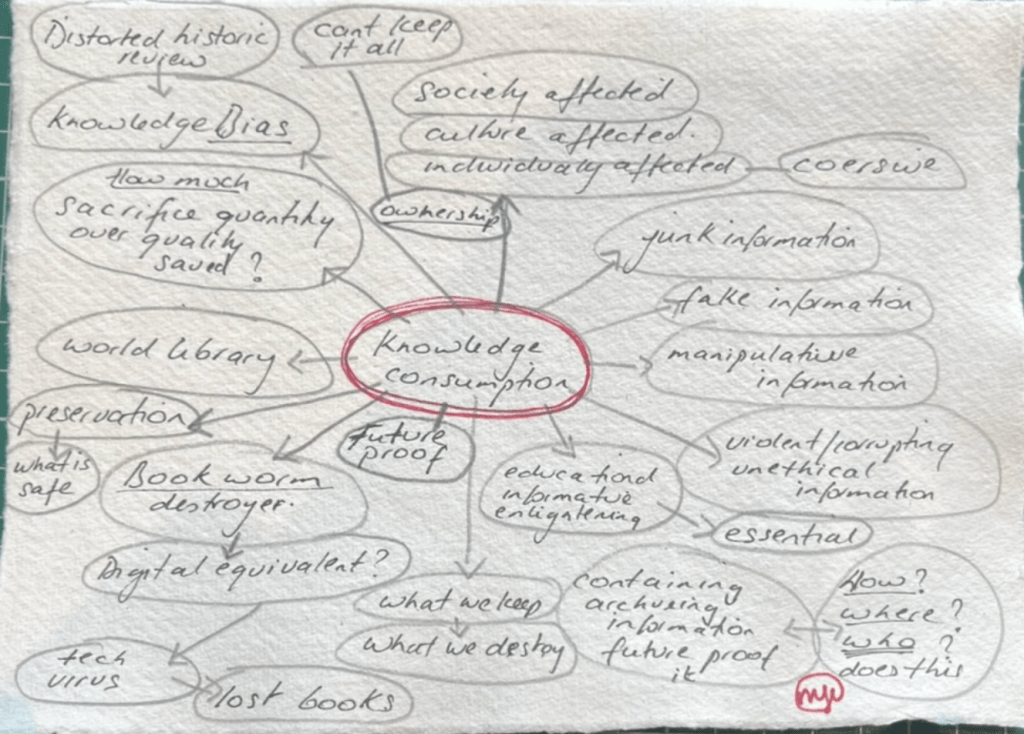
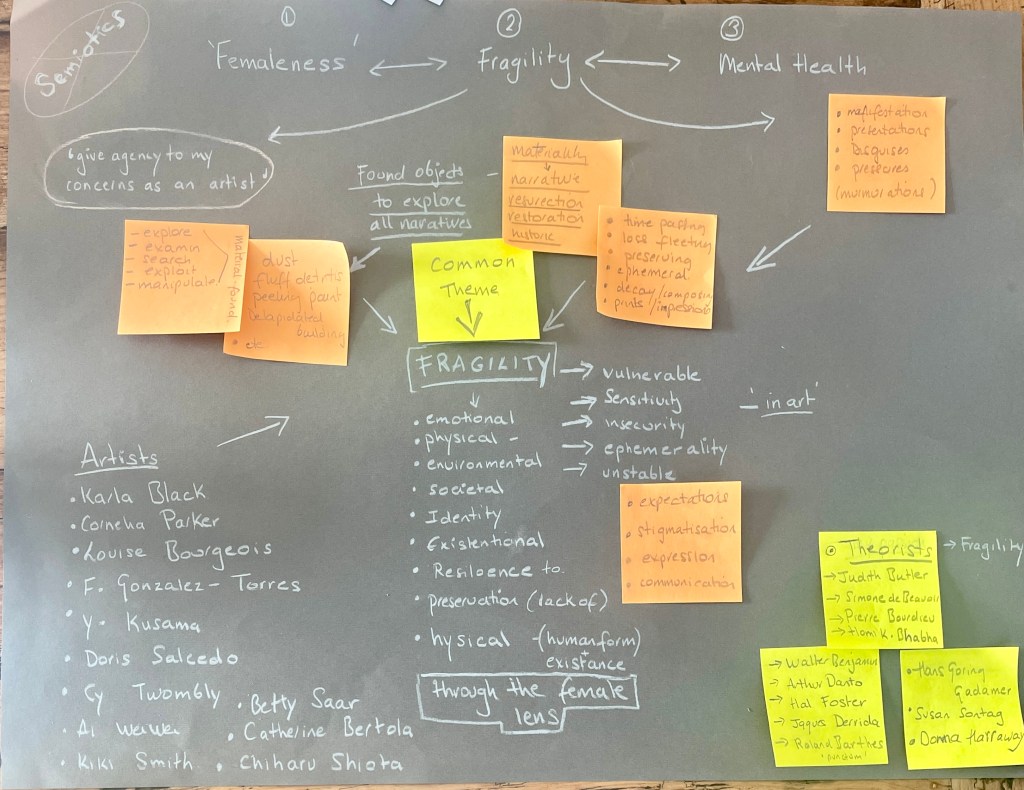
Valuable early mind mapping showing material enquiry of ‘detritus’ top left.
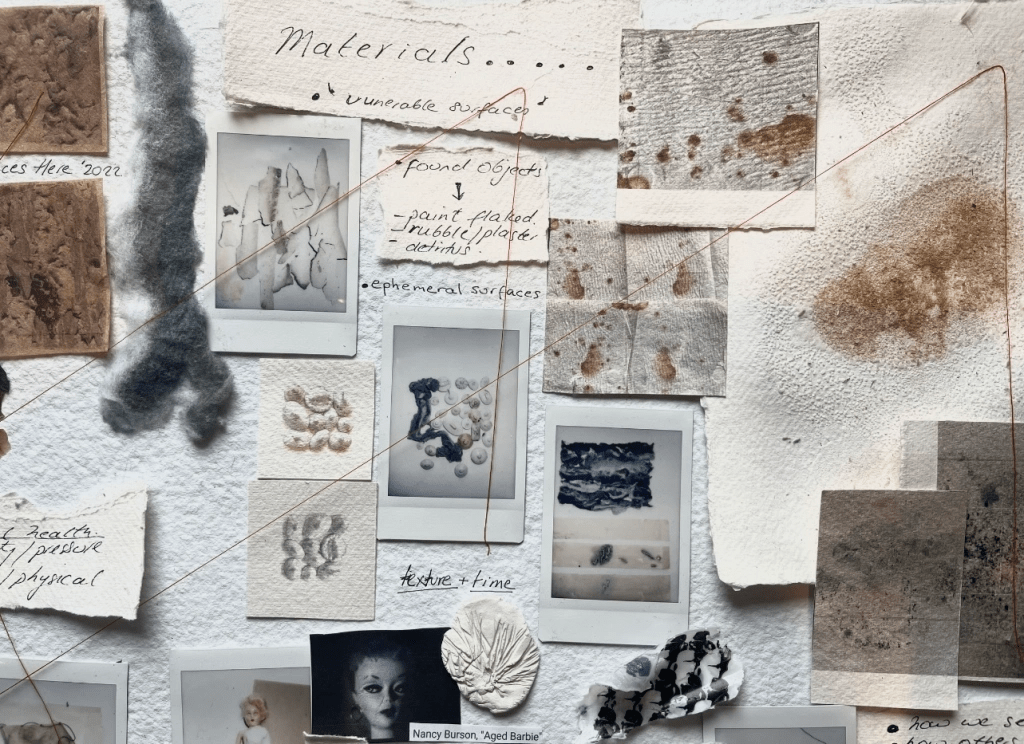
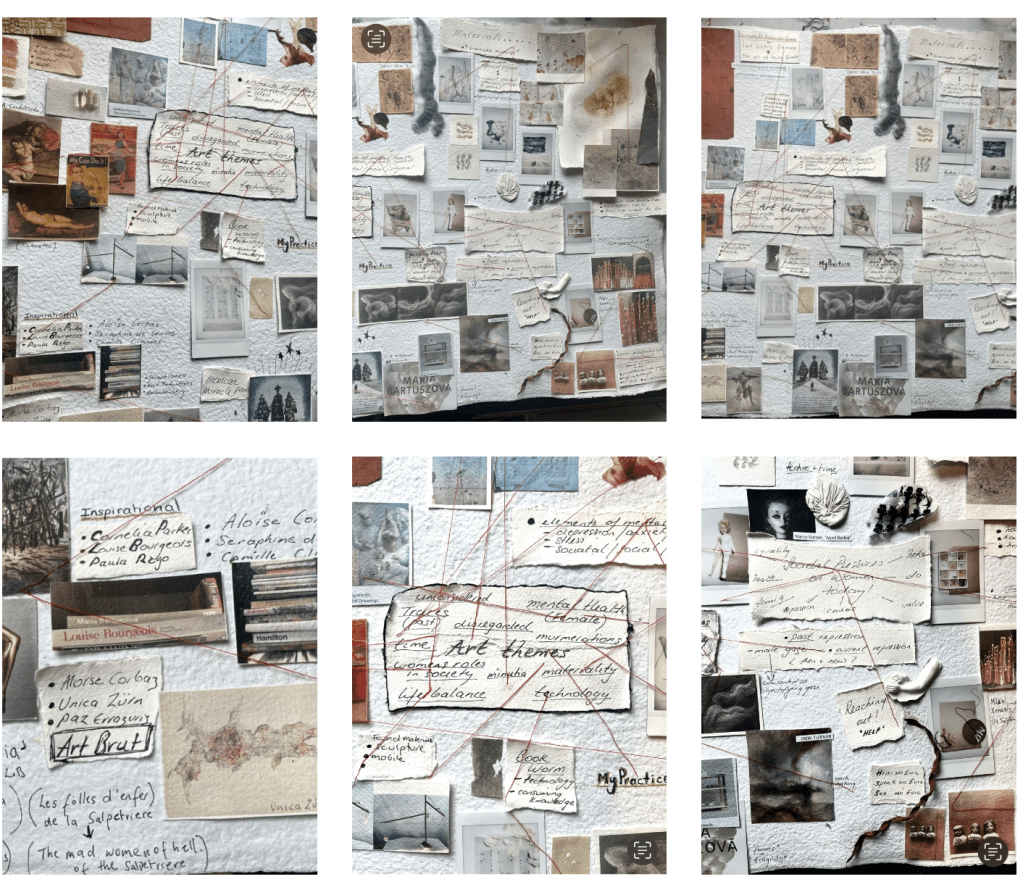
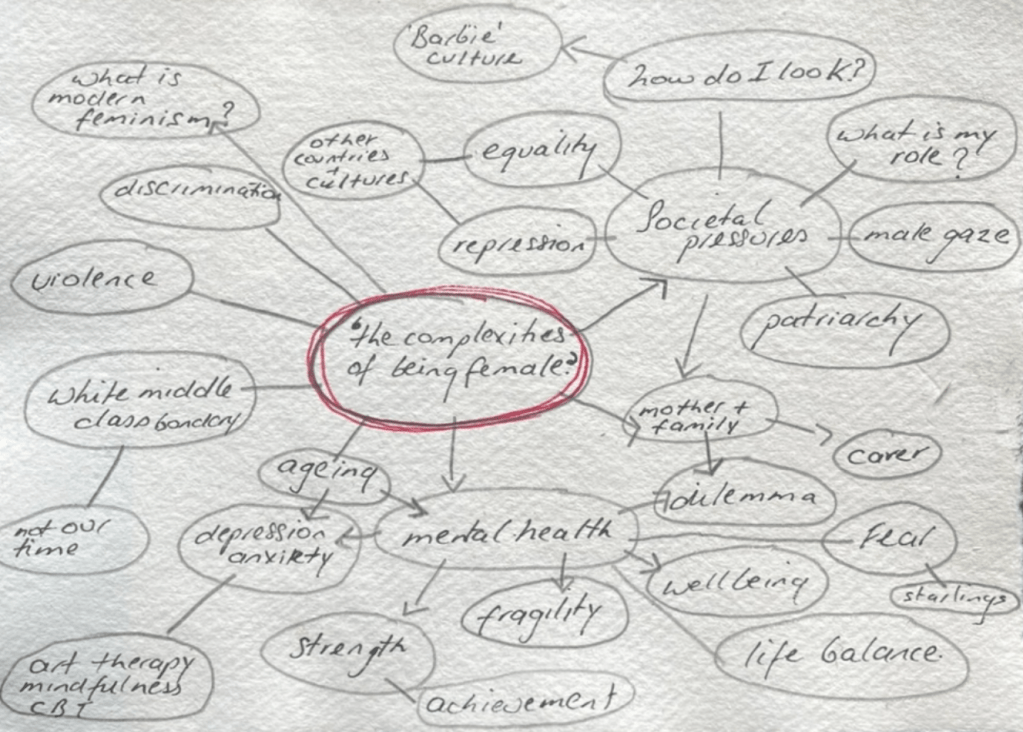
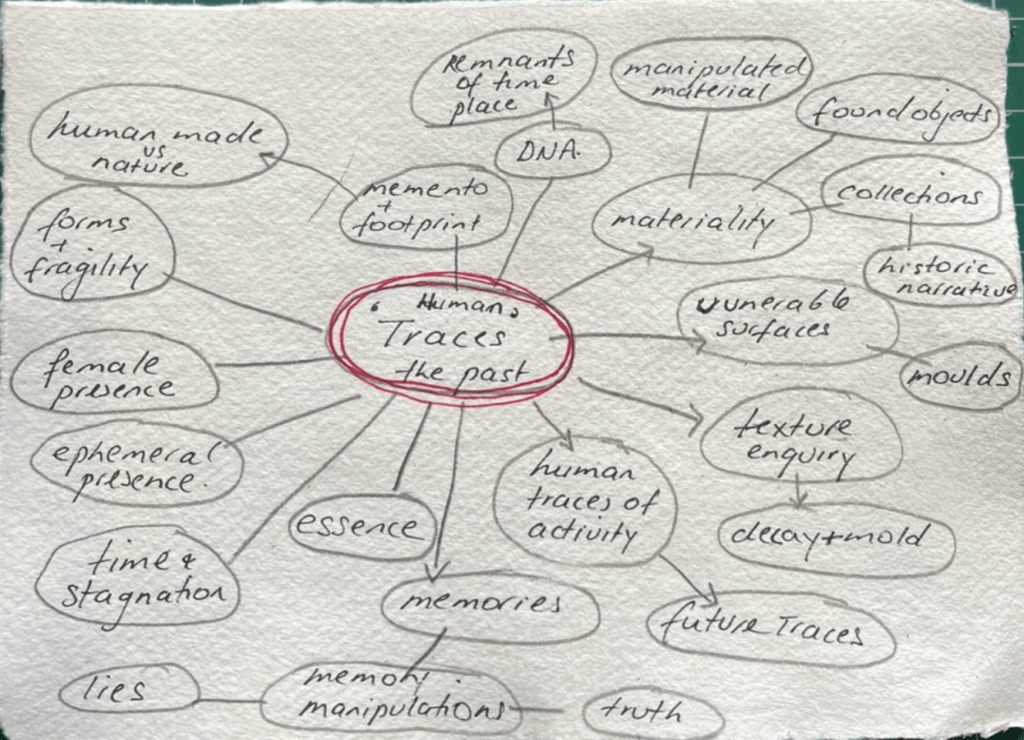
(Aug. 2024 Initial thought bubbles to focus the mind and find direction: These considered topics were referred to regularly were invaluable to my practice and concerns going forward.)
Assignment 1 .
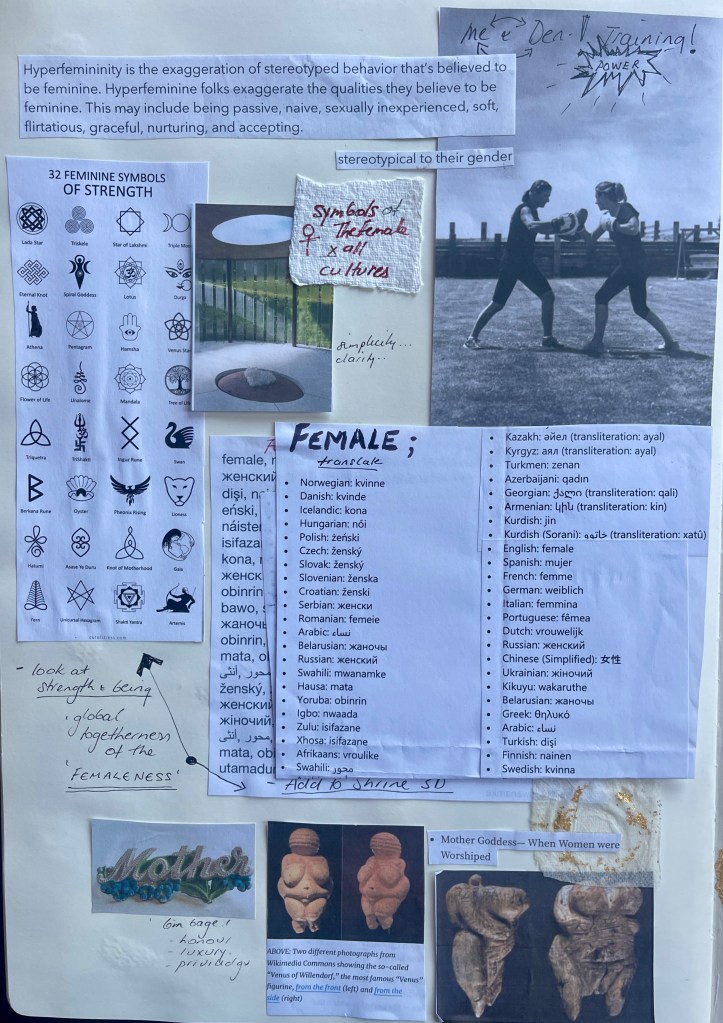
Veneration or ‘Shrines’ – Exploration of ‘Femaleness’
This project has come to fruition through a number of research and resources channels that highlighted a possible gap in issues regarding feminine depictions in art and notions of ‘femaleness’. Specifically focussing on what are the most generic, non cultural and ethnic origins of female representation and what are the key notions and attributes relating to this. Ancient art revealed a range of deity’s and goodness like statures, and objects that revered the female with breasts and vulvas often exaggerated, faces and limbs underdeveloped or incomplete. Was it ultimately just ‘her’ her ability to reproduce and feed her young that was venerated?
Religious figures, expressions of health, grandmother goddesses, or even as self-depictions by female artists.
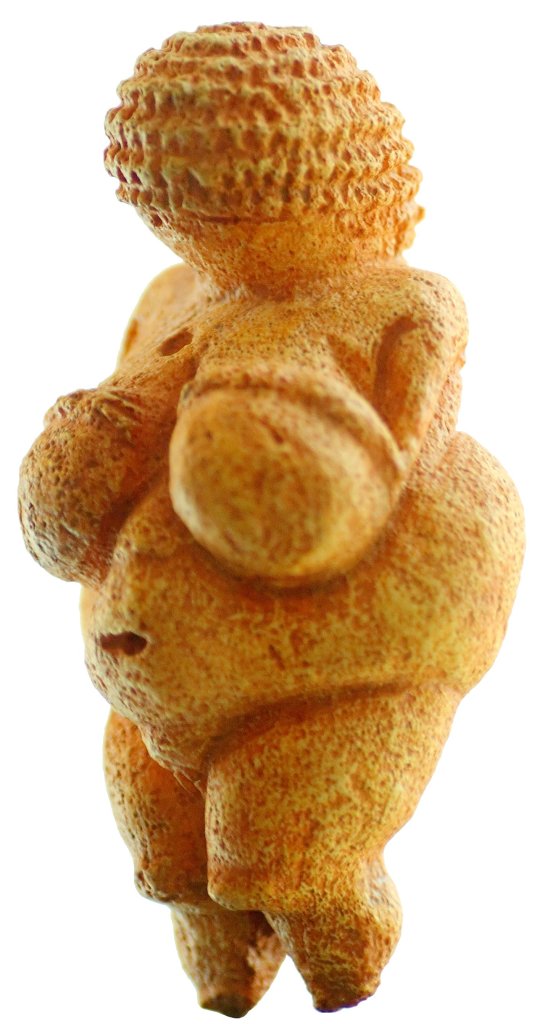
Venus of Willendorf
The oldest being the ‘Venus of Willendorf’ found in Austria made around 25,000 to 30,000 years ago. Whilst we judge these artefacts by todays social constructs it is widely agreed they were considered venerated objects. at the time of ceation.
The focus’s of this body of work is informed by the curiosity of these ancient artefacts and is in response to the patriarchal and segregated world we occupy today. The concept of the work is to create a coming together and a celebration of the female and those that identify with her. Looking at artists that boldly and proudly celebrated their femaleness . An example being Hepworth:
‘it would be naive to try to rub out Hepworth’s femaleness. She worked from a strong sense of her own body, ( Jeanette Winterson 2003)
Creating a non-secular, cross boundaries work to ‘venerate femaleness’ within a possible shrine like setting encompassing the language of 100’s of countries, semiotics and symbols to allow a global admiration, honour and respect of ‘femaleness’. Will I able to pare down the theme of ‘femaleness’ and arrive at a place full acceptance, understanding and acceptance by all humans?
(N.B Further and later exploration into this area proved to be and overwhelming subject matter to contain within this educational framework and hence will continue to be a work in progress going forward. Aug 2024)
The quote by acclaimed author Chimamanda Ngozi Adichie ( below) encompasses much of my desired direction:
“I have chosen to no longer be apologetic for my femaleness and my femininity. And I want to be respected in all of my femaleness because I deserve to be,” (Chimamanda Ngozi Adichie )
This author is claiming back her femaleness and empowering it, is a classless, unthreatening and ethnically and culturally neutral.
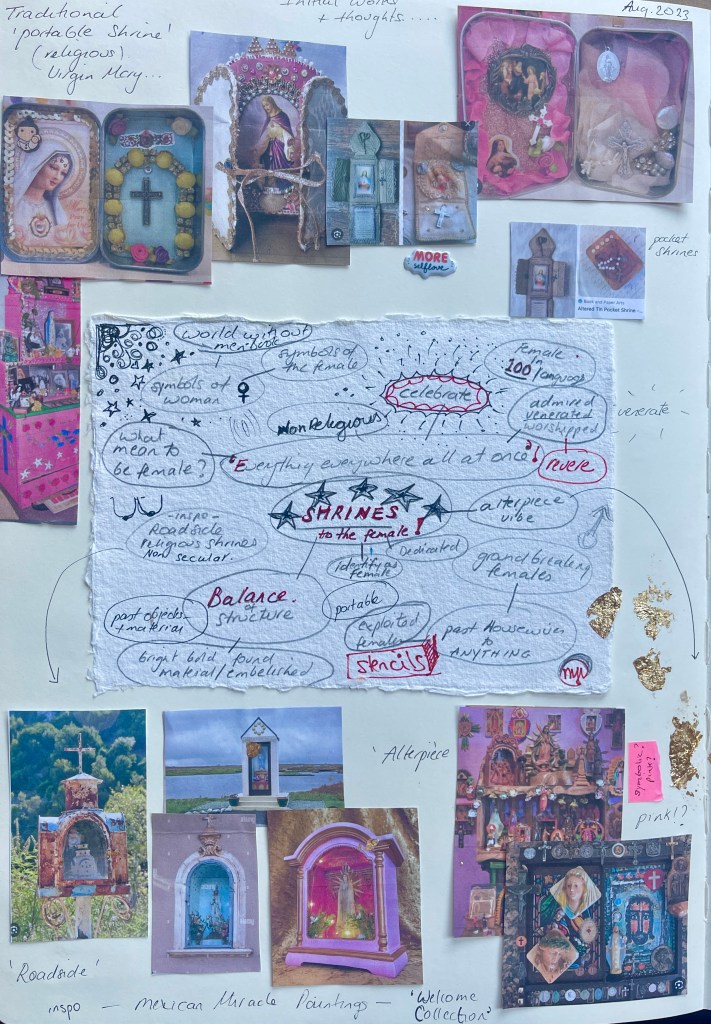
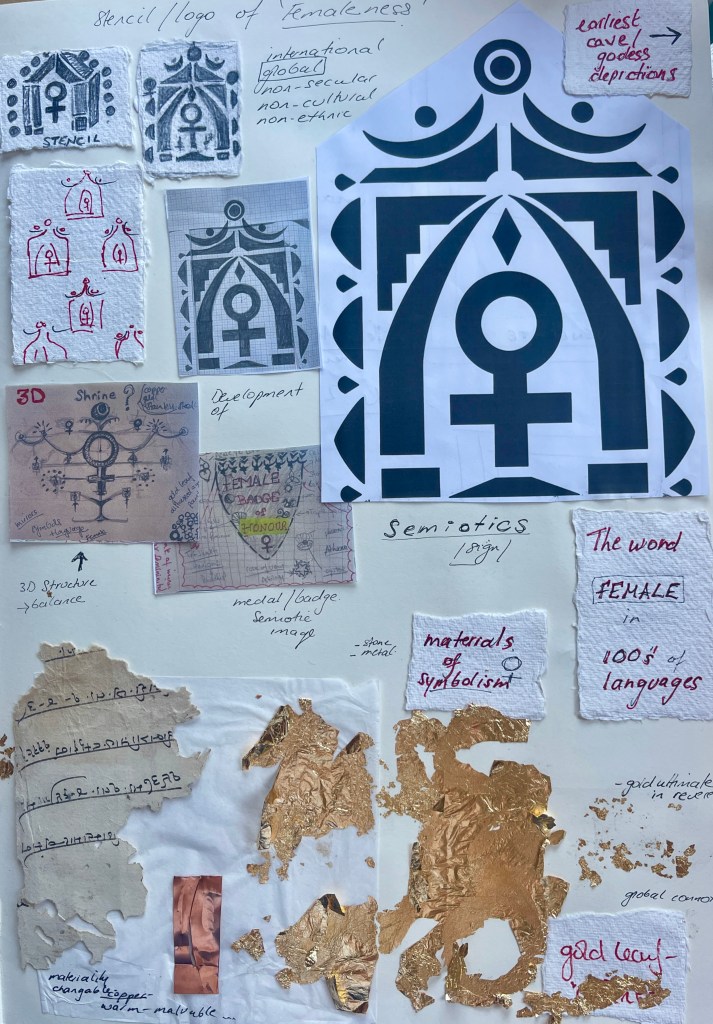
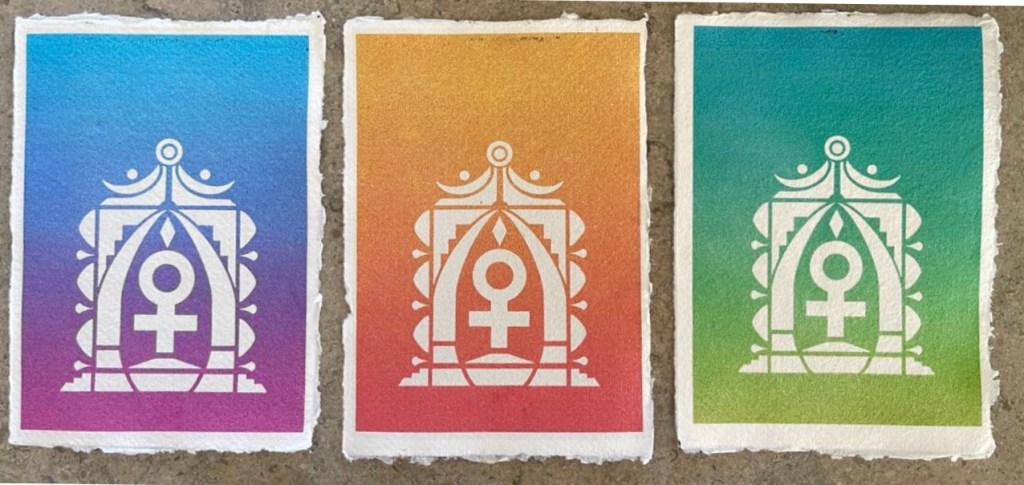
The final semiotic below was created digitally from a sketch. I worked with a number if key themes and images in mind to form various cultural reference of the female. This were explored looking at various deities and shrines alluding to worship with female references(often religious) Key to my theme was, the breast and vulva, the international sign of the female, an elated or exulted ( non secular) position.
Sketch book work below;
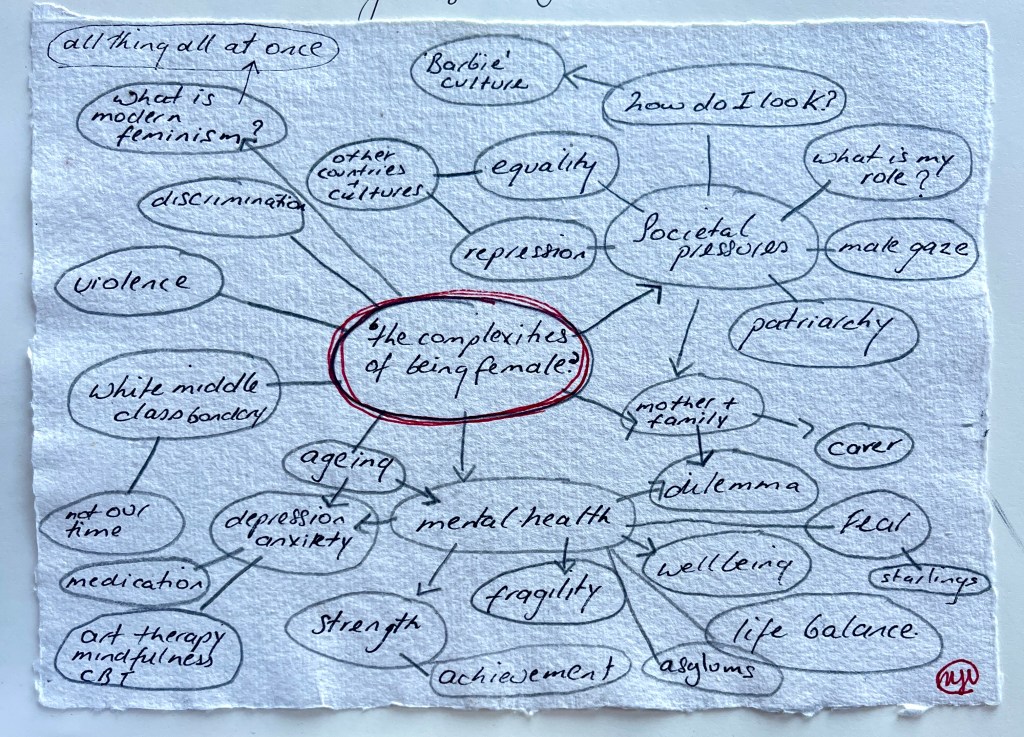
This ‘ thought bubble’ study below became THE key focus for my concerns and informed later practice:
Final Semiotic work creating a neutral image of ‘femaleness’ in 2D format
Printed on Khadi paper they are postcard in size and purpose. My aim was to create a collaborative group of works – (ideally and exhibition on day )inviting artists to explore the notion of ‘femaleness’ and it meaning.
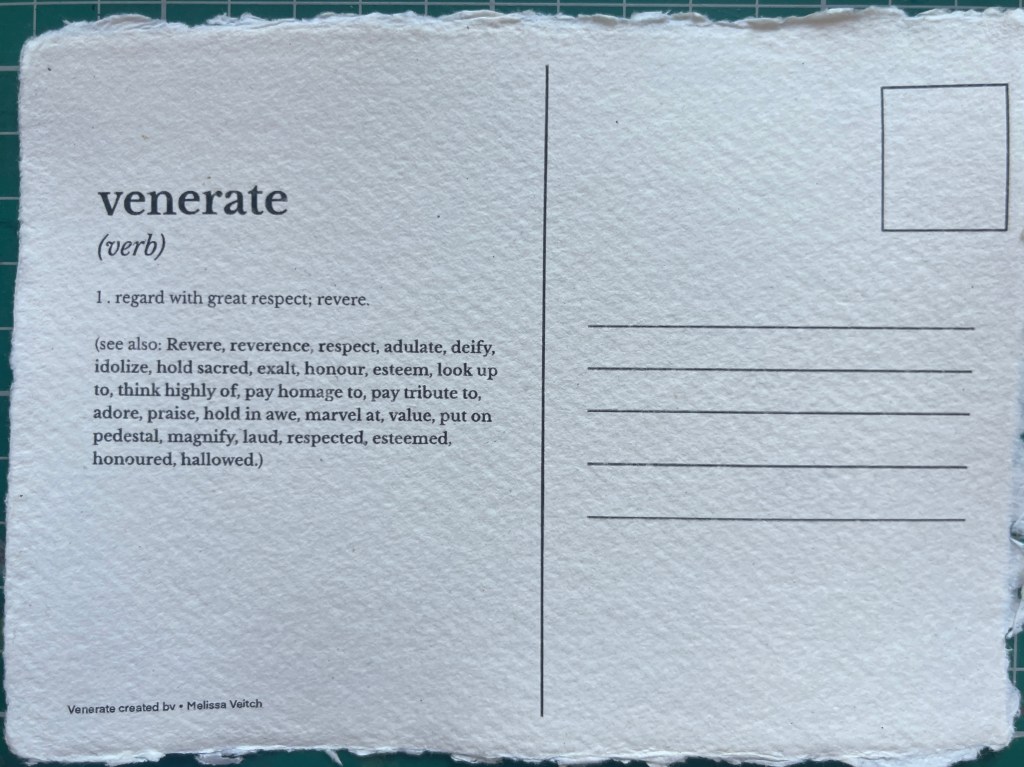
The reverse:
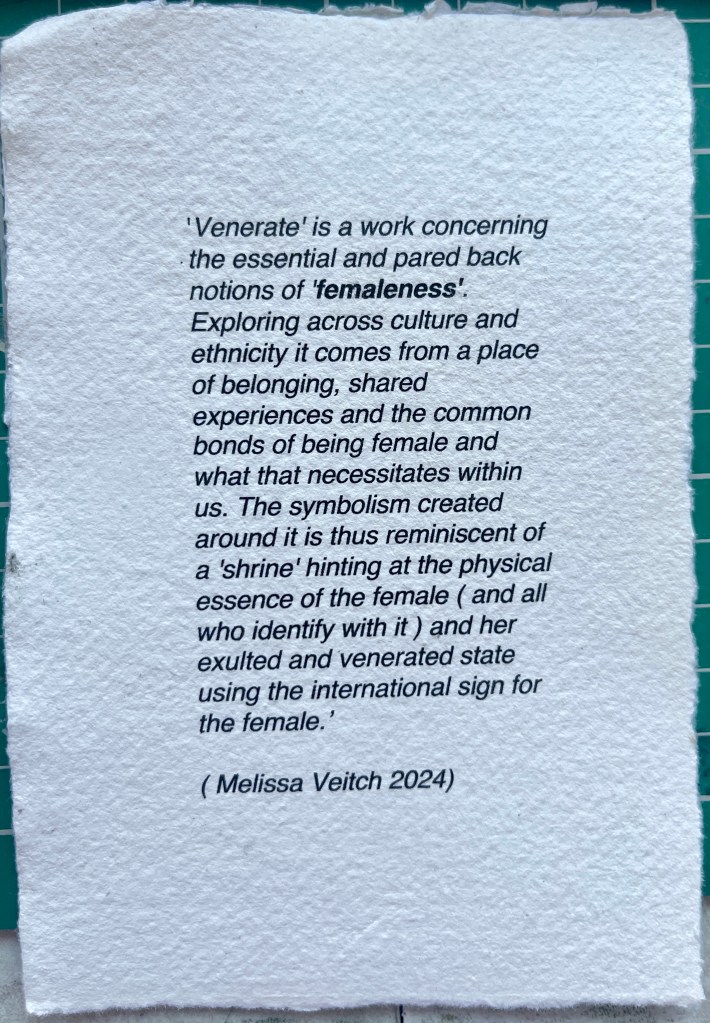
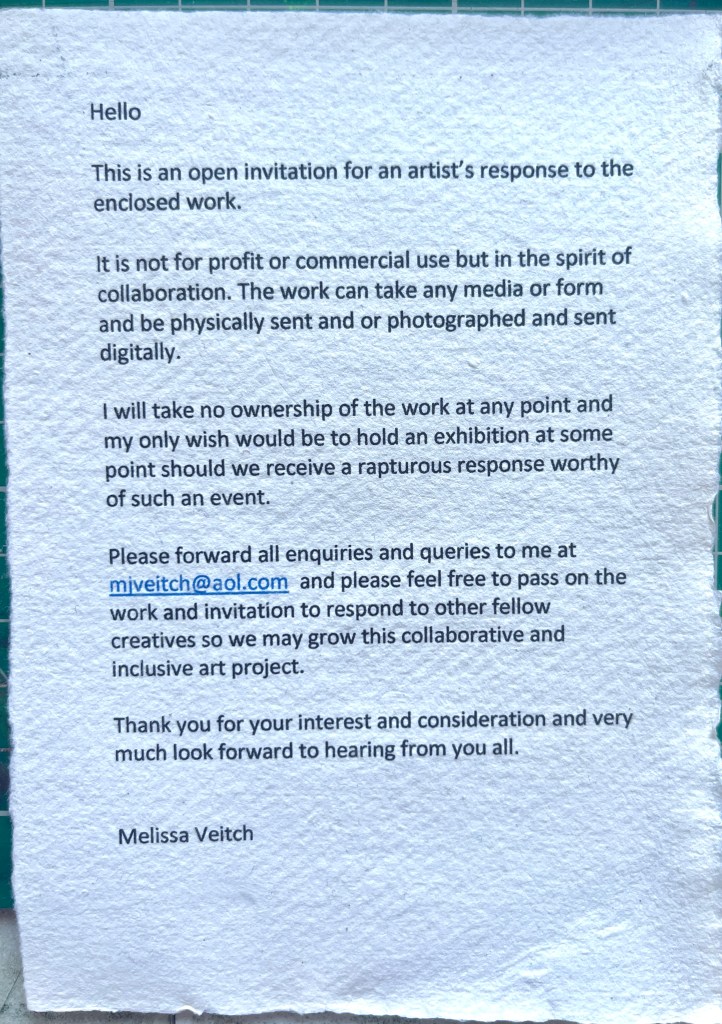
Accompanying text and invitation – sent on Khadi paper .
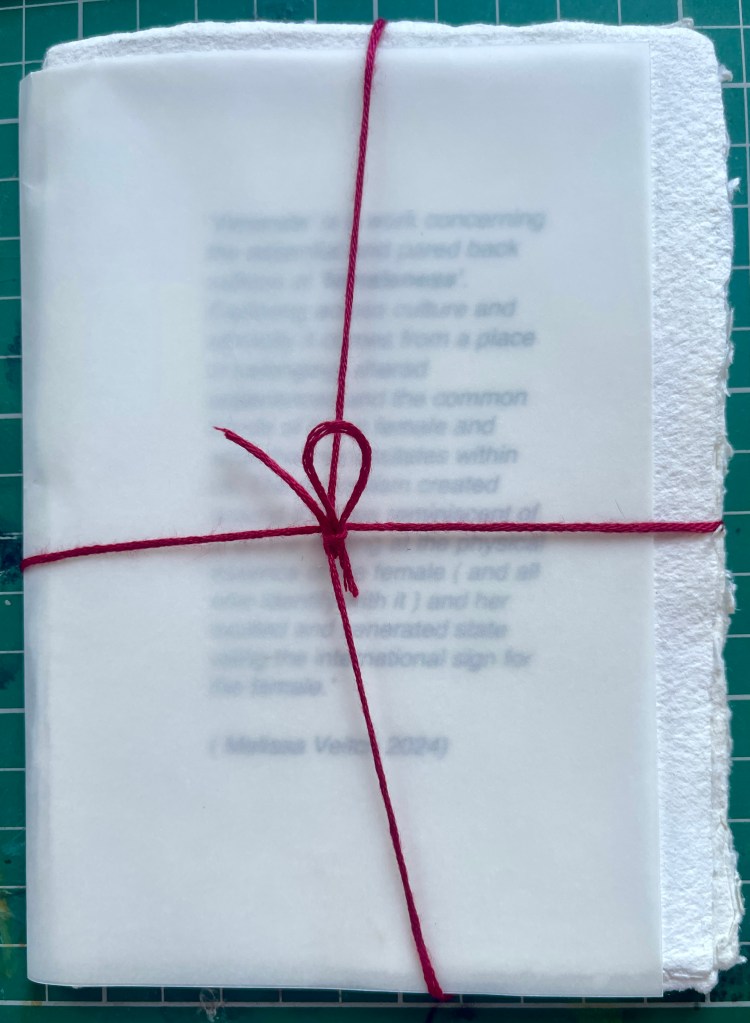
This was sent out as below: Wrapped in translucent paper and tied with red silk thread.
The beginning results of this project can be seen below on on the body of work page : Page 3 – Peer Interactions
Bibliography
Dr.B Harris / Dr S Zucker. ‘Venus” (or Woman) of Willendofr Naturel History Museum. Vienna https://smarthistory.org/venus-of-willendorf/ (Acessed Sept 29th 2023)
Adichie Ngozi Chimamanda . We Should all be Feminists’ Harper Collins ( London ) 2014.
Jeanette Winterson, ‘The hole of life’, Tate Research Publication, 2003, https://www.tate.org.uk/art/artists/dame-barbara-hepworth-1274/hole-life, accessed 29 September 2023
Quotes :
“My illustrious lordship, I’ll show you what a woman can do” – Artemisia Gentileschi
”Excellence has no sex.” – Eva Hesse
“I am my own muse. The subject I know best. The subject I want to better.” Frida Khalo
Selection of learning log. 2.
Sorting and Categorising
Re thinking and re-evalating :
Rethinking and re-evaluating and going back to my original passions in regards to materiality and the found material – adding this dimension to my work as part of a a narrative of issues concerns explored, ie, femaleness, female mental health and time/decay what is abandoned, saved, lost.
RE-considering the proposed questions below:
1 Femaleness. Exploring this collaborative inclusive concept aimed at venerating the notion of what it means to be female in society today. How does it fit into the second wave of feminism and what are its current artistic representations? –
2.What is the definition of ‘Femaleness’ in art culture today. Can it be seen as a collaborative and inclusive concept/viewpoint across a global society?
3. “How does semiotics in art contribute to the understanding and deconstruction of gender stereotypes in visual media through a feminist lens?”
4.“In what ways can semiotic analysis be employed to examine the portrayal of women in art, and how does this analysis intersect with feminist perspectives on representation and empowerment?”
Cont:
After further research into the artist Matt Mullican, ( as advised by Dr .M. Whiting) and exploring his bold, strong semiotic narrative I felt I was coming from a different place, a quieter voice, a less influenced by mass media imagery and more from the hidden or overlooked cultural influences
Despite my work on Shrines ( ‘Veneration’ ) being a strong semiotic with a complimentary narrative there was a softer undertone to it and it was, in hindsight , just the beginning or ‘Logo’ of work to come with out being a consistent to come back to in regards to style or medium of the work. It will however serve as a strong overall and encompassing theme.
‘Femaleness; will continue to be visible through out my work as this this is the place I occupy and present, identifying and inhabiting a female artist and a feminist.
With this comes the delicate condition of mental health and in particular female mental health bound and framed by cultural conditioning. This concern and and theme will be part of future works fulled by the experiences I have encountered and by others around me. It will be part of the hidden narrative ‘ of the female voice.
Planning – out ideas in bold uninhibited format was significant in realising the common theme and message that continually informs my work.
Large format notes:
Transcript to X’cel sheet.
Photographed image of sheet.
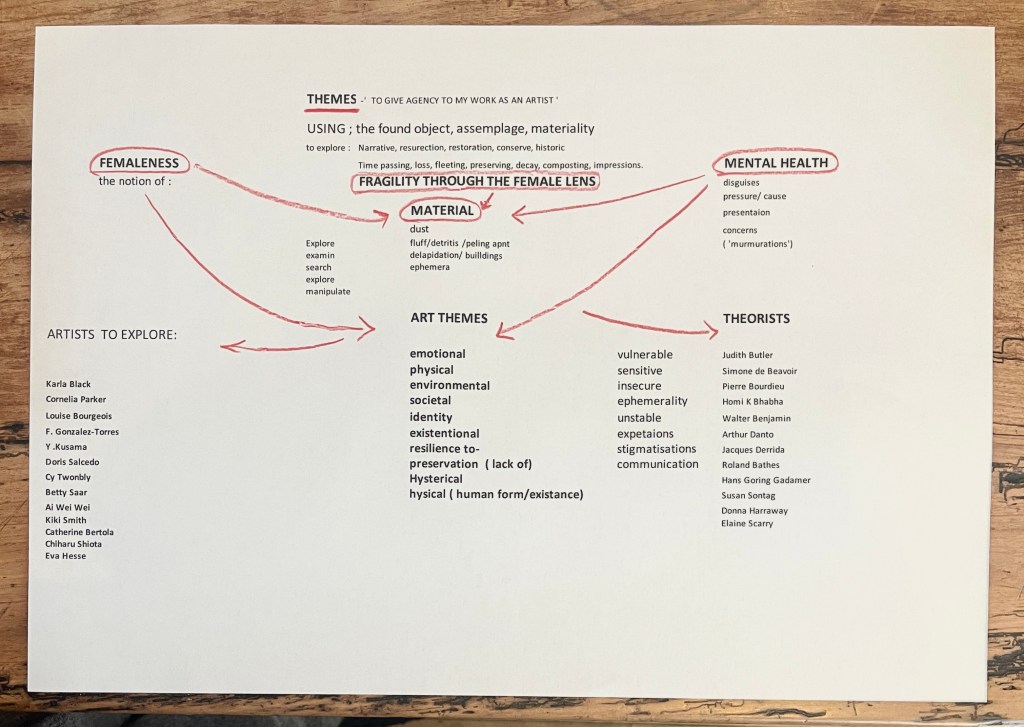
I began to re consider my question as : ( 1)
‘Discuss how artists explore the fragility of materials as a metaphor to explore and express concerns in their work.
Looking at examples of how the deliberate and ephemeral mediums in art and installations convey the transient and vulnerable nature of human emotion and existence.
How does the inherent fragility of materials become a powerful symbol allowing artists to capture the nuances of emotions, impermanence and the ephemeral qualities of being.
Who are the artists and theorists that exemplify this approach and what is the intended impact transferred to the viewer through the interpretation and emotional engagement with the artwork
Data /RESEARCH – exploring and uncovering:
Re-evaluating…..
Swamped by too much information I was not able to pin point a specific area of investigation and concern.
I started again with the 3 areas – Materiality, Mental Health “femaleness’.
I wanted to explore the combination of these concerns together…
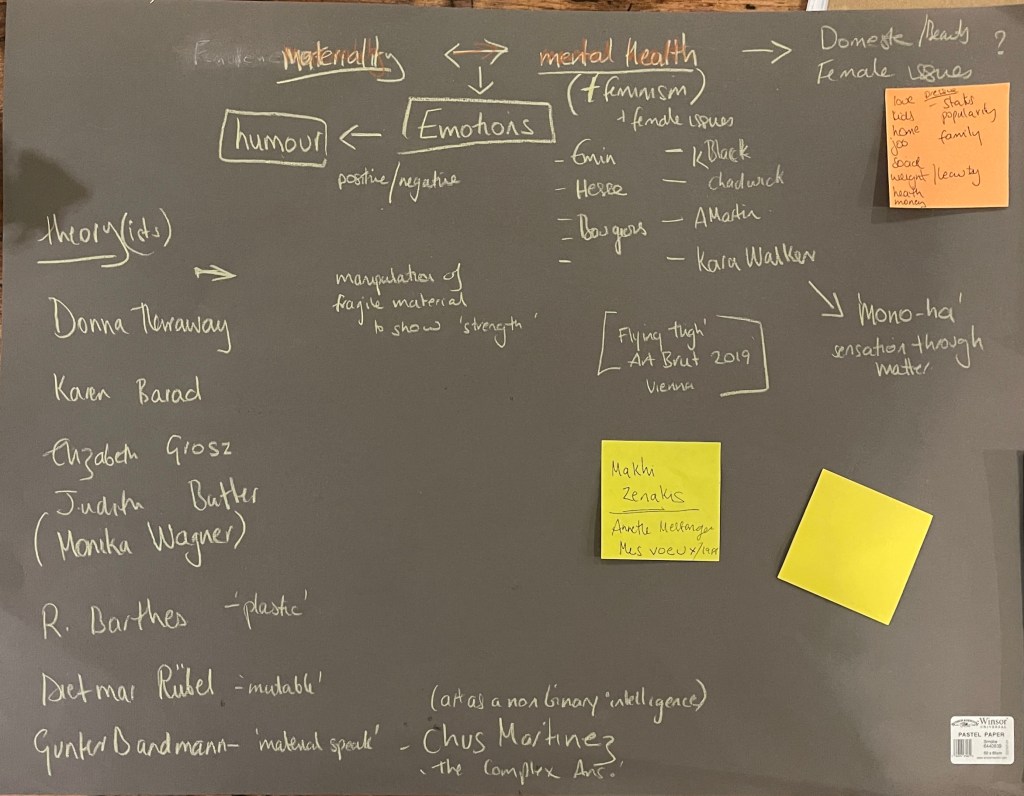
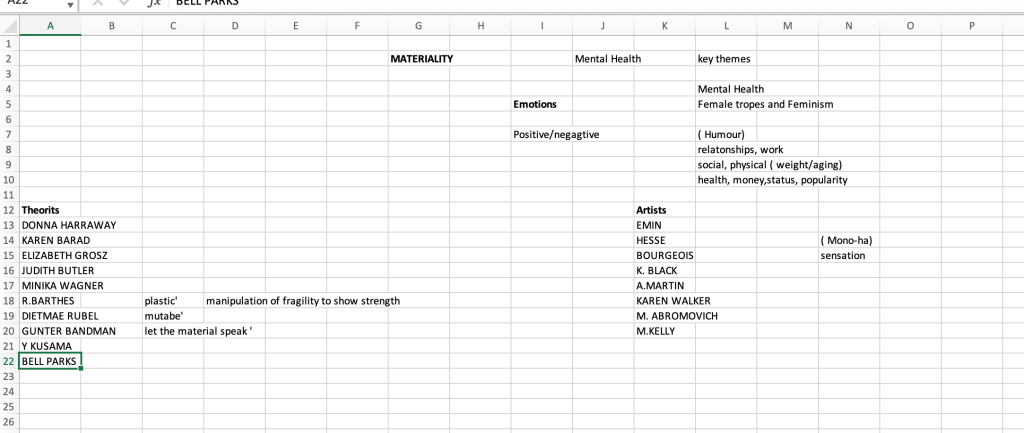
Formulating Key Artists and concepts :
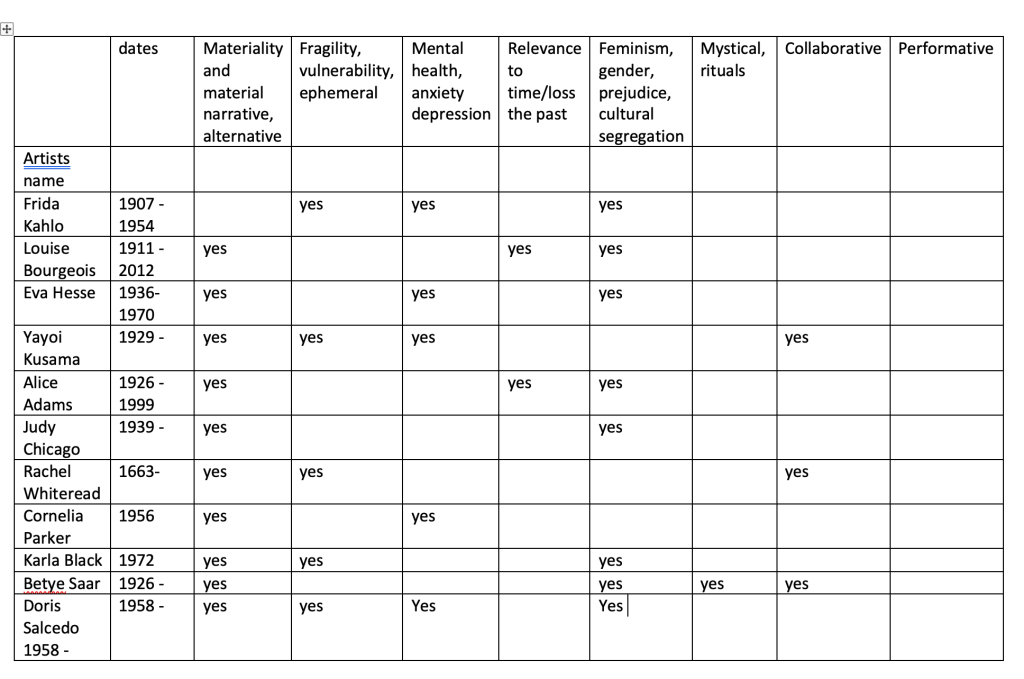
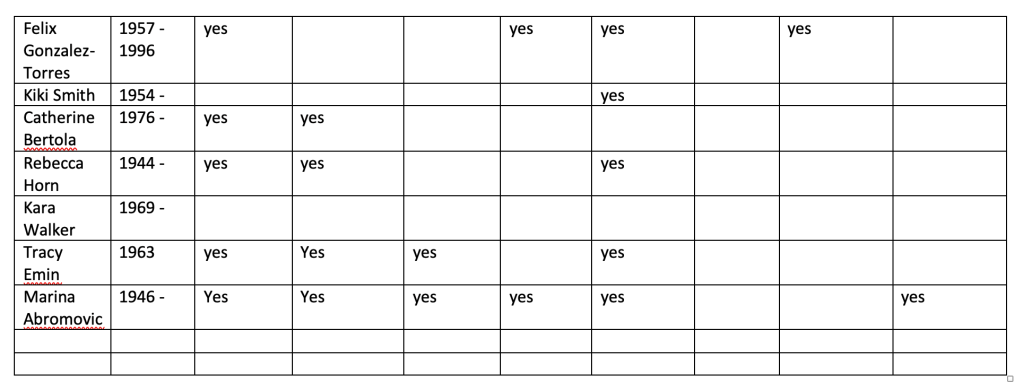
Theorists relevant to concerns:
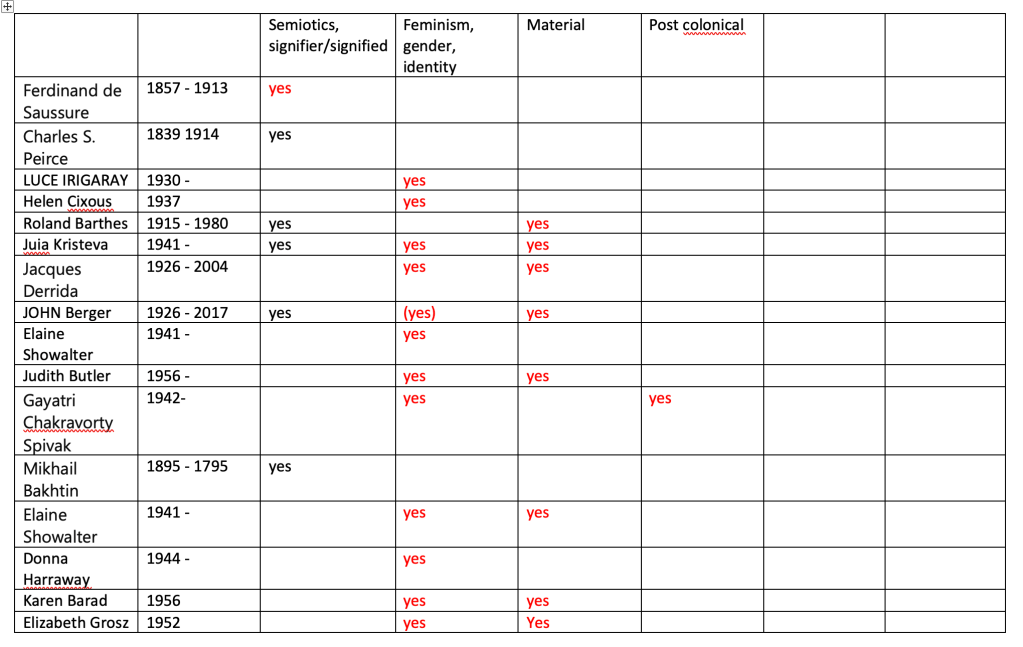

Re – evaluating Questions to pose : eg:
How might artists use the fragility and mutability of materials to express emotion? (particularly negative feelings of anxiety , depression)
How can the fragility of materiality lead to concerns regarding ‘femaleness’ and wider reaching concerns of feminism.
Might materiality change the viewer concept of these issues leading to a deeper understanding of artistic and emotional expression?
Explore the positive impacts of this?
State the main feature of the argument.
Selection of learning log. 3
Project 2 – Murmuration
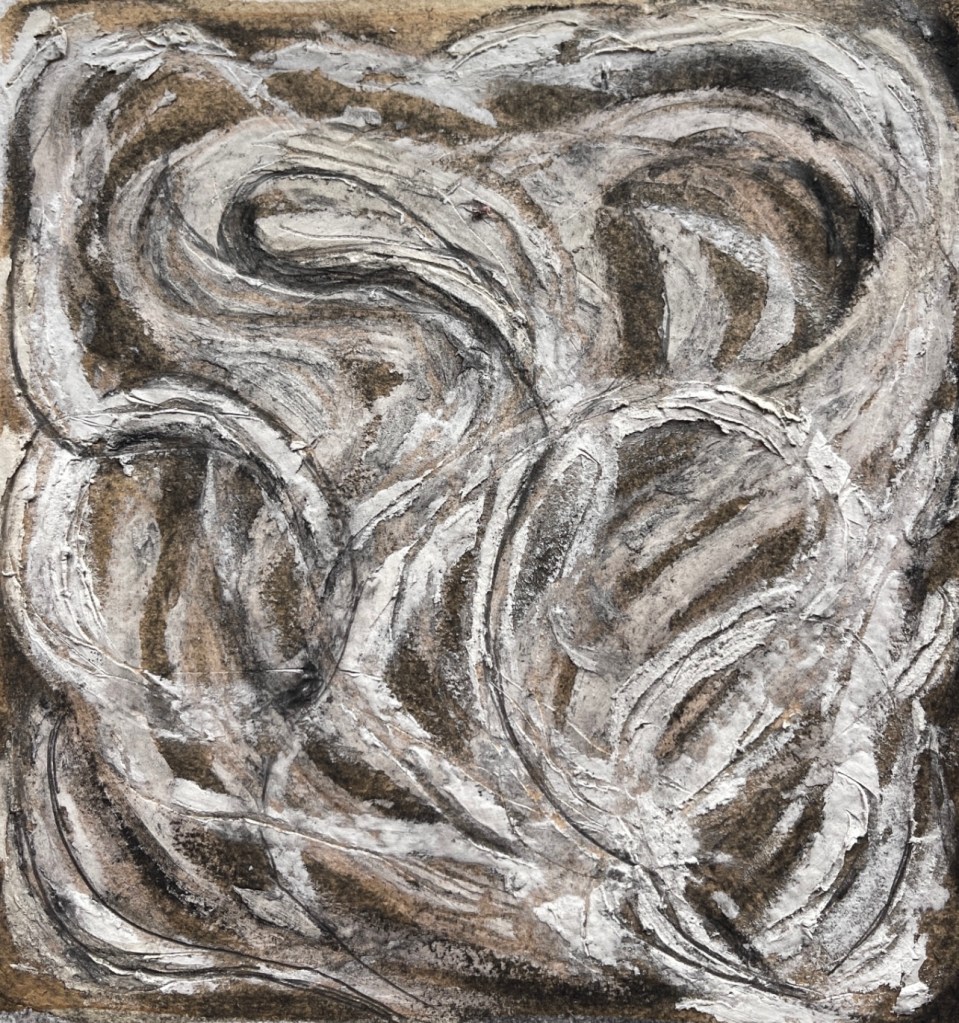
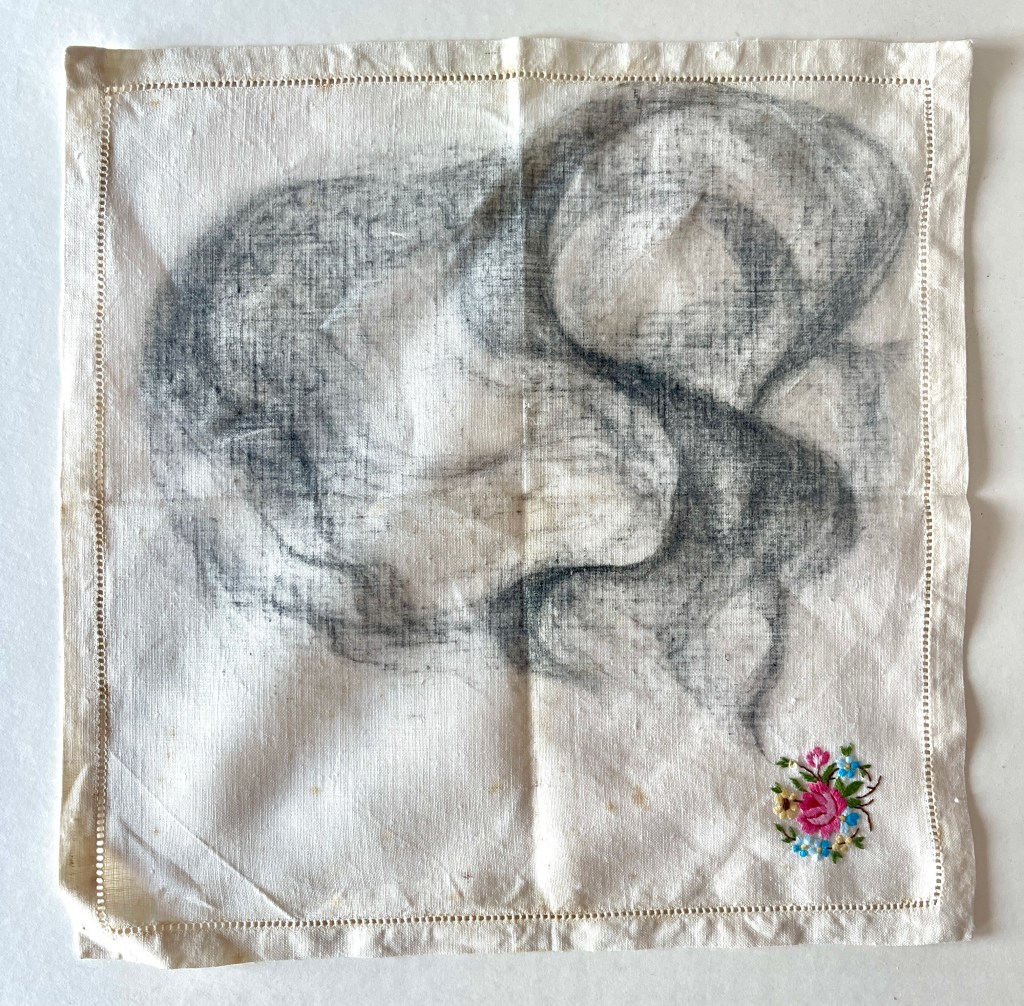
The visual impact of a starling murmuration is a awe inspiring natural phenomena that occurs at early evening/dusk just before the flock come into roost. Thousands of these small birds create vast sweeping, undulating and flowing shapes across the sky. There is an eerie sound of the thousands of wings in flight all strangely and curiously synchronised and almost moving as one. This image combined with a line from a poem “our fears like starlings..” (sadly now lost to me) brought about strong feelings of connectivity and understanding.
I rewrote my version of the text that I felt pertinent to the work:
The small lonely night hours that should be filed with calm slumber can be filled with a wash of thoughts steeped in anxiety, worry and panic as they whirl around inside our heads in those unwanted waking moments. The murmuration visual was a metaphors for this state of mind:
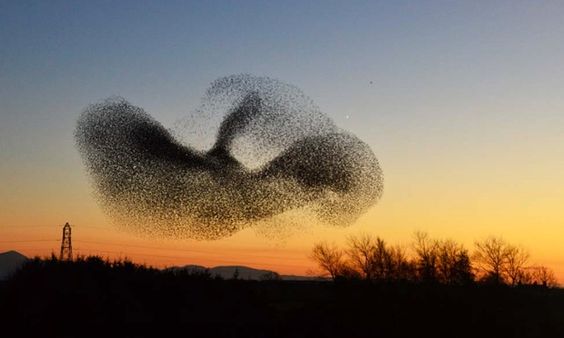
‘Thousands of Starlings getting ready to roost. There’s a bird of prey above the star and the starlings group together for safety’ ( November 22, 2013 Joan Thirlaway/Guardian Green Shoots)
Charcoal sketches below:
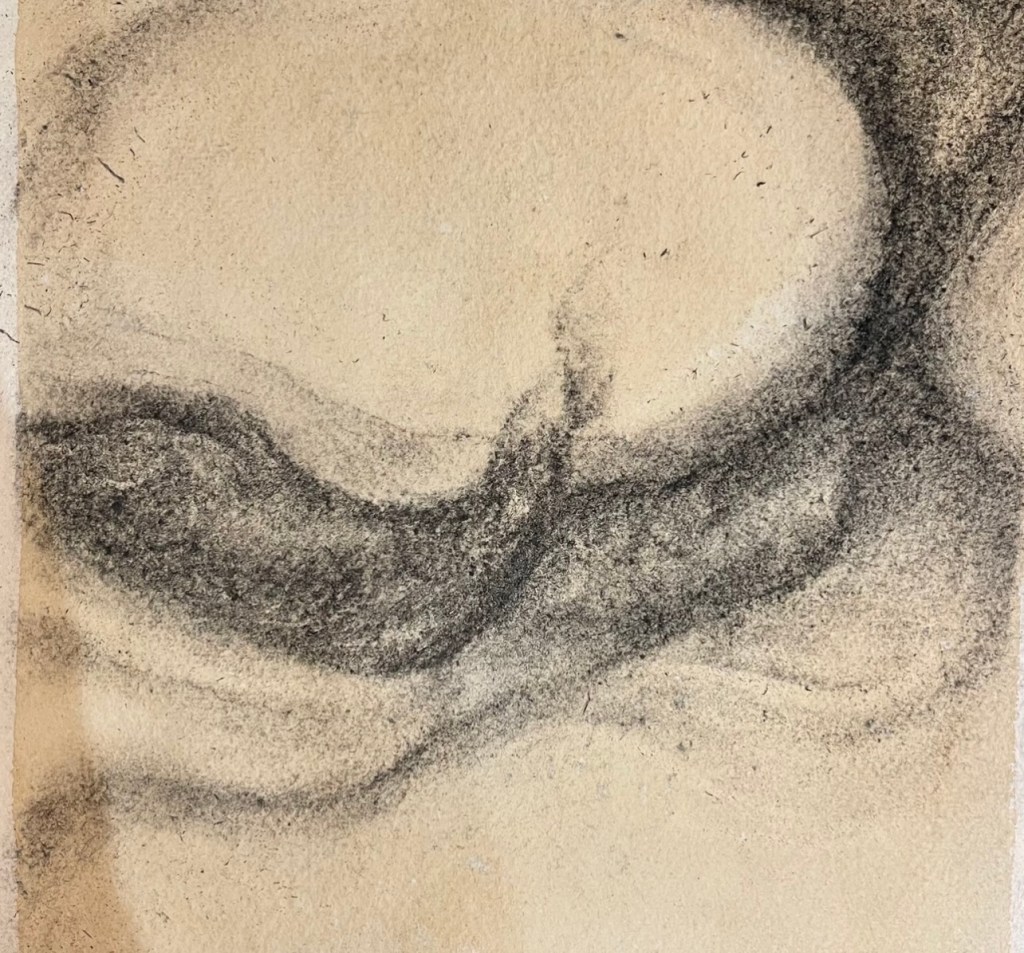
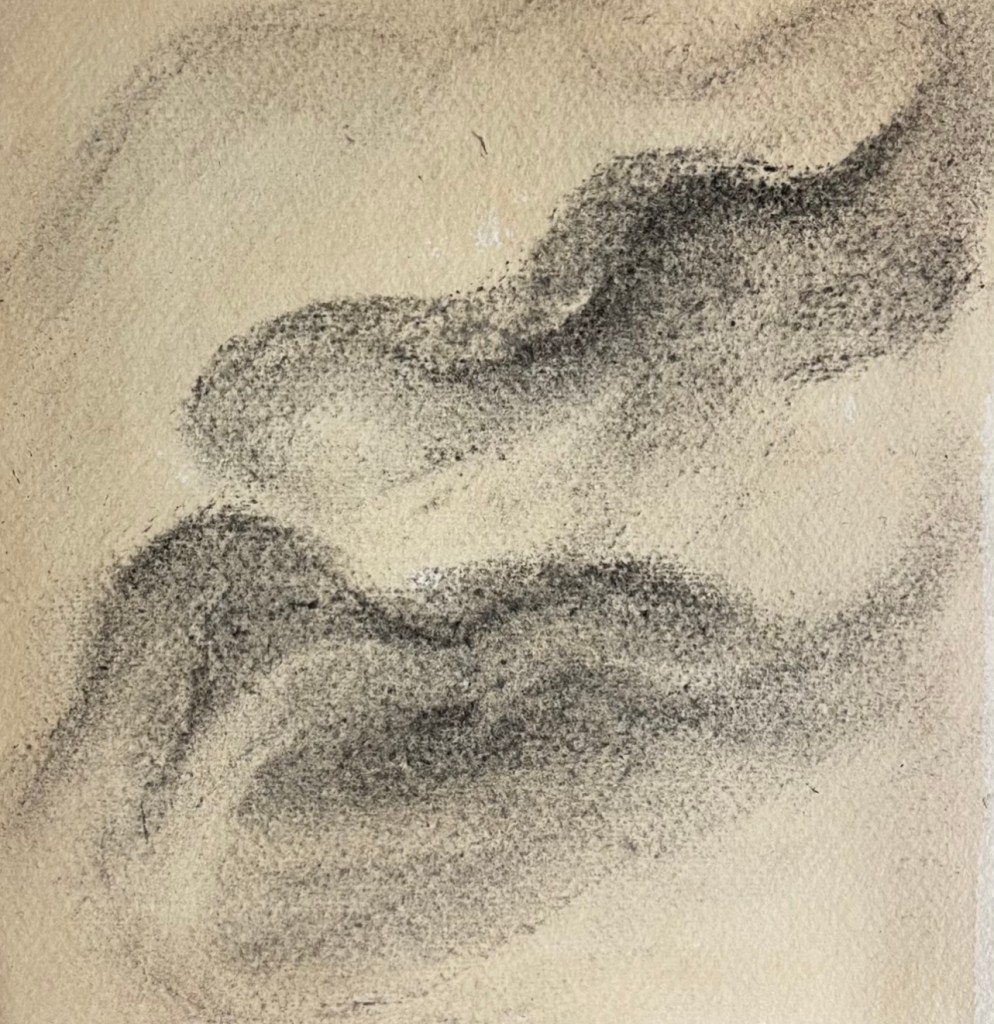
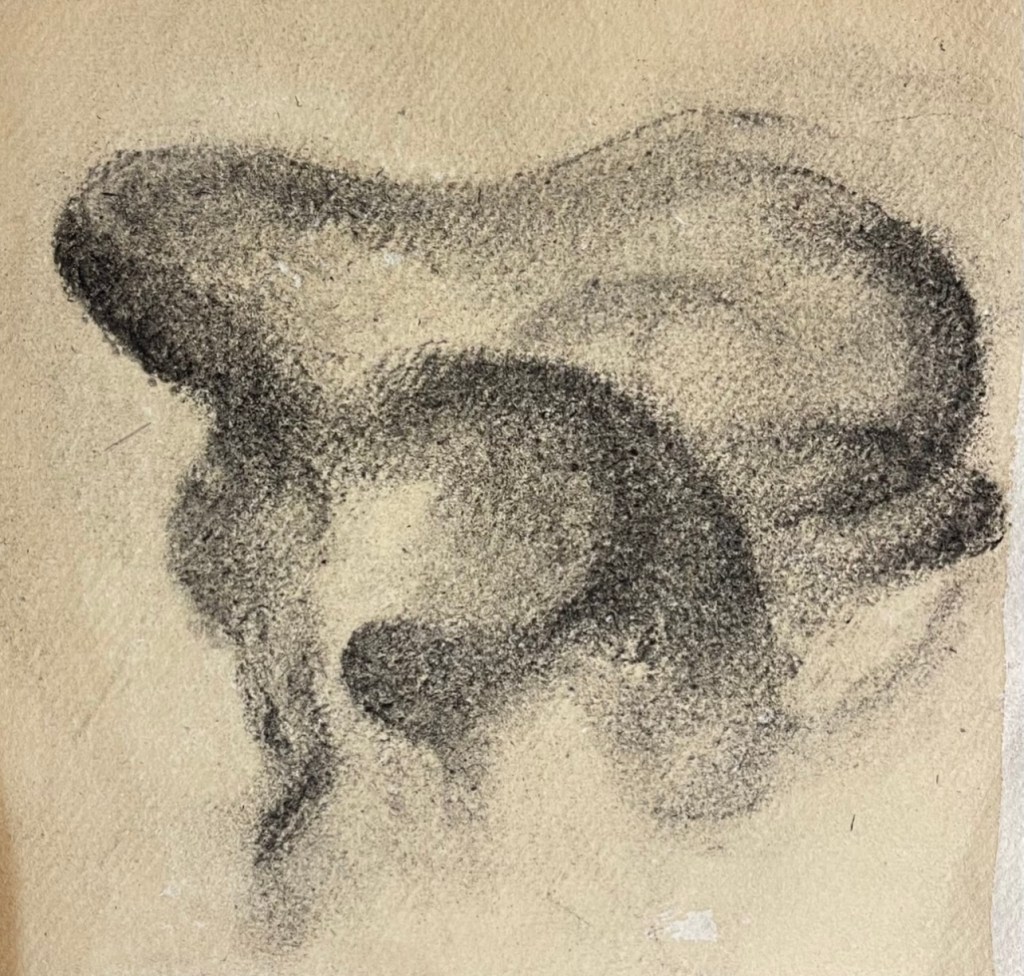
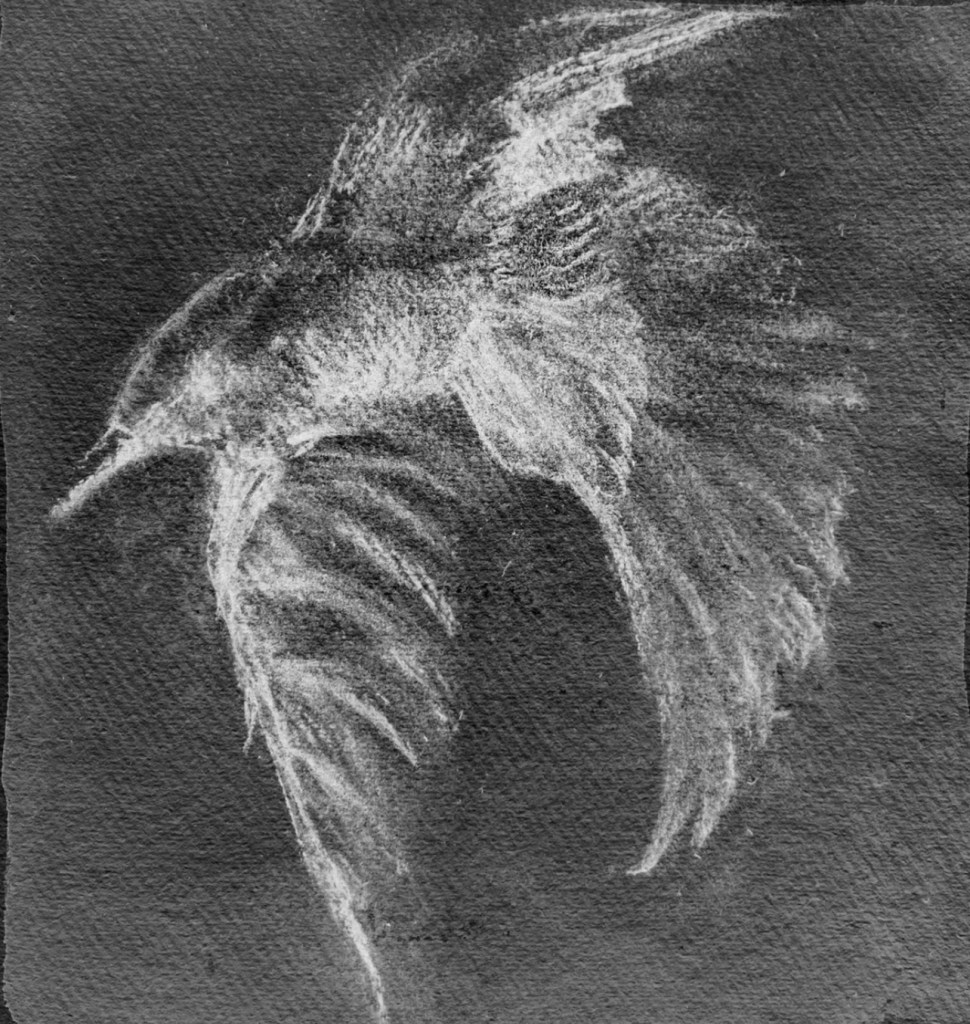
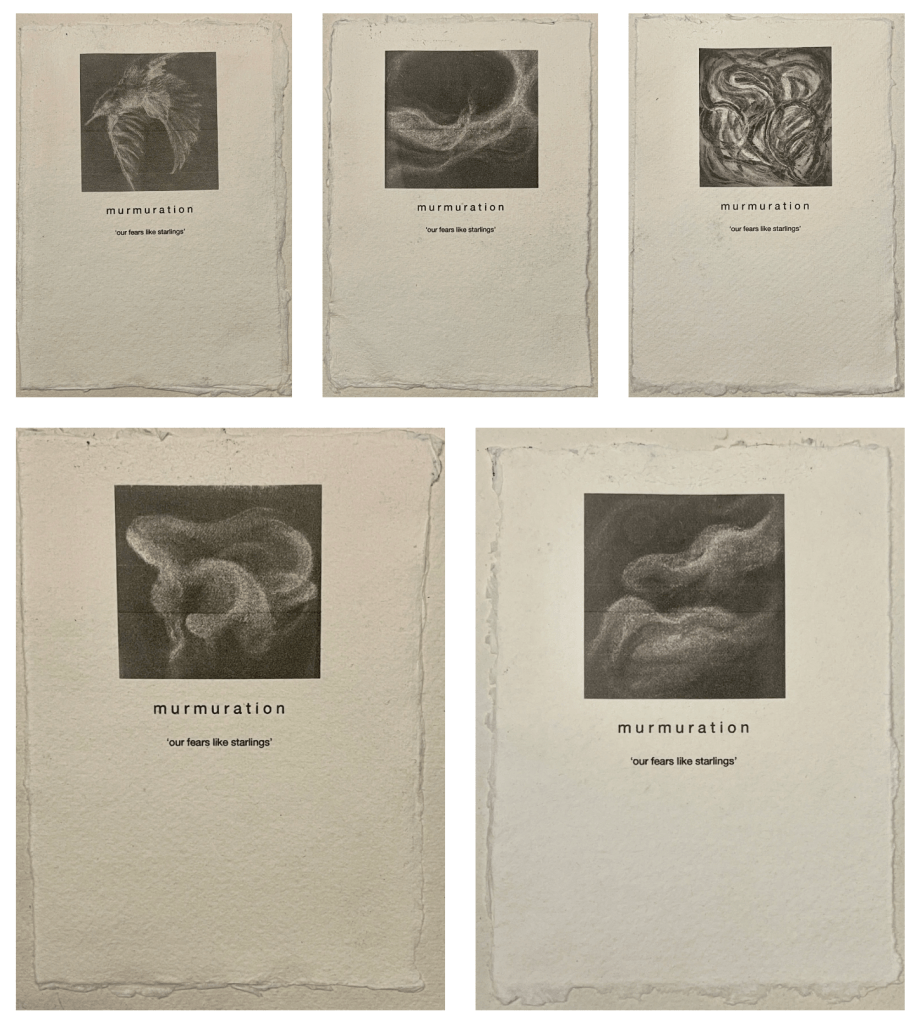
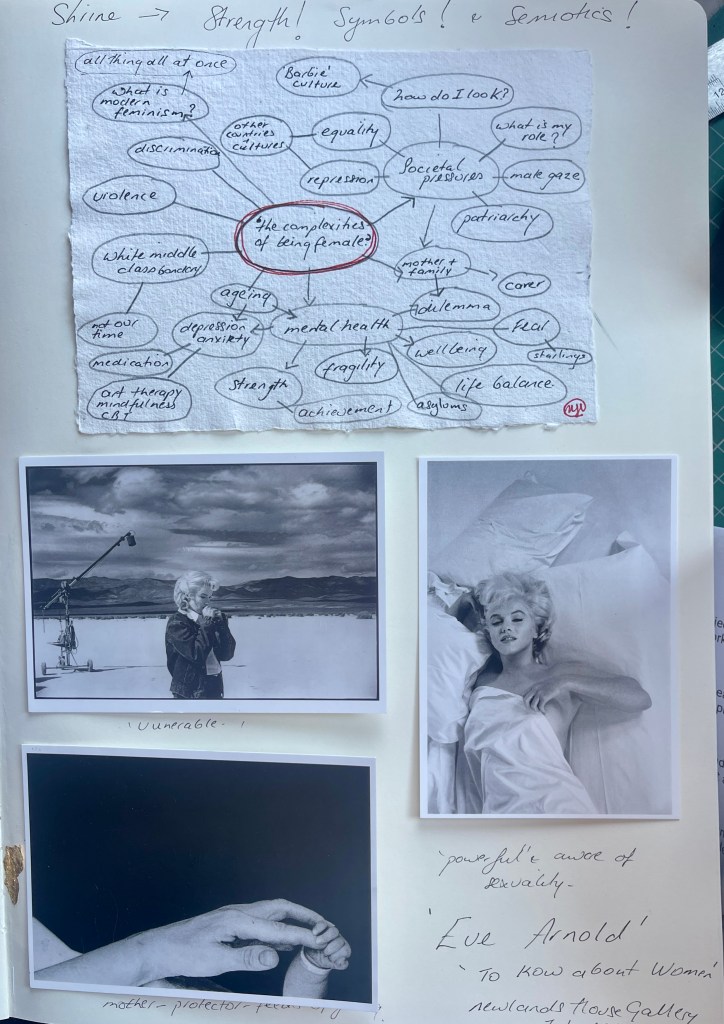
Mental Health and particularly female mental health was a theme I was concerned within a past project looking at the history of its appalling diagnosis and treatment over the centuries, usually at the hands of the male patriarchy and researching the inmates of the famous asylum at the La Salpetriere in Paris . Noting later work informed by these women and produced by Louise Bourgeois’ ‘Arc of Hysteria’ plus work crated within the asylums at the time by artist such as Camille Claudel (1864 -1943) and Aloise Corbaz. There is a running theme of women being bed ridden, chained to beds and confined. The safety, comfort and reassurance one associates with the bed is distorted and altered as it becomes a place for confinement and horror.
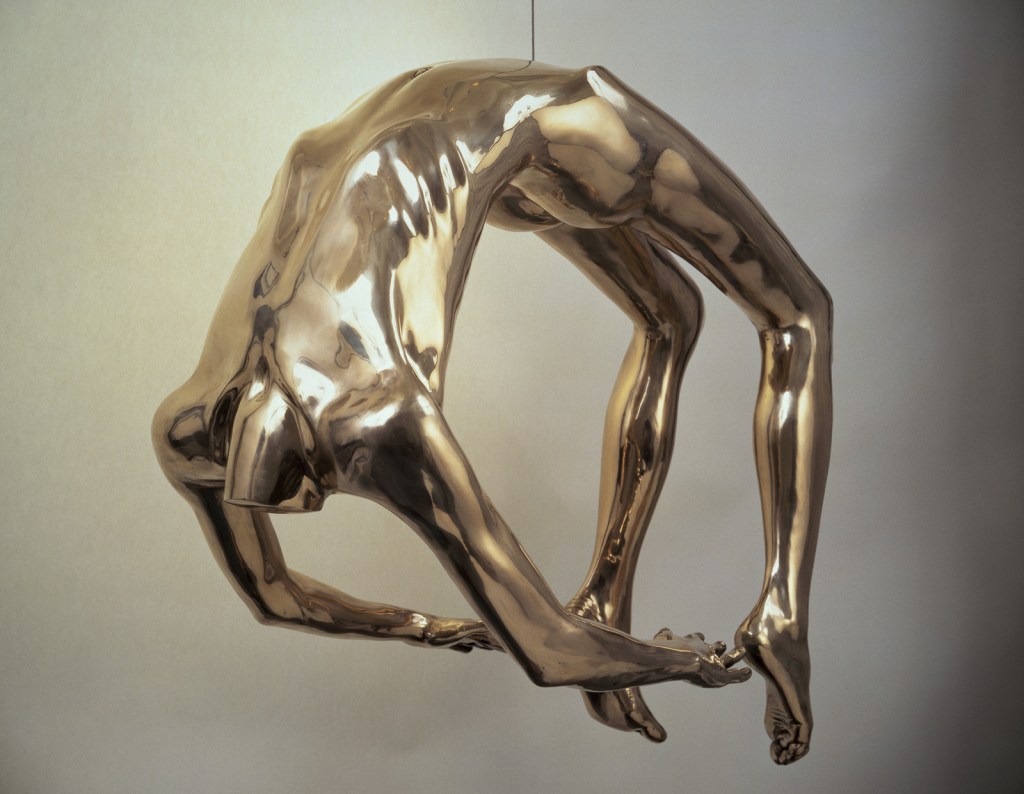
Louise Bourgeois. Arch of Hysteria. 1993
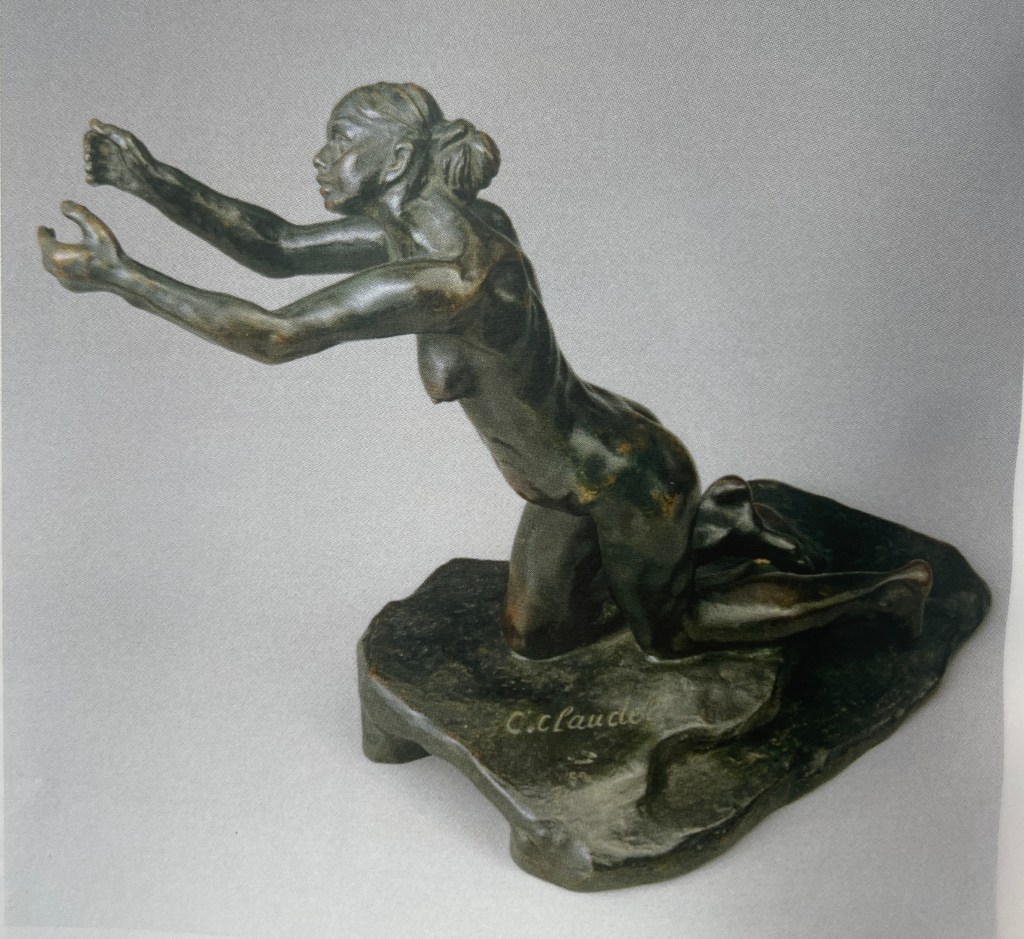
Camille Claudel 1889 ‘ La Implorante ‘ – ( MOMA)
Less physically traumatic and horrific than anything the women in the asylums experienced in past centuries night fear and anxiety is an increasing wide spread phenomenon, women suffering the greatest and are twice as likely as men to be diagnosed with an anxiety disorder and its prevalence is also significantly higher for women 23.4 % in women and 14.3% in men according to the Journal of Psychiatry.
Perhaps as our beds have becomes one of the few places of solace, rest and reflection in a fast pace demanding society it is here we are finally able to process and compute. We awake, suddenly wide eyed gripped with worry as the waves of thoughts, fears and worry swirl around us.
Bedding and shrouds are prominent in art most famously Tracy Emin’s ‘My Bed’ (1998) perhaps using bedding as a canvas for the work could be pertinent. My exploration in to vintage objects such as embroidered napkins also bring with them a narrative of past lives and constraints. I am also keen to look at common every day objects to replicate this imagery in an attempt to inform the viewer of the underlying anxiety and worry carried through out the day.
“Work is good. If I don’t make things, I become ill and depressed. Painting makes me feel like a better human being. It’s what I’m supposed to be doing.” Tracey Emin.
The vintage , linen napkin below symbolic of the female domestic, the neat, folded and repressed. The enforced etiquette of the past that can be seen as a blanket for covering concerns and issues in the home, often controlled by the male patriarchy.
‘Not a Stitch out of Place’ Murmuration on Embroidered napkin . 2023
Bibliography
Vircondelet, A., 2016. Art Until Madness. Artege Group, Monaco.
Bourgeois, L., 1986. Louise Bourgeois. Bell Point Press, New York.
McLean, C.P., Asnaani, A., Litz, B.T., and Hofmann, S.G., 2011. Gender differences in anxiety disorders: prevalence, course of illness, comorbidity and burden of illness. Journal of Psychiatric Research, [e-journal] 45(8), pp.1027-1035. Available at: https://www.ncbi.nlm.nih.gov/pmc/articles/PMC3135672/ [Accessed 30 September 2023].
Manchester, E., 2000. Pain and Sympathy – History of the Main Complaint. Tate. Available at: https://www.tate.org.uk/art/artworks/kentridge-history-of-the-main-complaint-t07480 [Accessed July 2023].
Hoffman, N., 2023. Jenny Holzer. The Guardian. Available at: https://www.theguardian.com/artanddesign/2023/jan/04/artist-jenny-holzer-women-are-not-horrible-were-largely-not-the-problem [Accessed July 2023].
Lange-Berndt, P. (Ed.), 2015. Materiality. Whitechapel Gallery, MIT Press.
Selection of Learning Log. 3.
Assignment 2
Proposed Research ethics and methodology and theoretical frameworks:
1.Literature Review : My research will come from a collection of books and text that I have identified as suitable resource material: These include work by individual artists I will research plus academic works regarding art theories and visual culture and research consultations. I will conduct a reflective ( practice ) review of this information and data.
2. Participant work / Collaborative work – potentially looking at artist response feedback to Veneration Project – art work produced by fellow artists in response to sending out my post card sized art work. This will be confidential and anonymous if required by the participant.
3. I will aim to be aware of my own biases and assumptions. My context and influences that may affect / influence research and interpretations.
4. I will look at a cross section of culture and ethnicity in my research. Artists and theorists from a cross section of society and culture and more. ( LGBTQ+ individuals )
5. Analysing of works and or interpretations will be fair and rounded with out stereotype and pre conceived notions . I will state/outline what constitutes the notion of ‘ poor or weak mental health; as defined accredited medical profession.
6. I will state what is accepted and defined when using words such as “feminism’ ‘femaleness’ etc from approved academic sources.
7. I will source the industry recognised description of ‘material practice’.
8. I will look to relevant theorists to underpin/underscore and blser atistci practic and main question/ concern.
9. I will look to offer conclusions that promote awareness, positive change and understanding of the sensitive topics raised.
10. Look at work/ artists over a wide time scale for cultural and political diversity.
500 word research summary
My research material is informed by my Advanced Practice and my exploration into Female depictions of Mental Health in art and also the separate but corresponding concerns regarding “femaleness’ as a collaborative inclusive theory and practice. Both aspects of my work include looking at female depictions in visual culture via the male gaze or the patriarchy. Particular attention paid to the materiality of practice .
At a crossroads of exploration I can assert that these two concerns will have mutual overlays in regards to feminism, empowerment and subverted female achievements and depictions of the past. My research is aiming to explore areas of feminism that relate directly to artistic visual culture. Looking for evidence of semiotics that embrace ‘femaleness’ as opposed to the feminine exclusively in order to establish what is the essence of ‘femaleness’ and what it means today. Can it be seen as a collaborative, positive sate with inclusive traits that will in turn bring togetherness in societies and cultures torn apart by segregation, bias and discrimination? Feminist theorists including : Judith Butler, Lynda Nochill, Luce Irigaray will be reviewed along side artists such as Maria Abramovic, Louise Bourgeois, Jenny Saville Shirin Neshat, Carrie Mae Weems to find symbiotic references most relevant to my concerns . I will explore artists over the last century cross culturally that have sought to to bring about change. I am aiming to receive some artistic responses to my work on ‘Veneration’ ( Shrine) from fellow female artists. This will be an additional avenue of thought and process to explore based on feedback and interpretation.
Semiotic of ‘Veneration’ ( Shrine)
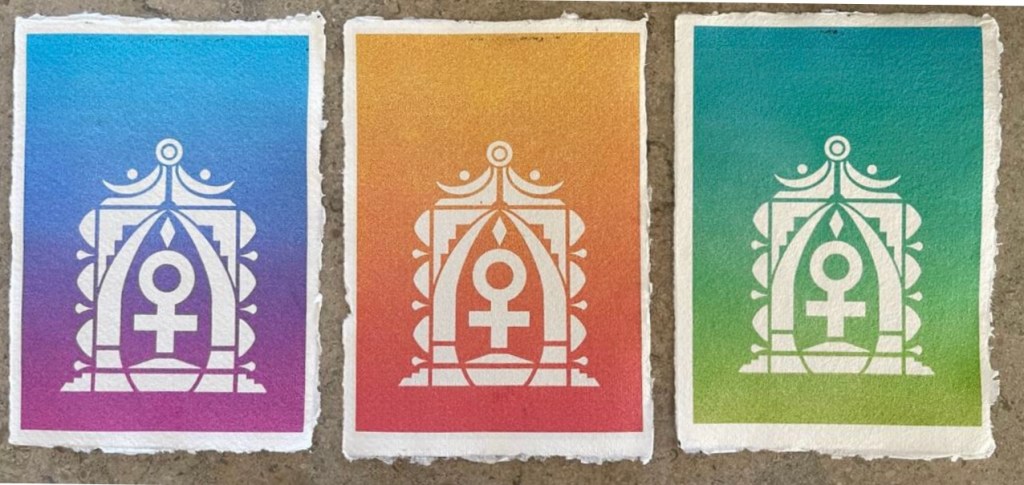
Back of Post card below:
Alternative research focussing on female mental health will be explored via a range of publications concerning the historic descriptions asylums of the 18th/19th century and their powerful negative depictions in art and the time through to the Surrealist art movement in the 1920’s and beyond. Looking at embodied semiotics and commonly used representations of mental health. It will include an exploration of artists pushing boundaries of representation in this field and theorists such as Donna Haraway and Laura Mulvey.
( N.B Laura Mulvey was not included in final theorist research as more pertinent theorists were uncovered latterly., as was the impact of the ‘material practice’ of female artists. August 2024)
In both topics of research I will look to explore the positive impact of artwork and artists that have been trail blazers in addressing issues of female positivity, and equality cross culturally. In conclusion I will aim to to bring together positive and negative attributes of the research findings. Has visual cultures depictions and values moved sufficiently into the next phase of intent and identity concerning the female and all who identify with her.
Annotated Bibliography:
Selection of Learning Log. 4.
Bullet Point content – summary of relationship between studio practice and critical investigation.
- My critical investigation focusses on the detailed material practice of 3 key female artists.
- These artists have been chosen specifically for their strength in material practice and the layers of narrative they uncover with the work. Their practice resonates strongly with my own enquiries into use of unusual materials and the underlying narrative these represent.
- These artists are concerned by notions of ‘femaleness’ in regards to response, reaction, emotion and physicality within their work. the female narrative and the trope of the domestic work load in relation to ‘home’, ‘ feminism’, ‘suffering’ and ‘motherhood ‘.
- The artists work present narratives of strength and empowerment. Often looking back to the past to bring forward themes of the patriarchy and female repression.
- The artists I have chosen to include in my essay have an essential link to issues concerning the essentially female narrative and use a selection of diverse and unusual materials, and practice to explore these themes. Working with materials that offer up a deeper sense of enquiry and questioning.
- The theorists I have chosen to underpin the work of my chosen artists plus my own practice include: Judith Butler, Donna Haraway, Elizabeth Grosz and Karen Barad. These seem to have the most pertinent theories that relate to the female narrative and to material practice in todays Anthropocene.
- Their theories overlap to some extent but remain pertinent and relevant to the emotive and visceral practice of key artists I have chosen to research: Louise Bourgeois, Doris Salcedo and Karla Black ( potentially adding Catherine Bertola ).
750 Word text to define and support key arguments settled on :
The proposal and theories I have settled on to support my own work and the critical investigation surround the material practice and concerns of the female artist. With possible investigation into the notion of ‘femaleness’ rather than just the concept of the ‘female’ aware of the complex dynamics and definition this may engender. I will enquire into the theories of 4 eminent female academics whose concepts are well considered and documented and concern the following ; gender, identity, and the entanglement of materiality and discourse. Plus 3-4 key artists that embrace and engender these concerns in their practice.
Judith Butler is renowned for her theory of gender performativity, which challenges the notion of gender as ‘fixed’. She considers artistic materials and practices can be seen as performative acts that question established gender norms and identities.
Donna Haraway’s work blends feminist theory with science and technology studies, introducing the concept of the cyborg which unsettles boundaries between human, animal, and machine. Her theories encourage viewing materials not merely as inert substances but as active participants in the art-making process influencing and transforming the narrative and meaning.
Karen Barad’s framework of agential realism introduces the idea of intra-action, where entities and their agencies emerge through their relationships rather than preceding them. Barad’s theory supports an approach where materials are not passive but are dynamic and integral to the formation of meaning. Encouraging artist to recognise and harness their potential in their artistic narrative.
Elizabeth Grosz’s work is deeply influenced by Deleuzian philosophy, focusing on bodies, cities, and art from a strong feminist perspective. Grosz argues that art is a way of experiencing and expressing the intensities and sensations that material practice provokes. Arguing that material is not merely as a backdrop but forces that have the potential shape lives and cultures.
These theorists provide a strong theoretical foundation for investigating how female artists utilize material practices, and express ‘femaleness’ or the ‘female’ within their practice.
Artist Louise Bourgeois’ work explores themes of sexuality, family, trauma and other psychological emotions. Her use of diverse materials, ranging from fabric and wood to marble and latex material is a visceral metaphor expressing the intricacies of human feelings and memories. She examines the feminine psyche through various works using everyday objects and fabrics that comment on women’s identities within domestic spaces and reflect a continual struggle with anxiety, trauma and gender.
Karla Black’s workEmphasizing the fluidity and impermanence of materials, Black’s installations make extensive use of ephemeral and unlikely substances like cosmetics, toiletries, cellophane, and plaster. Her works are interactive and sensory that can create environments that invite viewers to contemplate the physicality of the materials and their own societal relations to it . Black challenges traditional notions of sculpture and gallery space pushing the boundaries between material practice and the environment. Her use of materials commonly associated with femininity and personal care critiques gender norms and highlights the performative nature of identity.
Doris Salcedo’ssculptures and installations are intensively used to articulate collective grief and loss, particularly within the context of political violence and torture. The materials in Salcedo’s work such as furniture, clothing, concrete, are recontextualized to convey profound narratives of absence and memory. Her intense material discourse speaks to the fragility and resilience of the human condition.
The combination of these theories/theorist and the material practice of my chosen artists will be a gateway from which I will build up on my own enquiries concerning my own practice. My use of every day materials and found objects can be supported by a rich premise of context.
My current studio work involves machine detritus and is concerned with the female as the dominant, domestic worker. This societal and patriarchal view connects with concerns of identity and gender primarily but is also underscored by notions of mother, carer and home and what this necessitates and entails in today’s Anthropocene. How can we use material enquiry to explore these trope and widen its enquiry?
Exploring my chosen material and pushing its boundaries will also bring about new ways of seeing and engaging. I will continue to use a range of methods and processes to explore the hidden the language of the unseen and discarded perhaps being visually part of this process in final renderings. I work in the moment as a maker and an artist that responds to material qualities directly with an urgent interconnectedness that fuels my intentions and process.
Selection of Learning Log. 5
Project 4 – Finalising your research Question
SUGGESTED STRUCTURE:
TITLE: Narrative, Materiality and Femaleness: Exploration and negotiation of Material Practice through the Female lens.
Introduction : The aim of this essay is to explore the practice employed by female artists negotiating the material qualities of the every day object in relation to the complex qualities and responsibilities of ‘femaleness’. Considering the conversations and discussions relating to the material narrative through a female lens.
I will seek to examine the essential and more unusual material qualities present in visual artworks by three principal women artists working today with reference to artists work from the past who implore and encourage the viewer to look beyond the evident and enquire into the supposition of immersive meaning and relevance. The methodology chosen for this exploration is a blend of material analysis of each art work combined with theorists discussion and discourse.
Doris Salcedo ( 1958 – ) has pushed her focus and commitment to materiality to new extremes over the course of her practice from permanent material to that of an ephemeral fragile nature, verging on the absent to inquire into violence and loss. Mary Kelly ( 1941 -) whose Post-Partum Document (1973 -7) retains a strong influence today as a seminal piece investigating the unexplored notions of motherhood, child development and loss informed by a feminist viewpoint. Karla Black ( 1972 – ) practice involves materially abstract sculpture using some more traditional female mediums like make -up and powders and essentially the work is immersed in its material qualities of fragility and existence. Black work directly expressing her sense of self and exposes the physical and mental attributes she brings to the work. Catherine Bertola ( 1976 – ) looks for the hidden narratives found in the residues and detritus around her typically in the home environment. She ‘questioning invisible labour and the overlooked narratives of domestic spaces.’ ( Bertola) Observing the female trope of domesticity, traces of time, historic narrative and a sense of re looking and resurrection.
Louise Bourgeois’( 1911 – 2010) early work from 1946 “Femme Maison’ explored the woman and home relationship, with sculptures and drawings that show the women’s heads replaced by houses, ultimately isolating their bodies from the outside world and keeping their minds domestic. Bourgeois went onto to explore many personal emotional states with a variety of material and mediums using the art as a mouth piece to explore her deeply held trauma.
Investigating the interconnectedness and historic references of material and practice the essay will research the conversation the artists are engendering with the objects, what they achieving and realising and what does their every day practice support and uncover?
In reference to this I will consider how and why these artists practice speaks to my own and delve into the theories that support, define and conflict with the narrative of materiality and ‘femaleness’. Enquiring into the discussions and essays by Petra – Lange-Berndt, Iwona Blazwick, Elizabeth Grosz, Judith Butler, Kaisa Kontturi and Dietmar Rubel underpinned by pertinent supporting quotes from the theories of Jack Derrida and Giles Deleuze.
PROJECT 4
Finalising your research question
EARLY OUTLINE
Title 1 – Narrative, Materiality and Femaleness:
‘Exploration and negotiation of material practice through the considered lens of ‘femaleness’. ( or the female )
INTRODUCTION.
The aim of this essay is to explore the practice employed by female artists negotiating the material qualities of the everyday object in relation to the complex qualities and responsibilities of ‘femaleness’. Considering the conversations and discussions relating to the material narrative through a female lens. The context and definition of ‘femaleness’ broadly depends on perspective and context. For the purpose of this essay it refers to the characteristics, experiences and identities associated with being female or woman- aligned within the framework of gender. Noting that gender is a problematic, multifaceted construct that extends beyond biological sex. Within the discussions surrounding feminist and gender studies ‘femaleness’ is considered a social and cultural category moulded and dictated by societal norms and expectations . Culturally ascribed expressions, behaviours and identities define the diverse notions of ‘femaleness’ influenced by historical contexts, class, religions, sexuality and identity offering diverse, explorative and fluid definitions. This diversity of definition and its narrative will be explored and exploited differently by each artist pertinent to their experienced context.
The artists I have chosen to include in my essay have an essential link to issues concerning the female narrative and use a selection of diverse and unusual materials to explore these themes. Working with materials that offer up a deeper sense of enquiry and questioning.
The material practice employed by the artists will refer to the everyday object or ready-made objects incorporated into the artworks with particular attention focussed on the material qualities chosen, its appropriation, conceptualisation, consideration and transformation and how it relates to the artist notions of ‘femaleness’ as an individual, mother, home-maker, provider, carer, etc. How does the practitioner illuminate their concerns and narrative through their material practice.
I will seek to examine the essential and more unusual material qualities present in visual artworks by three principal women artists working today and the past whose works implore and encourage the viewer to look beyond the evident and enquire into the supposition of immersive meaning and relevance.
The methodology chosen for this exploration will include a mix of theory and theorist discussion and discourse on nuanced and complicit relationships with materials, their aesthetic and symbolic content, the transformative thinking, historical narratives and their engendering qualities.
Chapter 1. – Literature and Resource Review.
This chapter will begin to investigate the essays and reviews of Petra – Lange-Berndt, Iwona Blazwick and Kaisa Kontturi. Plus feminist theories of Elizabeth Grosz, Judith Butler and Luce Irigae in relation to the interconnectedness and historic references of material practice of artists and the conversation the artists are engendering with the objects.
(I will consider how and why artists Doris Salcedo, Mary Kelly, Karla Black, Catherine Bertola and Louise Bourgeois practice speaks to my own and enquiry and practice.)
the theories that support, define and conflict with the narrative of materiality and ‘femaleness’ considering the discussions and essays by:
Chapter 2 – CHAPTER 2: Doris Salcedo ( to include in all studies of artists )
Doris Sacedo – Doris Salcedo (1958 – ) has pushed her focus and commitment to materiality to new extremes over the course of her practice from permanent material to that of an ephemeral fragile nature, verging on the absent to inquire into violence and loss.
CHAPTER 3 . – Mary Kelly (1941 -) whose Post-Partum Document (1973 -7) retains a strong influence today as a seminal piece investigating the unexplored notions of motherhood, child development and loss informed by a feminist viewpoint.
CHAPTER 4: Karla Black /Bertola
Karla Black (1972 – ) practice involves materially abstract sculpture using some more traditional female mediums like make -up and powders and essentially the work is immersed in its material qualities of fragility and existence. Black work directly expressing her sense of self and exposes the physical and mental attributes she brings to the work.
Catherine Bertola (1976 – ) looks for the hidden narratives found in the residues and detritus around her typically in the home environment. She ‘questioning invisible labour and the overlooked narratives of domestic spaces.‘ (Bertola) Observing the female trope of domesticity, traces of time, historic narrative and a sense of re looking and resurrection.
Chapter 5. – Louise Bourgeois (1911 – 2010) early work from 1946 “Femme Maison’ explored the woman and home relationship, with sculptures and drawings that show the women’s heads replaced by houses, ultimately isolating their bodies from the outside world and keeping their minds domestic. Bourgeois went onto to explore many personal emotional states with a variety of material and mediums using the art as a mouth piece to explore her deeply held trauma.
Chapter 6. Evaluation, Analysis, Synergy,
Optional: How it directly relates to your own work and experience can be a thread running through . Explore own practice relevant to the research question.
I will consider how and why artists Doris Salcedo, Mary Kelly, Karla Black, Catherine Bertola and Louise Bourgeois practice speaks to my own and enquiry and practice.) How do the artists relate to each other – themes threads, practice ?
Conclusion 7.
Is there an inclusive narrative – a sense of kin and connectivity amongst the artists ? A common narrative ?
Inclusivity and connectivity though the materials employed in art. Is there a common practice and voice of the artists and or/of the materials?
These artists works are informed by an empathy, awareness and insight into women’s lived experiences and material narrative and agency
. Created and informed by a perception of female strength, freedom and empowerment, they are unique and personalised works that shine a light on the every day female experience, emotion and physicality.
How does my practice link to these artists – how have I been informed by them and the theorists? My practice now and going forward.
References: ( alphabetical listing by author surname of any texts and resources read.accessed or used in the text0 – Harvard ref System)
Bibliography :
- Lange-Berndt, P. (Ed.). 2015). Materiality. Whitechapel Gallery. MIT Press 2015
- Rubel, D. (2012). Plasticity: An Art History of the Mutable.( translation by Philippa Hurd 2015)
- Kontturi, K. (2019). Ways of Following: Art, Materiality, Collaboration. Open Humanities Press.
- Unknown Author/Editor. (2020). Chaos, Territory, Art: Deleuze and the Framing of the Earth (The Wellek Library Lectures). .
- A Macat Analysis . Sontag, S. (2017Y). On Photography. Macat International Ltd USA.
- Butler, J. (1993). Bodies that Matter. In Materiality: Documents of Contemporary Art (p. 120).
- Blazwick, I. (2013). Cornelia Parker. Thames and Hudson.
- Morris, F. (2008). Louise Bourgeois. Rizzola/Electa. USA
- Grosz, E. (2007). Chaos, Territory, Art. Colombia University Press.
- Kelly, M. (1997) . M. Iversen, M. (Ed.), Mary Kelly . Phaidon. London
- Salcedo, D. (2016). The Materiality of Mourning. Yale University Press.
- Unknown Author. (Year unknown). “Karla Black” [Online article]. Available from: www.medium.com ( accessed Feb 2024)
- [https://www.performancephilosophy.org/journal/article/view/145/265U].Accessed Feb 2024)
- Johnstone . S ( Ed.) The Everyday . Documents of Contemporary Art. Whitechapel Gallery. MIT PRESS 2008
- Johnstone.S ( Ed) (2008) The Everyday. Whitechapel Gallery MIT Press (London)
- Dohm. K (2020) Karla Black Conditions. Schirn Kunsthalle Frankfurt. Germany
Annotated Bibliography:
https://wordpress.com/page/sharpe.gallery/583
Glossary:
https://wordpress.com/page/sharpe.gallery/1190
Reference:
 The Sharpe Gallery